Clinical Knowledge › Internal medicine › Rheumatology and immunology › Allergy and hypersensitivity disorders
Urticaria
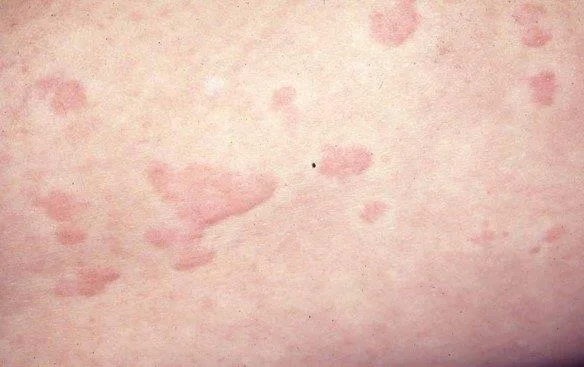
Urticaria is a mast cell-driven disease characterised by wheals (itchy, raised, blanching swellings of the superficial dermis that resolve within 24 hours without marks), angioedema, or both. It is acute when it lasts less than 6 weeks and chronic when it lasts 6 weeks or more. Acute urticaria is very common and is usually triggered by viral infection, drugs such as NSAIDs and antibiotics, or food allergy. Chronic urticaria is either spontaneous (CSU), often autoimmune with IgG autoantibodies against IgE or its receptor or IgE against self-antigens, or inducible by physical triggers such as scratching, cold, heat, pressure or exercise. Diagnosis is clinical; in CSU only limited tests are needed (FBC, CRP or ESR, total IgE and IgG anti-TPO). Wheals that last longer than 24 hours, burn rather than itch, or leave bruising suggest urticarial vasculitis and need biopsy. Treatment is stepwise: a non-sedating second-generation H1 antihistamine, increased up to fourfold, then omalizumab, with ciclosporin and newer agents such as dupilumab and remibrutinib for resistant disease. Most CSU remits within a few years.
Patient case, mechanism, investigations, management, flashcards and exam-style questions.Open the lesson →
Key facts
- Wheals itch, blanch and each lasts under 24 hours without leaving marks; angioedema occurs with wheals in about 40–50% of chronic urticaria
- Acute urticaria < 6 weeks (infections, drugs, foods); chronic urticaria ≥ 6 weeks (spontaneous or inducible)
- CSU affects about 0.5–1% of people at any time, twice as many women; associated with autoimmune thyroid disease
- Symptomatic dermographism is the commonest chronic inducible urticaria; others are cold, cholinergic, delayed pressure, solar, heat and vibratory
- Routine tests in CSU: FBC with differential, CRP or ESR, total IgE and IgG anti-TPO; avoid extensive allergy panels
- Step 1: standard-dose second-generation H1 antihistamine; step 2: up to four times the dose; step 3: add omalizumab 300 mg SC every 4 weeks; step 4: ciclosporin
- Wheals lasting > 24 hours, painful or leaving bruising: suspect urticarial vasculitis and biopsy
- NSAIDs, alcohol, stress and infections aggravate CSU; avoid oral steroids except short courses (≤ 10 days) for flares
Differential diagnosis
| Condition | Clues | Key test |
|---|---|---|
| Urticarial vasculitis | Wheals last over 24 hours, burn, leave bruising; arthralgia | Skin biopsy (leucocytoclastic vasculitis); C3, C4, C1q |
| Anaphylaxis | Urticaria plus airway, breathing or circulation compromise | Clinical; tryptase |
| Bradykinin angioedema (HAE, ACE inhibitor) | Swelling without wheals or itch | C4; drug history |
| Autoinflammatory syndromes (Schnitzler, CAPS) | Non-itchy urticarial rash with fever, bone pain, arthralgia | CRP high; IgM paraprotein; NLRP3 genetics |
| Mastocytosis (urticaria pigmentosa) | Brown macules that urticate on rubbing (Darier sign) | Skin biopsy, baseline tryptase |
| Erythema multiforme | Fixed target lesions lasting days, mucosal involvement | Clinical; herpes simplex history |
| Bullous pemphigoid (urticarial phase) | Older adult, itchy plaques before blisters | Biopsy with direct immunofluorescence |
| Insect bites (papular urticaria) | Grouped persistent papules on exposed skin | History; lesions last days |
Exam pearls
Guideline
International EAACI/GA²LEN/EuroGuiDerm/APAAACI urticaria guideline (2021 edition, with an updated revision published in 2026) and BSACI chronic urticaria and angioedema guideline (2015)
References
- Zuberbier T, Abdul Latiff AH, Abuzakouk M, et al.. The international EAACI/GA²LEN/EuroGuiDerm/APAAACI guideline for the definition, classification, diagnosis, and management of urticaria. Allergy 2022.
- EAACI/GA²LEN/EuroGuiDerm/APAAACI. The international guideline for the definition, classification, diagnosis and management of urticaria (updated revision). 2026.
- Powell RJ, Leech SC, Till S, et al.. BSACI guideline for the management of chronic urticaria and angioedema. Clin Exp Allergy 2015.
- Maurer M, Rosén K, Hsieh HJ, et al.. Omalizumab for the treatment of chronic idiopathic or spontaneous urticaria. N Engl J Med 2013.
- Kolkhir P, Muñoz M, Asero R, et al.. Autoimmune chronic spontaneous urticaria. J Allergy Clin Immunol 2022.
- Metz M, Giménez-Arnau A, Hide M, et al.. Remibrutinib in chronic spontaneous urticaria. N Engl J Med 2025.
Related topics
By Dr Khalid Seidi (B.Sc., M.D.) · MedEd World Clinical Knowledge library. Original teaching content checked against current guidelines (November 2026); confirm the latest local guidance before clinical use. Not a substitute for clinical judgement.