Clinical Knowledge › Internal medicine › Rheumatology and immunology › Allergy and hypersensitivity disorders
Mastocytosis
Mastocytosis is a clonal neoplasm of mast cells that accumulate in the skin, bone marrow, gut, liver, spleen or lymph nodes. In children it is usually confined to the skin (cutaneous mastocytosis), appears in the first two years of life and often fades by adolescence. In adults it is almost always systemic and driven by the activating KIT D816V mutation, which makes the stem cell factor receptor signal without its ligand. Symptoms come from released mediators (flushing, itch, diarrhoea, abdominal pain, hypotension and anaphylaxis, classically after a wasp or bee sting), and in advanced disease from organ infiltration. Diagnosis uses the WHO 2022 criteria: dense mast cell aggregates in marrow plus minor criteria (spindle-shaped mast cells, KIT mutation, CD25/CD2/CD30 expression, baseline tryptase above 20 ng/mL). Most adults have indolent disease with normal life expectancy, managed with trigger avoidance, H1 and H2 antihistamines, cromoglicate, adrenaline auto-injectors and bone protection; avapritinib is approved for symptomatic indolent disease and midostaurin or avapritinib for advanced disease.
Patient case, mechanism, investigations, management, flashcards and exam-style questions.Open the lesson →
Key facts
- Clonal mast cell neoplasm; KIT D816V mutation (exon 17) is found in over 90% of adults with systemic mastocytosis
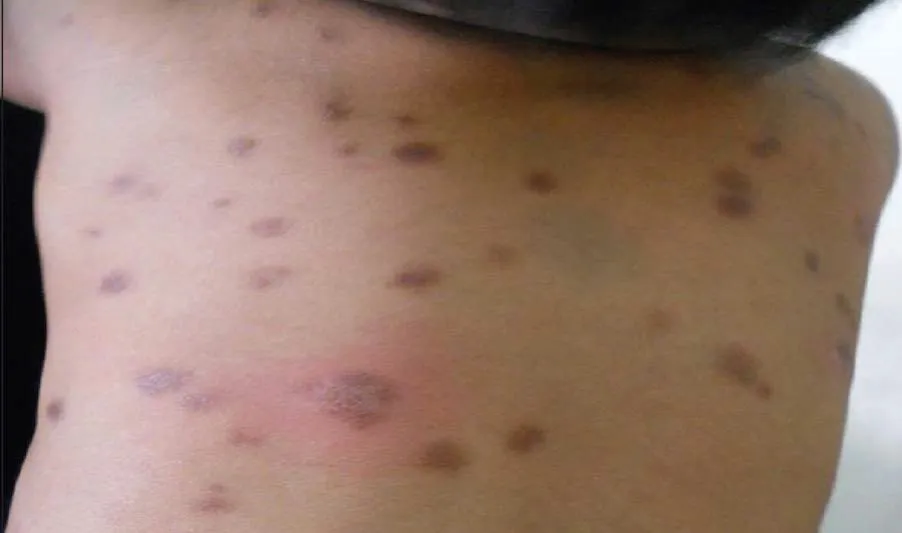
- Children: cutaneous mastocytosis with Darier sign, usually starts before age 2 and often regresses by puberty
- Adults: systemic disease is the rule even when skin lesions (maculopapular cutaneous mastocytosis) are the only visible sign
- Baseline serum tryptase above 20 ng/mL is a minor WHO criterion; normal is below about 11.4 ng/mL
- Severe hypotensive anaphylaxis after a hymenoptera sting, often without urticaria, should prompt a tryptase level and assessment for clonal mast cell disease
- B findings ('burden') define smouldering disease; C findings ('cytoreduction needed') define aggressive disease
- Everyone with systemic mastocytosis and prior anaphylaxis should carry two adrenaline auto-injectors; venom immunotherapy is lifelong after venom anaphylaxis
- KIT inhibitors: avapritinib (indolent and advanced disease) and midostaurin (advanced disease); imatinib does not work against D816V
Differential diagnosis
| Condition | Clues | Key test |
|---|---|---|
| Hereditary alpha-tryptasaemia | Raised baseline tryptase (often 8–20 ng/mL), flushing, IBS-like symptoms, no mast cell aggregates | TPSAB1 copy number genotyping |
| Idiopathic or IgE-mediated anaphylaxis | Clear allergen or no clonal markers; tryptase returns to normal baseline | Specific IgE, baseline tryptase, KIT D816V in blood |
| Chronic spontaneous urticaria | Transient wheals lasting under 24 hours, negative Darier sign | Clinical; skin biopsy if atypical |
| Carcinoid syndrome | Flushing, diarrhoea, wheeze, right heart valve disease, liver metastases | Urinary 5-HIAA, chromogranin A, imaging |
| Phaeochromocytoma | Paroxysmal headache, sweating, palpitations, hypertension rather than hypotension | Plasma free metanephrines |
| Mast cell activation syndrome (non-clonal) | Episodic multisystem mediator symptoms, tryptase rise 20% + 2 ng/mL during attacks, no clonal markers | Event and baseline tryptase, KIT testing, response to mediator blockers |
| Myeloproliferative neoplasm or chronic eosinophilic leukaemia | Eosinophilia, splenomegaly, cytopenias | Bone marrow, FIP1L1-PDGFRA, JAK2 |
Exam pearls
Guideline
WHO Classification of Haematolymphoid Tumours, 5th edition (2022) and International Consensus Classification (2022), with ECNM/AIM consensus on mast cell disorders
References
- Khoury JD, Solary E, Abla O, et al.. The 5th edition of the World Health Organization Classification of Haematolymphoid Tumours: myeloid and histiocytic/dendritic neoplasms. Leukemia 2022.
- Arber DA, Orazi A, Hasserjian RP, et al.. International Consensus Classification of myeloid neoplasms and acute leukemias: integrating morphologic, clinical, and genomic data. Blood 2022.
- Gotlib J, Castells M, Elberink HO, et al.. Avapritinib versus placebo in indolent systemic mastocytosis. NEJM Evid 2023.
- Gotlib J, Kluin-Nelemans HC, George TI, et al.. Efficacy and safety of midostaurin in advanced systemic mastocytosis. N Engl J Med 2016.
- Valent P, Akin C, Metcalfe DD.. Mastocytosis: 2016 updated WHO classification and novel emerging treatment concepts. Blood 2017.
- Muraro A, Worm M, Alviani C, et al.. EAACI guidelines: anaphylaxis (2021 update). Allergy 2022.
Related topics
By Dr Khalid Seidi (B.Sc., M.D.) · MedEd World Clinical Knowledge library. Original teaching content checked against current guidelines (November 2026); confirm the latest local guidance before clinical use. Not a substitute for clinical judgement.