Clinical Knowledge › Internal medicine › Rheumatology and immunology › Allergy and hypersensitivity disorders
Serum sickness
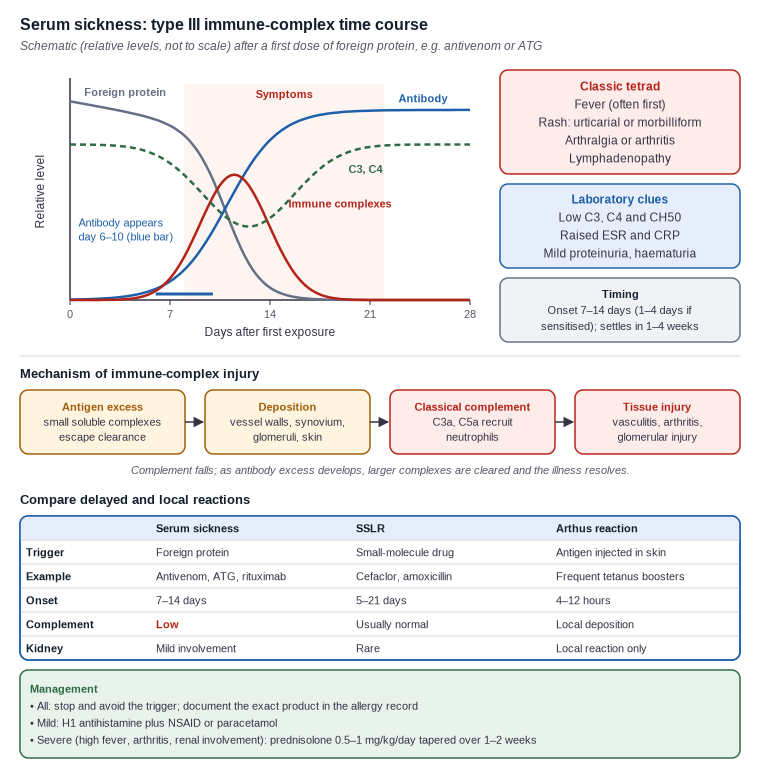
Serum sickness is a systemic type III (immune complex) hypersensitivity reaction to foreign proteins, classically animal-derived antisera. Today the main causes are animal antivenoms, equine rabies immunoglobulin, anti-thymocyte globulin and chimeric monoclonal antibodies. About 7–14 days after first exposure, antibodies form against the protein while it is still circulating; small immune complexes deposit in vessels, joints and glomeruli, activate complement and recruit neutrophils. Patients develop fever, an urticarial or morbilliform rash, arthralgia or arthritis and lymphadenopathy, with low C3 and C4, raised inflammatory markers and mild proteinuria or haematuria. Serum sickness-like reactions to drugs such as cefaclor, amoxicillin and other antibiotics look similar but usually lack hypocomplementaemia and kidney involvement. Management is withdrawal of the trigger, antihistamines and NSAIDs, and a short corticosteroid course for severe disease. The illness resolves within weeks; the key lessons are prevention and accurate allergy labelling.
Patient case, mechanism, investigations, management, flashcards and exam-style questions.Open the lesson →
Key facts
- Type III hypersensitivity: soluble immune complexes formed in antigen excess deposit in small vessels and activate complement
- Causes: antivenoms, equine rabies immunoglobulin, anti-thymocyte globulin, botulinum/diphtheria antitoxins, chimeric monoclonals (rituximab, infliximab)
- Onset 7–14 days after first exposure (1–4 days if previously sensitised)
- Classic tetrad: fever, rash (urticarial or morbilliform), arthralgia/arthritis and lymphadenopathy
- Laboratory clues: low C3, C4 and CH50, raised ESR/CRP, mild proteinuria and microscopic haematuria
- Serum sickness-like reaction (SSLR): drug-induced (cefaclor, amoxicillin, sulfonamides, minocycline, bupropion), usually normal complement and no renal disease
- Treatment: stop the trigger, H1 antihistamine, NSAID or paracetamol; prednisolone for severe disease; self-limiting in 1–4 weeks
- Arthus reaction is the local type III counterpart: painful swelling and necrosis at an injection site 4–12 h after a booster
Differential diagnosis
| Condition | Clues | Key test |
|---|---|---|
| Serum sickness-like reaction | Child with rash and joint swelling on cefaclor or amoxicillin; normal complement | C3/C4 normal; drug history |
| Drug reaction with eosinophilia and systemic symptoms (DRESS) | 2–8 weeks after anticonvulsant or allopurinol; facial oedema, eosinophilia, hepatitis | FBC with eosinophils, LFTs; RegiSCAR score |
| Urticarial vasculitis | Wheals lasting >24 h that bruise; low complement in hypocomplementaemic form | Skin biopsy; C1q, anti-C1q |
| Viral exanthem with arthritis (parvovirus B19, rubella, hepatitis B prodrome) | Rash and polyarthralgia without drug exposure | Parvovirus IgM, HBsAg, rubella serology |
| Acute rheumatic fever | Migratory arthritis after sore throat; carditis | ASO/anti-DNase B, echocardiography (Jones criteria) |
| Systemic lupus erythematosus | Rash, arthritis, low complement; persistent | ANA, anti-dsDNA |
| IgA vasculitis | Palpable purpura on legs, arthritis, abdominal pain, haematuria | Clinical; urinalysis; skin biopsy with IgA |
| Infection-related reactive arthritis or disseminated gonococcal infection | Arthritis with fever and pustular rash | Cultures, NAAT |
Exam pearls
Guideline
WHO Guidelines for the management of snakebites (2nd edition, 2016), AAAAI/ACAAI Drug allergy practice parameter (2022) and EAACI nomenclature of hypersensitivity reactions (2023)
References
- Warrell DA, ed.. Guidelines for the management of snakebites, 2nd edition. WHO SEARO, New Delhi 2016.
- Khan DA, Banerji A, Blumenthal KG, et al.. Drug allergy: a 2022 practice parameter update. J Allergy Clin Immunol 2022.
- Jutel M, Agache I, Zemelka-Wiacek M, et al.. Nomenclature of allergic diseases and hypersensitivity reactions: adapted to modern needs: an EAACI position paper. Allergy 2023.
- Lawley TJ, Bielory L, Gascon P, et al.. A prospective clinical and immunologic analysis of patients with serum sickness. N Engl J Med 1984.
- Khalaf R, Choi U, Prosty C, et al.. Serum sickness-like reactions clinical characteristics and management: a systematic review. J Allergy Clin Immunol Pract 2025.
- Chatzigrigoriadis C, Koufopoulos E, Avramidis P, et al.. Serum sickness-like reaction: a narrative review of epidemiology, immunopathogenesis, diagnostic challenges, and therapeutic approaches. Clin Pract 2025.
Related topics
By Dr Khalid Seidi (B.Sc., M.D.) · MedEd World Clinical Knowledge library. Original teaching content checked against current guidelines (November 2026); confirm the latest local guidance before clinical use. Not a substitute for clinical judgement.