Clinical Knowledge › Surgery › Fractures and orthopaedic trauma
Ankle fractures and sprains
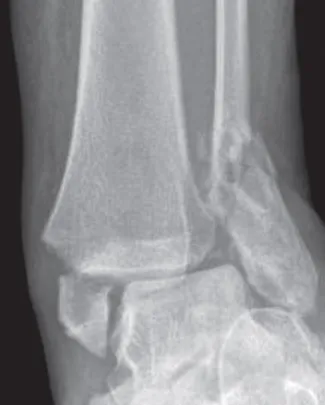
Twisting injuries of the ankle are among the commonest reasons for attending an emergency department. Most are lateral ligament sprains, usually of the anterior talofibular ligament, which recover with early functional treatment. The Ottawa ankle rules decide who needs an X-ray: bony tenderness at the posterior edge or tip of either malleolus, or inability to bear weight for four steps both immediately and in the department. The surgeon's key question in a fracture is stability of the ankle mortise. The Weber classification grades the fibular fracture by its level relative to the syndesmosis (A below, B at, C above), and Lauge-Hansen describes mechanism (supination–external rotation is commonest). Isolated stable Weber B fractures without talar shift are treated in a boot with early weight bearing. Bimalleolar, trimalleolar, Weber C, syndesmotic and displaced fractures usually need open reduction and internal fixation; frail older adults may be treated with close contact casting. A fracture-dislocation with tented skin or a pale foot is reduced immediately. Complications include wound breakdown, infection, venous thromboembolism, malunion and post-traumatic arthritis.
Patient case, mechanism, investigations, management, flashcards and exam-style questions.Open the lesson →
Key facts
- Lateral ligament sprains make up most ankle injuries; the anterior talofibular ligament (ATFL) fails first, then the calcaneofibular ligament
- Ottawa ankle rules: X-ray if malleolar-zone pain plus bone tenderness at the posterior edge or tip of either malleolus (distal 6 cm) or inability to bear weight for 4 steps
- Weber A: below the syndesmosis, usually stable; Weber B: at the level of the syndesmosis, stability depends on the medial side; Weber C: above, syndesmosis disrupted, unstable
- Talar shift or a widened medial clear space (more than about 4–5 mm) means deltoid or medial malleolar failure: the ankle is unstable
- Maisonneuve injury: proximal fibular fracture with deltoid and syndesmotic disruption; always examine and X-ray the whole fibula after a medial ankle injury
- Fracture-dislocation with tented skin, a pale foot or absent pulses: reduce and splint immediately, before formal imaging if needed
- Unstable fractures are fixed by ORIF once soft tissues allow (skin wrinkles), or within about 24 hours before swelling peaks; spanning external fixation if swelling is severe
- Diabetes with neuropathy, smoking and peripheral arterial disease greatly increase wound and fixation complications
Differential diagnosis
| Condition | Clues | Key test |
|---|---|---|
| Lateral ligament sprain | Inversion injury, tender over ATFL anterior to the lateral malleolus, no bony tenderness | Ottawa rules negative; clinical |
| High ankle (syndesmotic) sprain | External rotation injury, pain above the joint, positive squeeze test | Weight-bearing X-ray; MRI if doubt |
| Fifth metatarsal base fracture | Inversion with lateral midfoot pain, tender at fifth metatarsal base | Ottawa foot rules; foot X-ray |
| Achilles tendon rupture | Calf 'kick', palpable gap, weak plantarflexion | Simmonds–Thompson test; ultrasound |
| Pilon (tibial plafond) fracture | High-energy axial load, gross swelling, articular comminution | CT |
| Talar dome osteochondral lesion | Persistent deep ankle pain, catching after a 'sprain' | MRI |
| Peroneal tendon subluxation or tear | Retromalleolar pain and snapping on eversion | Ultrasound or MRI |
Exam pearls
Guideline
BOAST 12 The management of ankle fractures (BOA/BOFAS 2016), NICE NG38 Fractures (non-complex) 2016 and NICE NG89 VTE prophylaxis (2018, updated 2019)
References
- British Orthopaedic Association and British Orthopaedic Foot & Ankle Society. BOAST 12: The management of ankle fractures. BOA Standards for Trauma 2016.
- National Institute for Health and Care Excellence. Fractures (non-complex): assessment and management (NG38). NICE guideline 2016.
- Stiell IG, Greenberg GH, McKnight RD, et al.. Decision rules for the use of radiography in acute ankle injuries. Refinement and prospective validation. JAMA 1993.
- Willett K, Keene DJ, Mistry D, et al.. Close contact casting vs surgery for initial treatment of unstable ankle fractures in older adults: a randomized clinical trial. JAMA 2016.
- Kearney R, McKeown R, Parsons H, et al.. Use of cast immobilisation versus removable brace in adults with an ankle fracture: multicentre randomised controlled trial. BMJ 2021.
- Lamb SE, Marsh JL, Hutton JL, Nakash R, Cooke MW. Mechanical supports for acute, severe ankle sprain: a pragmatic, multicentre, randomised controlled trial. Lancet 2009.
Related topics
By Dr Khalid Seidi (B.Sc., M.D.) · MedEd World Clinical Knowledge library. Original teaching content checked against current guidelines (November 2026); confirm the latest local guidance before clinical use. Not a substitute for clinical judgement.