Clinical Knowledge › Surgery › Fractures and orthopaedic trauma
Tibial and femoral shaft fractures
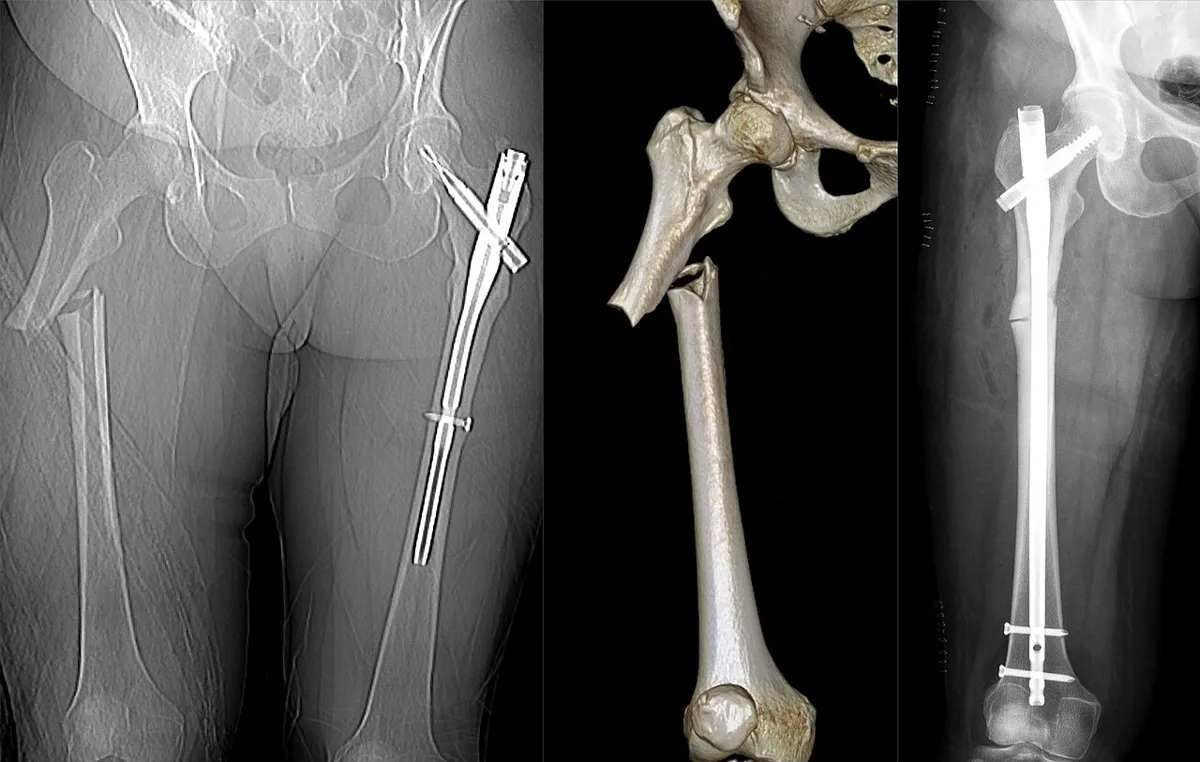
Femoral and tibial shaft fractures are major long-bone injuries. Femoral shaft fractures in adults usually follow high-energy trauma, can lose 1–1.5 litres of blood into the thigh, and often accompany life-threatening injuries, so management starts with an ATLS primary survey, a traction splint and a femoral or fascia iliaca nerve block. In older adults a low-energy transverse fracture after long-term bisphosphonate use suggests an atypical femoral fracture. Definitive treatment is usually a reamed intramedullary nail within 24 hours, which reduces pulmonary complications; unstable polytrauma patients get damage-control external fixation first. Tibial shaft fractures are the commonest long-bone shaft fractures and the commonest open long-bone fractures, because its anteromedial surface lies under the skin. Displaced tibial fractures are usually nailed; undisplaced closed fractures can be treated in a cast and brace. Open fractures need antibiotics within 1 hour, photographs, a saline dressing and specialist orthoplastic debridement. Watch for compartment syndrome, fat embolism, non-union, malunion and infection.
Patient case, mechanism, investigations, management, flashcards and exam-style questions.Open the lesson →
Key facts
- A closed femoral shaft fracture can lose 1–1.5 L of blood; bilateral fractures can cause haemorrhagic shock
- Apply a traction splint and give a femoral or fascia iliaca block early for pain, alignment and blood loss
- Definitive treatment for most adult femoral shaft fractures is a reamed intramedullary nail within 24 hours
- Damage-control orthopaedics (temporary external fixation) is used in physiologically unstable polytrauma
- The tibial shaft is the commonest site of long-bone shaft fracture and of open long-bone fracture
- Tibial shaft fractures carry the highest risk of acute compartment syndrome; young men are most at risk
- Open fractures: IV antibiotics within 1 hour, photograph, saline-soaked dressing, splint, tetanus cover, and orthoplastic debridement
- Transverse lateral-cortex femoral fracture with a 'beak' after years of bisphosphonate = atypical femoral fracture; image the other femur
Differential diagnosis
| Condition | Clues | Key test |
|---|---|---|
| Femoral neck fracture (may coexist) | Ipsilateral hip pain; present in a few per cent of femoral shaft fractures and often missed initially | Dedicated hip X-ray or fine-cut CT |
| Pathological fracture | Low-energy fracture, known cancer, lytic lesion | X-ray, CT, bone scan, biopsy before fixation |
| Atypical femoral fracture | Prodromal thigh pain, long-term bisphosphonate, transverse lateral cortex fracture | X-ray both femurs |
| Tibial plateau or pilon fracture | Articular involvement, knee or ankle haemarthrosis | CT |
| Non-accidental injury | Femoral fracture in a non-walking infant, inconsistent history | Skeletal survey, safeguarding referral |
| Knee ligament injury with shaft fracture | Instability tested after fixation | Examination under anaesthesia, MRI |
Exam pearls
Guideline
NICE NG37 Fractures (complex) 2016, NICE NG39 Major trauma 2016, BOAST Open fractures (BOA/BAPRAS 2017) and ATLS 11th edition (ACS 2025)
References
- National Institute for Health and Care Excellence. Fractures (complex): assessment and management (NG37). NICE guideline 2016.
- National Institute for Health and Care Excellence. Major trauma: assessment and initial management (NG39). NICE guideline 2016.
- British Orthopaedic Association and British Association of Plastic, Reconstructive and Aesthetic Surgeons. BOAST: Open fractures. BOA Standards for Trauma 2017.
- American College of Surgeons Committee on Trauma. Advanced Trauma Life Support (ATLS) Student Course Manual. American College of Surgeons 2025.
- Bone LB, Johnson KD, Weigelt J, Scheinberg R. Early versus delayed stabilization of femoral fractures. A prospective randomized study. J Bone Joint Surg Am 1989.
- Bhandari M, Guyatt G, Tornetta P, et al.. Randomized trial of reamed and unreamed intramedullary nailing of tibial shaft fractures. J Bone Joint Surg Am 2008.
Related topics
By Dr Khalid Seidi (B.Sc., M.D.) · MedEd World Clinical Knowledge library. Original teaching content checked against current guidelines (November 2026); confirm the latest local guidance before clinical use. Not a substitute for clinical judgement.