Clinical Knowledge › Surgery › Fractures and orthopaedic trauma
Distal radius fracture
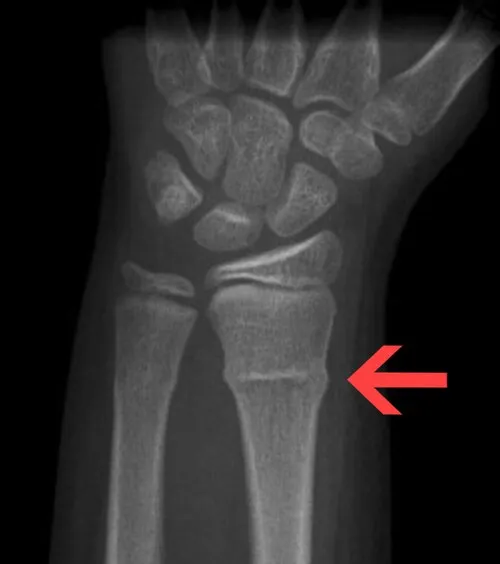
Distal radius fractures are the commonest fractures seen in emergency departments, with peaks in children and in postmenopausal women with osteoporosis after a fall on the outstretched hand. The classic Colles fracture is extra-articular with dorsal angulation, dorsal displacement and radial shortening, producing a dinner-fork deformity; Smith fractures angulate volarly and Barton fractures are intra-articular rim fracture-subluxations. PA and lateral radiographs measure tilt, radial height, inclination and articular step to judge stability. Most fractures are treated in a cast or splint; displaced fractures are manipulated under adequate anaesthesia and re-imaged at 1–2 weeks. Surgery (K-wires or volar locking plate) is considered for unstable, intra-articular, volarly displaced or open fractures, especially in younger active patients, whereas trials show that older adults usually do as well with a cast. Complications include acute carpal tunnel syndrome, extensor pollicis longus rupture, malunion and complex regional pain syndrome, and every fragility fracture should prompt a bone-health review.
Patient case, mechanism, investigations, management, flashcards and exam-style questions.Open the lesson →
Key facts
- Commonest adult fracture; bimodal: children (often buckle fractures) and older women with osteoporosis
- Colles = dorsally angulated and displaced extra-articular fracture (dinner-fork); Smith = volarly angulated (garden-spade)
- Barton = intra-articular rim fracture with carpal subluxation; radial styloid (chauffeur) fracture suggests scapholunate injury
- Normal adult values: radial inclination about 22°, radial height about 11 mm, volar tilt about 11°
- Instability markers: dorsal comminution, dorsal tilt over about 20°, shortening, intra-articular extension, associated ulnar fracture, older age
- Re-image unstable fractures at 1–2 weeks: re-displacement after manipulation is common
- In patients aged 65 or over, casting gives function similar to surgery for most dorsally displaced fractures
- Acute median nerve compression after a distal radius fracture needs urgent carpal tunnel decompression
Differential diagnosis
| Condition | Clues | Key test |
|---|---|---|
| Scaphoid fracture | Snuffbox and scaphoid tubercle tenderness, normal radius | Scaphoid series; MRI if occult |
| Scapholunate ligament injury | Dorsal wrist pain, positive Watson test, radial styloid fracture | Widened scapholunate gap on PA or clenched-fist view; MRI |
| Perilunate or lunate dislocation | High-energy injury, median nerve symptoms, gross swelling | Lateral radiograph: lunate 'spilled teacup'; urgent reduction |
| Galeazzi fracture-dislocation | Radial shaft fracture with DRUJ disruption | Forearm radiographs including wrist and elbow |
| Wrist sprain | Tenderness without bony deformity | Normal radiographs; reassess if persistent pain |
| Distal radial physeal (Salter–Harris) injury in a child | Child, tenderness at the growth plate | Radiograph; Salter–Harris II commonest |
| Pathological fracture | Minimal trauma, lytic area on radiograph | Further imaging and oncological work-up |
Exam pearls
Guideline
BOAST Management of distal radial fractures (BOA, 2017), AAOS Management of Distal Radius Fractures clinical practice guideline (2020) and NICE NG38 Fractures (non-complex) (2016)
References
- British Orthopaedic Association. BOAST: The management of distal radial fractures. BOA 2017.
- American Academy of Orthopaedic Surgeons. Management of Distal Radius Fractures: Evidence-Based Clinical Practice Guideline. AAOS 2020.
- National Institute for Health and Care Excellence. Fractures (non-complex): assessment and management (NG38). NICE 2016.
- Costa ML, Achten J, Parsons NR, et al.. Percutaneous fixation with Kirschner wires versus volar locking plate fixation in adults with dorsally displaced fracture of distal radius: randomised controlled trial. BMJ 2014.
- Costa ML, Achten J, Ooms A, et al.. Surgical fixation with K-wires versus casting in adults with fracture of distal radius: DRAFFT2 multicentre randomised clinical trial. BMJ 2022.
- Blom A, Warwick D, Whitehouse M, eds.. Apley and Solomon's System of Orthopaedics and Trauma. 2018.
Related topics
By Dr Khalid Seidi (B.Sc., M.D.) · MedEd World Clinical Knowledge library. Original teaching content checked against current guidelines (November 2026); confirm the latest local guidance before clinical use. Not a substitute for clinical judgement.