Clinical Knowledge › Surgery › Fractures and orthopaedic trauma
Hip fracture
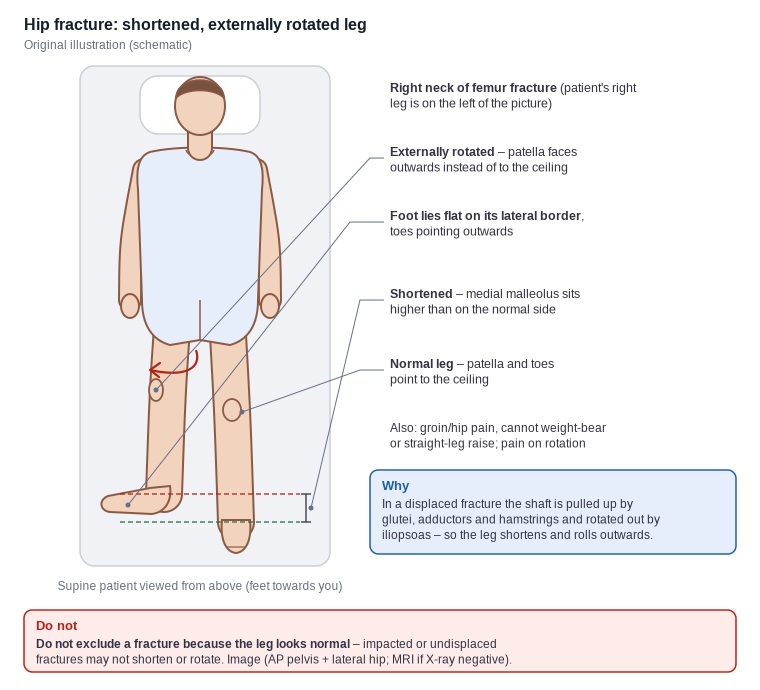
Hip fracture is a fracture of the proximal femur between the femoral head and about 5 cm below the lesser trochanter, usually in a frail older person with osteoporosis after a fall from standing height. Fractures are intracapsular (femoral neck, graded by Garden as undisplaced or displaced) or extracapsular (trochanteric and subtrochanteric). The patient cannot bear weight and has a shortened, externally rotated leg; AP pelvis and lateral hip radiographs confirm most fractures, and MRI detects occult ones. Care is a time-critical pathway: analgesia including a fascia iliaca block, orthogeriatric optimisation and surgery on the day of or day after admission. Displaced intracapsular fractures in older adults need cemented hemiarthroplasty or total hip replacement because the head's blood supply is disrupted; undisplaced ones are fixed; trochanteric fractures take a sliding hip screw and subtrochanteric fractures a nail. Delirium, pneumonia and VTE are common, about a quarter die within a year, and falls and bone-health prevention are essential.
Patient case, mechanism, investigations, management, flashcards and exam-style questions.Open the lesson →
Key facts
- Hip fracture = proximal femoral fracture from the femoral head to about 5 cm below the lesser trochanter
- Intracapsular (subcapital, transcervical) fractures threaten the retinacular vessels from the medial femoral circumflex artery: risk of avascular necrosis and non-union
- Garden I–II = undisplaced (internal fixation); Garden III–IV = displaced (arthroplasty in older adults)
- Classic sign: shortened, externally rotated leg with pain on any hip movement and inability to straight-leg raise
- Normal radiographs with ongoing suspicion: MRI is the next test; CT if MRI is not available within 24 hours
- Surgery on the day of or the day after admission; delays beyond 36–48 hours are linked to higher mortality and complications
- Stable trochanteric fractures: sliding hip screw; reverse oblique and subtrochanteric fractures: intramedullary nail
- One-year mortality is about 25–30%; every patient needs a falls assessment and bone-health treatment
Differential diagnosis
| Condition | Clues | Key test |
|---|---|---|
| Pubic ramus fracture | Groin pain after a fall, can often walk, leg not rotated | AP pelvis; CT if unclear |
| Acetabular fracture | Higher-energy fall or dashboard injury, pain on axial loading | Judet views or CT pelvis |
| Isolated greater trochanter fracture | Lateral hip tenderness, able to weight-bear | MRI to exclude intertrochanteric extension |
| Pathological fracture (metastasis, myeloma) | Minimal trauma, preceding pain, weight loss | Radiograph lytic lesion, CT staging, myeloma screen |
| Hip osteoarthritis flare | Chronic groin pain, stiffness, no acute deformity | Radiograph: joint-space loss, osteophytes |
| Septic arthritis of the hip | Fever, severe pain on any movement, no trauma | Ultrasound-guided aspiration, CRP, blood cultures |
| Prosthetic hip dislocation or periprosthetic fracture | Known hip replacement, shortened and rotated leg | Radiograph of the whole prosthesis |
| Referred pain from lumbar spine | Back pain radiating to buttock, normal hip movement | Neurological examination; spine imaging |
Exam pearls
Guideline
NICE CG124 Hip fracture: management (2011, last updated January 2023), AAOS Management of Hip Fractures in Older Adults clinical practice guideline (2021) and Association of Anaesthetists hip fracture guideline (2020)
References
- National Institute for Health and Care Excellence. Hip fracture: management (CG124), last updated January 2023. NICE 2023.
- American Academy of Orthopaedic Surgeons. Management of Hip Fractures in Older Adults: Evidence-Based Clinical Practice Guideline. AAOS 2021.
- HEALTH Investigators; Bhandari M, Einhorn TA, Guyatt G, et al.. Total hip arthroplasty or hemiarthroplasty for hip fracture. N Engl J Med 2019.
- Fernandez MA, Achten J, Parsons N, et al.. Cemented or uncemented hemiarthroplasty for intracapsular hip fracture. N Engl J Med 2022.
- HIP ATTACK Investigators. Accelerated surgery versus standard care in hip fracture (HIP ATTACK): an international, randomised, controlled trial. Lancet 2020.
- National Institute for Health and Care Excellence. Venous thromboembolism in over 16s: reducing the risk of hospital-acquired deep vein thrombosis or pulmonary embolism (NG89). NICE 2018.
Related topics
By Dr Khalid Seidi (B.Sc., M.D.) · MedEd World Clinical Knowledge library. Original teaching content checked against current guidelines (November 2026); confirm the latest local guidance before clinical use. Not a substitute for clinical judgement.