Clinical Knowledge › Surgery › Fractures and orthopaedic trauma
Proximal humerus and humeral shaft fractures
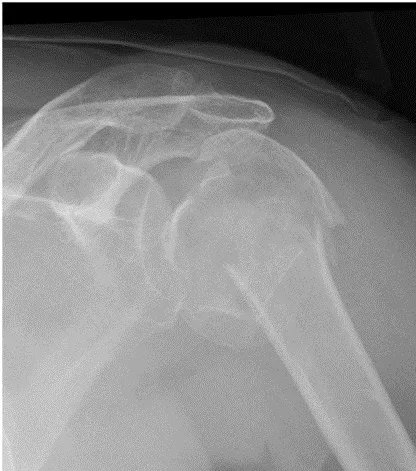
Proximal humerus fractures are common osteoporotic fractures in older women after a fall from standing, whereas humeral shaft fractures follow falls, twisting injuries and higher-energy trauma at any age. Proximal fractures are described by the Neer system according to which of four segments (head, greater and lesser tuberosities, shaft) are displaced. Most are minimally displaced and heal with a sling and early physiotherapy; the PROFHER trial and a 2022 Cochrane review found that surgery for displaced fractures in older adults does not improve function. Fixation or arthroplasty (increasingly reverse shoulder arthroplasty) is reserved for fracture-dislocations, head-splitting or displaced tuberosity fractures and selected younger patients. Shaft fractures are usually treated in a functional brace; plating or nailing is used for open fractures, vascular injury, floating elbow, polytrauma or failed bracing, and the FISH trial showed similar function but frequent non-union with bracing. The axillary nerve is at risk proximally and the radial nerve in the spiral groove; most radial palsies with closed fractures recover.
Patient case, mechanism, investigations, management, flashcards and exam-style questions.Open the lesson →
Key facts
- Proximal humerus fractures: third commonest osteoporotic fracture; typical patient is an older woman after a fall
- Neer: a segment is 'displaced' if separated by over 1 cm or angulated over 45°; fractures are one-, two-, three- or four-part
- About 80% of proximal fractures are minimally displaced and treated in a sling with early pendulum exercises
- PROFHER and the 2022 Cochrane review: surgery for displaced proximal fractures in older adults gives no better function than a sling
- Axillary nerve injury: numbness over the lateral deltoid ('regimental badge') and deltoid weakness
- Humeral shaft fractures: most are treated in a functional brace; acceptable alignment is roughly 20° anterior, 30° varus angulation and 3 cm shortening
- Radial nerve palsy complicates about 1 in 10 shaft fractures, especially distal-third spiral (Holstein–Lewis) fractures; most recover
- FISH trial: functional bracing and plating gave similar function at 1 year, but about 30% of braced patients needed surgery for slow healing
Differential diagnosis
| Condition | Clues | Key test |
|---|---|---|
| Anterior shoulder dislocation | Squared shoulder, humeral head palpable anteriorly | Shoulder AP and Y or axillary view |
| Posterior shoulder dislocation | Arm locked in internal rotation after seizure or electric shock | Axillary view; 'light bulb' head on AP |
| Rotator cuff tear | Weak abduction or external rotation, normal radiographs | Ultrasound or MRI |
| Clavicle fracture or AC joint injury | Tenderness over clavicle or AC joint | Clavicle radiographs |
| Pathological humeral fracture | Minimal trauma, preceding pain, known cancer or myeloma | Lytic lesion on radiograph; staging CT, myeloma screen |
| Supracondylar humeral fracture (child) | Child after fall, elbow swelling | Elbow radiographs; check brachial artery and nerves |
| Non-accidental injury | Spiral humeral shaft fracture in a non-ambulant infant | Skeletal survey and safeguarding assessment |
Exam pearls
Guideline
No single international guideline; recommendations draw on the Cochrane review of interventions for proximal humeral fractures (2022), the PROFHER trial (2015), the FISH trial (2020) and NICE NG38 Fractures (non-complex) principles (2016)
References
- Handoll HH, Elliott J, Thillemann TM, Aluko P, Brorson S. Interventions for treating proximal humeral fractures in adults. Cochrane Database Syst Rev 2022.
- Rangan A, Handoll H, Brealey S, et al.. Surgical vs nonsurgical treatment of adults with displaced fractures of the proximal humerus: the PROFHER randomized clinical trial. JAMA 2015.
- Rämö L, Sumrein BO, Lepola V, et al.. Effect of surgery vs functional bracing on functional outcome among patients with closed displaced humeral shaft fractures: the FISH randomized clinical trial. JAMA 2020.
- Rämö L, Paavola M, Sumrein BO, et al.. Outcomes with surgery vs functional bracing for patients with closed, displaced humeral shaft fractures and the need for secondary surgery: a prespecified secondary analysis of the FISH randomized clinical trial. JAMA Surg 2021.
- Rangan A, Gwilym S, Keding A, et al.. Reverse shoulder arthroplasty versus hemiarthroplasty versus non-surgical treatment for older adults with acute 3- or 4-part fractures of the proximal humerus: study protocol for a randomised controlled trial (PROFHER-2). Trials 2023.
- National Institute for Health and Care Excellence. Fractures (non-complex): assessment and management (NG38). NICE 2016.
Related topics
By Dr Khalid Seidi (B.Sc., M.D.) · MedEd World Clinical Knowledge library. Original teaching content checked against current guidelines (November 2026); confirm the latest local guidance before clinical use. Not a substitute for clinical judgement.