Clinical Knowledge › Surgery › Fractures and orthopaedic trauma
Open fractures
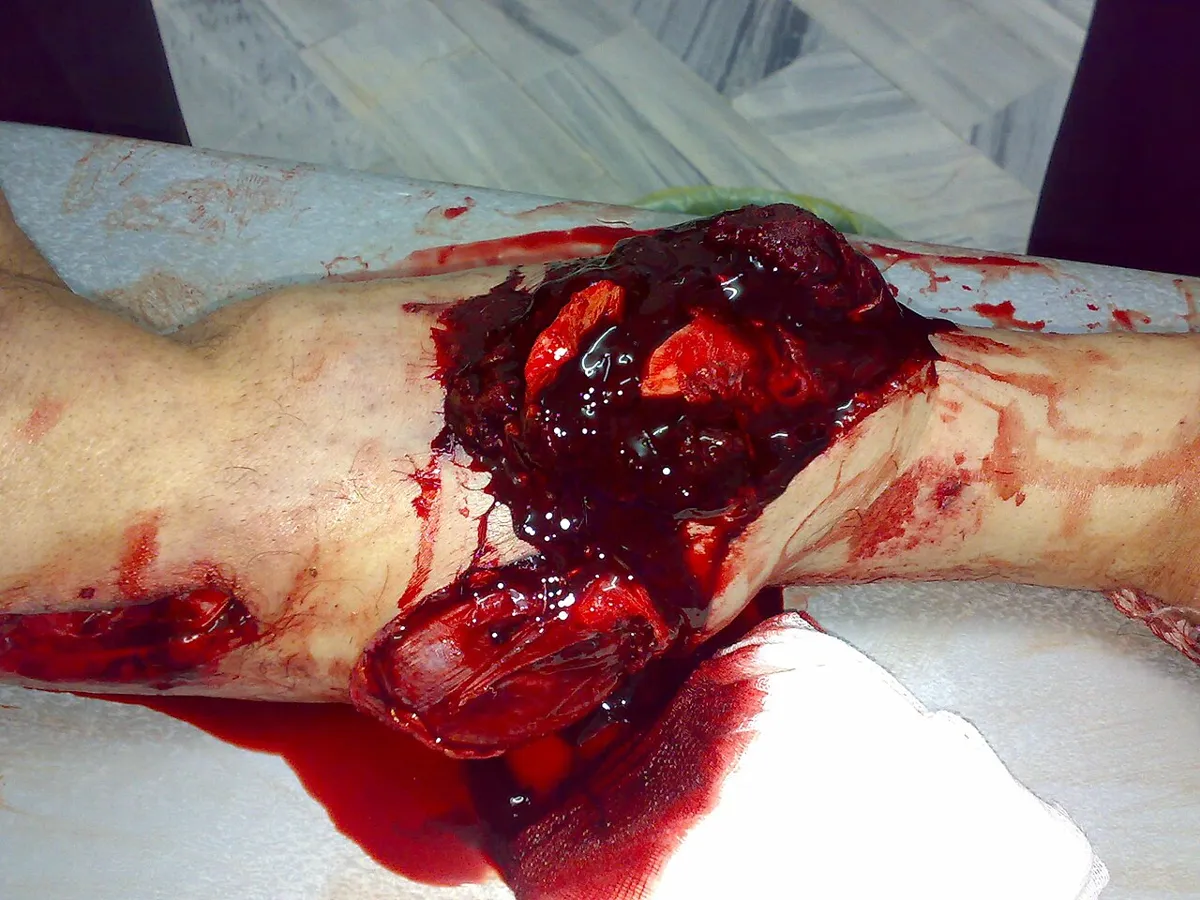
An open (compound) fracture is a fracture that communicates with the outside environment through a breach in the skin or mucosa. Contamination and soft-tissue damage make infection, non-union and amputation far more likely than in closed injuries. The tibial shaft is the commonest open long-bone fracture. Severity is graded with the Gustilo–Anderson classification (types I, II, IIIA, IIIB and IIIC), finalised at surgical debridement. Emergency care follows xABCDE: control haemorrhage, give intravenous antibiotics within 1 hour of injury, check tetanus status, remove gross contamination, photograph the wound, cover it with a saline-moistened dressing and splint the limb, and document neurovascular status. Definitive care is a combined orthopaedic and plastic surgical approach in a specialist centre: early debridement (immediately for heavily contaminated or ischaemic limbs, within 12 hours for high-energy injuries, within 24 hours for others), low-pressure saline irrigation, skeletal stabilisation and soft-tissue cover within 72 hours.
Patient case, mechanism, investigations, management, flashcards and exam-style questions.Open the lesson →
Key facts
- Any wound near a fracture is an open fracture until proved otherwise, even a small puncture
- Give IV antibiotics as soon as possible, ideally within 1 hour of injury; this is the most effective single measure against infection
- Gustilo–Anderson: I (wound under 1 cm, clean), II (1–10 cm, moderate soft-tissue injury), III (high energy, extensive damage): IIIA cover possible, IIIB flap needed, IIIC arterial injury needing repair
- Photograph the wound, remove gross contamination, apply a saline-moistened dressing and occlusive film; avoid repeated inspection in the emergency department
- Debride immediately if grossly contaminated (agricultural, aquatic, sewage) or with vascular compromise; within 12 hours for high-energy and within 24 hours for other open fractures
- Use low-pressure normal saline for irrigation; soap solutions and high pressure add no benefit
- Achieve definitive soft-tissue cover within 72 hours of injury; joint orthoplastic care improves outcomes
- Restore perfusion within about 3–4 hours in an ischaemic limb (shunt first) and perform fasciotomies
Differential diagnosis
| Condition | Clues | Key test |
|---|---|---|
| Closed fracture with separate laceration | Wound not communicating with fracture | Decided only at surgical exploration; treat as open meanwhile |
| Closed fracture with tented skin | Skin intact but blanched over bone | Urgent reduction to prevent conversion to open |
| Degloving injury without fracture | Extensive skin avulsion | Radiographs |
| Traumatic arthrotomy | Wound near a joint without fracture | CT showing intra-articular air; saline load test |
| Mangled extremity | Combined bone, soft-tissue, nerve and vascular injury | Clinical and vascular assessment; senior decision on salvage |
| Gas gangrene (late) | Rapidly spreading pain, crepitus, systemic toxicity days after injury | Radiograph gas in tissues; emergency debridement |
Exam pearls
Guideline
BOAST Open fractures (British Orthopaedic Association and BAPRAS, 2017), NICE NG37 Fractures (complex) (2016), Standards for the management of open fractures (BOA/BAPRAS, 2020) and ATLS 11th edition (ACS 2025)
References
- British Orthopaedic Association and British Association of Plastic, Reconstructive and Aesthetic Surgeons. BOAST: Open fractures. British Orthopaedic Association 2017.
- National Institute for Health and Care Excellence. Fractures (complex): assessment and management (NG37). NICE 2016.
- Eccles S, Handley B, Khan U, McFadyen I, Nanchahal J, Nayagam S, eds.. Standards for the Management of Open Fractures. 2020.
- American College of Surgeons Committee on Trauma. Advanced Trauma Life Support (ATLS) Student Course Manual, 11th edition. American College of Surgeons 2025.
- Gustilo RB, Anderson JT. Prevention of infection in the treatment of one thousand and twenty-five open fractures of long bones: retrospective and prospective analyses. J Bone Joint Surg Am 1976.
- Gustilo RB, Mendoza RM, Williams DN. Problems in the management of type III (severe) open fractures: a new classification of type III open fractures. J Trauma 1984.
Related topics
By Dr Khalid Seidi (B.Sc., M.D.) · MedEd World Clinical Knowledge library. Original teaching content checked against current guidelines (November 2026); confirm the latest local guidance before clinical use. Not a substitute for clinical judgement.