Clinical Knowledge › Surgery › Fractures and orthopaedic trauma
Clavicle fracture
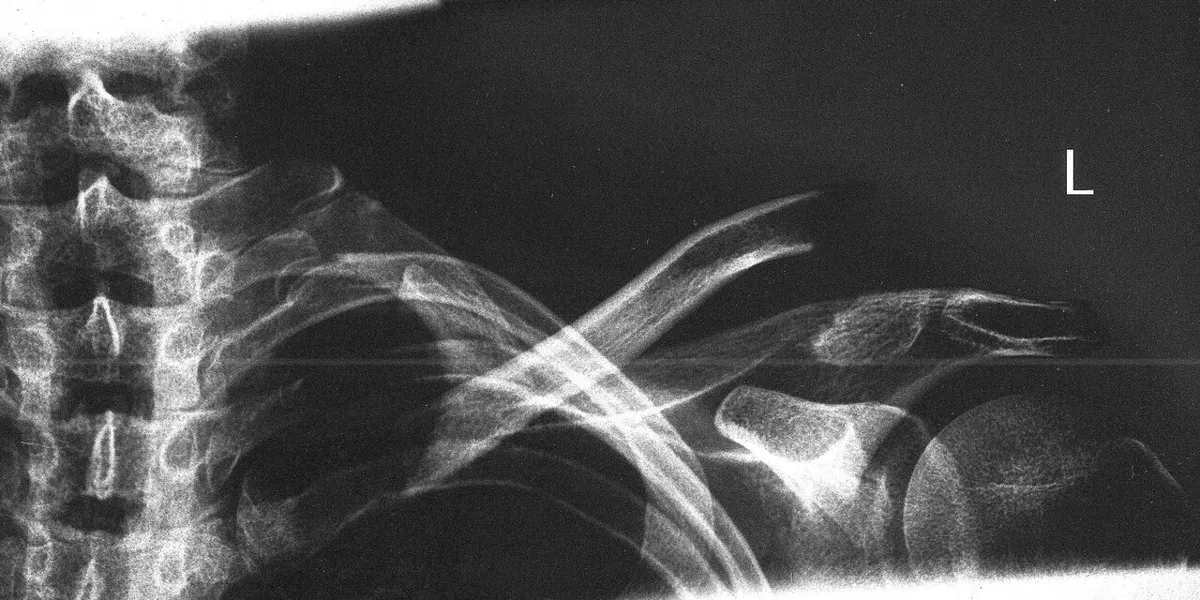
Clavicle fractures are common, especially in young men after falls onto the shoulder or sporting and cycling injuries, in children and as birth injuries. About four-fifths involve the middle third, where the bone is thinnest and unsupported by ligaments; lateral-third fractures are graded by their relation to the coracoclavicular ligaments (Neer), and medial fractures are rare and may accompany sternoclavicular injury. Examination must check the skin for tenting, the subclavian vessels, the brachial plexus and breath sounds. An AP radiograph plus a cephalic-tilt view confirms the fracture; CT helps for medial fractures. Most fractures heal with a sling and early movement. Surgery (usually plate fixation) is indicated for open fractures, threatened skin and neurovascular injury, and is considered for displaced floating shoulder injuries, displaced, shortened midshaft fractures in active adults and for displaced lateral (Neer type II) fractures. Trials show fixation lowers non-union and symptomatic malunion but brings hardware irritation, implant removal and infection, so treatment is a shared decision.
Patient case, mechanism, investigations, management, flashcards and exam-style questions.Open the lesson →
Key facts
- Middle-third fractures make up about 80%; lateral about 15%; medial about 5%
- Mechanism: fall onto the point of the shoulder (most), fall on the outstretched hand or direct blow
- Check skin tenting, subclavian vessels, brachial plexus and lung (pneumothorax) in every fracture
- Imaging: AP view plus a 15–30° cephalic-tilt view; CT for medial-third and sternoclavicular injuries
- Most heal with a broad-arm sling for comfort and early range-of-movement exercises
- Absolute surgical indications: open fracture, skin at risk, neurovascular injury; a displaced floating shoulder is a strong relative indication
- Displaced midshaft fractures treated in a sling have a symptomatic non-union rate of about 10–15%; fixation reduces this but adds hardware problems
- Neer type II lateral fractures (medial fragment detached from the coracoclavicular ligaments) have a high non-union rate
Differential diagnosis
| Condition | Clues | Key test |
|---|---|---|
| Acromioclavicular joint dislocation | Step at the AC joint, tenderness at the joint not the shaft | AP and Zanca view; coracoclavicular distance |
| Sternoclavicular joint dislocation | Medial pain; posterior type may cause dysphagia, stridor or venous congestion | CT of the sternoclavicular joints |
| Proximal humerus fracture | Older patient, arm bruising, shoulder pain | Shoulder trauma series |
| Anterior shoulder dislocation | Squared-off shoulder, arm held abducted and externally rotated | AP and lateral (Y or axillary) views |
| First rib or scapular fracture | High-energy trauma, posterior pain | Chest radiograph or CT |
| Pathological fracture | Minimal trauma, previous radiotherapy or malignancy | Radiograph showing lytic lesion; staging |
Exam pearls
Guideline
No single international guideline; practice is based on the Cochrane review of surgical versus conservative treatment of midshaft fractures (2019), multicentre trials (COTS 2007, Clavicle Trial 2017) and NICE NG38 Fractures (non-complex) principles (2016)
References
- Lenza M, Buchbinder R, Johnston RV, Ferrari BA, Faloppa F. Surgical versus conservative interventions for treating fractures of the middle third of the clavicle. Cochrane Database Syst Rev 2019.
- Canadian Orthopaedic Trauma Society. Nonoperative treatment compared with plate fixation of displaced midshaft clavicular fractures. A multicenter, randomized clinical trial. J Bone Joint Surg Am 2007.
- Ahrens PM, Garlick NI, Barber J, Tims EM. The Clavicle Trial: a multicenter randomized controlled trial comparing operative with nonoperative treatment of displaced midshaft clavicle fractures. J Bone Joint Surg Am 2017.
- National Institute for Health and Care Excellence. Fractures (non-complex): assessment and management (NG38). NICE 2016.
- Clement ND, Goudie EB, Brooksbank AJ, Chesser TJS, Robinson CM. Smoking status and the Disabilities of the Arm Shoulder and Hand score are early predictors of symptomatic nonunion of displaced midshaft fractures of the clavicle. Bone Joint J 2016.
- Blom A, Warwick D, Whitehouse M, eds.. Apley and Solomon's System of Orthopaedics and Trauma. 2018.
Related topics
By Dr Khalid Seidi (B.Sc., M.D.) · MedEd World Clinical Knowledge library. Original teaching content checked against current guidelines (November 2026); confirm the latest local guidance before clinical use. Not a substitute for clinical judgement.