Clinical Knowledge › Internal medicine › Endocrinology › Relevant pharmacology
Antithyroid drugs and radioiodine
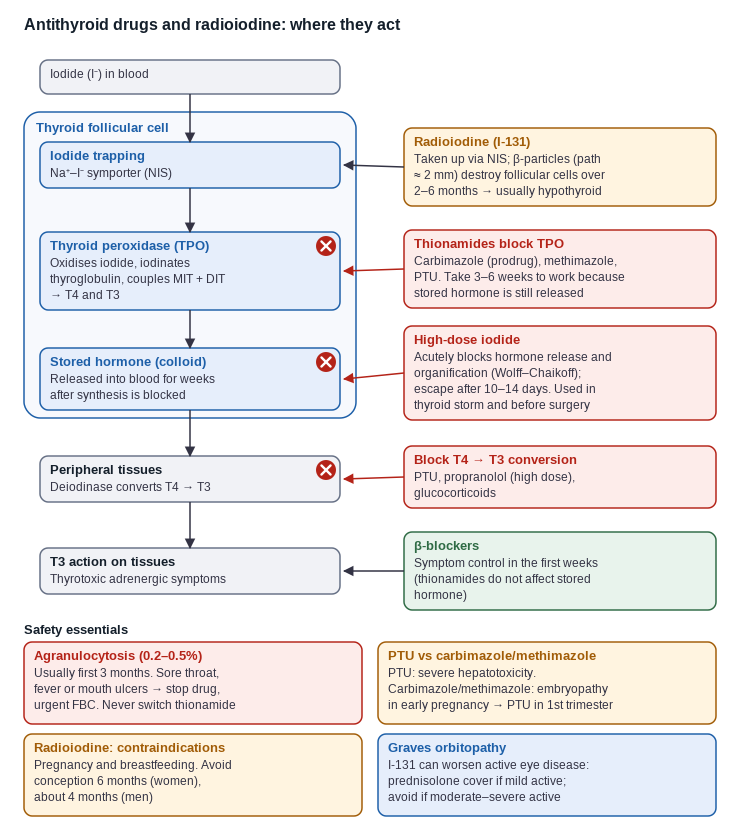
Hyperthyroidism is treated with three tools: thionamide antithyroid drugs, radioactive iodine (I-131) and surgery, supported by β-blockers for symptom control. Carbimazole (a prodrug of methimazole), methimazole and propylthiouracil (PTU) inhibit thyroid peroxidase and so block new hormone synthesis; PTU also blocks peripheral T4-to-T3 conversion. Methimazole or carbimazole is first choice because of once-daily dosing and less liver toxicity; PTU is kept for the first trimester of pregnancy, thyroid storm and intolerance. In Graves disease a 12–18-month course gives remission in about half, and long-term low-dose therapy is now an accepted option. The most feared adverse effect is agranulocytosis (about 0.2–0.5%), so every patient must stop the drug and get an urgent blood count if sore throat or fever develops. Radioiodine is concentrated by thyroid cells and destroys them with β-radiation over weeks to months; it is the usual definitive treatment for toxic nodules and for many with Graves disease, and most patients become hypothyroid and need lifelong levothyroxine. It is contraindicated in pregnancy and breastfeeding and can worsen active Graves orbitopathy, which may need steroid cover. The ETA 2018, ATA 2016 and NICE NG145 guidelines frame these choices.
Patient case, mechanism, investigations, management, flashcards and exam-style questions.Open the lesson →
Key facts
- Thionamides block thyroid peroxidase (iodination and coupling); PTU also inhibits peripheral T4-to-T3 conversion
- Teaching doses: carbimazole 20–40 mg daily (methimazole 10–30 mg), PTU 100–150 mg 8-hourly; titrate to free T4 and T3 every 4–6 weeks (check local formulary)
- Graves disease: 12–18 months of titrated therapy gives about 50% remission; long-term low-dose methimazole is an alternative to definitive treatment
- Agranulocytosis (0.2–0.5%), usually in the first 3 months: stop the drug and check a full blood count urgently with any sore throat, fever or mouth ulcers
- PTU causes severe hepatotoxicity; carbimazole/methimazole cause embryopathy in early pregnancy – hence PTU in the first trimester
- Radioiodine (I-131) is the treatment of choice for toxic adenoma and toxic multinodular goitre; antithyroid drugs do not cure nodular disease
- Radioiodine is contraindicated in pregnancy and breastfeeding; avoid conception for 6 months (women) and about 4 months (men)
- Radioiodine can worsen active Graves orbitopathy, especially in smokers; give oral prednisolone cover in mild active disease and avoid it in moderate–severe active disease
Differential diagnosis
| Condition | Clues | Key test |
|---|---|---|
| Agranulocytosis from thionamide | Fever, sore throat or mouth ulcers in first months | Urgent neutrophil count; stop drug |
| Viral pharyngitis on a thionamide | Sore throat but normal neutrophils | Full blood count |
| PTU-induced hepatitis | Jaundice, raised ALT, anorexia | Liver function tests; stop PTU |
| Painless or subacute thyroiditis | Thyrotoxicosis with low radioiodine uptake; tender gland in subacute | Uptake scan, ESR; β-blocker only, no thionamide |
| Post-radioiodine hypothyroidism | Fatigue, weight gain 2–6 months after I-131 | TSH and free T4 |
| Graves orbitopathy flare after radioiodine | New grittiness, proptosis, diplopia | Clinical activity score; ophthalmology review |
| Thyroid storm | Fever, delirium, tachyarrhythmia in untreated or interrupted therapy | Clinical scoring (Burch–Wartofsky); free T4, T3 |
Exam pearls
Guideline
ETA 2018 guideline for Graves hyperthyroidism; ATA 2016 guidelines for hyperthyroidism and other causes of thyrotoxicosis; NICE NG145 (2019); EUGOGO 2021 orbitopathy guideline; ATA 2026 pregnancy guideline
References
- Ross DS, Burch HB, Cooper DS, et al.. 2016 American Thyroid Association guidelines for diagnosis and management of hyperthyroidism and other causes of thyrotoxicosis. Thyroid 2016.
- Kahaly GJ, Bartalena L, Hegedüs L, Leenhardt L, Poppe K, Pearce SH.. 2018 European Thyroid Association guideline for the management of Graves' hyperthyroidism. Eur Thyroid J 2018.
- National Institute for Health and Care Excellence. Thyroid disease: assessment and management (NG145). NICE guideline NG145 2019.
- American Thyroid Association. American Thyroid Association 2026 Guidelines for Thyroid Disease in Preconception, Pregnancy, and Postpartum. Thyroid 2026.
- Bartalena L, Kahaly GJ, Baldeschi L, et al.. The 2021 European Group on Graves' orbitopathy (EUGOGO) clinical practice guidelines for the medical management of Graves' orbitopathy. Eur J Endocrinol 2021.
- Cooper DS.. Antithyroid drugs. N Engl J Med 2005.
Related topics
By Dr Khalid Seidi (B.Sc., M.D.) · MedEd World Clinical Knowledge library. Original teaching content checked against current guidelines (November 2026); confirm the latest local guidance before clinical use. Not a substitute for clinical judgement.