Clinical Knowledge › Internal medicine › Endocrinology › Relevant pharmacology
Sulfonylureas
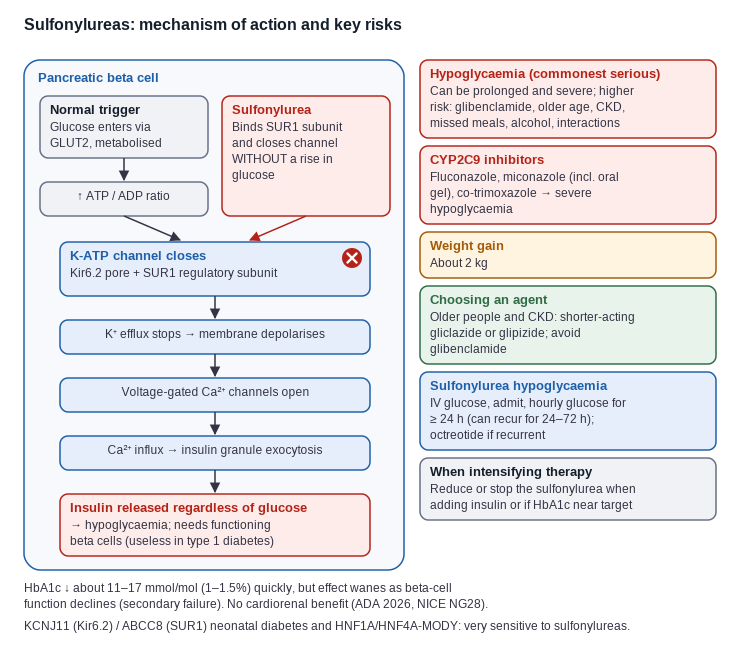
Sulfonylureas are oral insulin secretagogues that close ATP-sensitive potassium (K-ATP) channels on pancreatic beta cells by binding the SUR1 subunit, depolarising the cell and triggering calcium-dependent insulin release regardless of the blood glucose level. Gliclazide, glimepiride and glipizide are the commonly used second-generation agents; glibenclamide (glyburide) is long-acting with active renally cleared metabolites, and first-generation drugs such as chlorpropamide are obsolete. They lower HbA1c by about 11–17 mmol/mol (1–1.5%) quickly and cheaply, which keeps them on the WHO essential medicines list, but their effect wanes as beta-cell function declines (ADOPT, GRADE). The main harms are hypoglycaemia, which can be prolonged and severe in older people, CKD and with interacting drugs such as fluconazole or co-trimoxazole, and weight gain of about 2 kg. CAROLINA showed glimepiride had similar cardiovascular safety to linagliptin, but sulfonylureas have no cardiorenal benefit. They are uniquely effective in HNF1A-MODY and in neonatal diabetes from KCNJ11 or ABCC8 mutations.
Patient case, mechanism, investigations, management, flashcards and exam-style questions.Open the lesson →
Key facts
- Mechanism: bind SUR1 on beta-cell K-ATP channels, close them, depolarise the cell, open voltage-gated calcium channels and release insulin
- Need functioning beta cells; useless in type 1 diabetes
- HbA1c falls about 11–17 mmol/mol (1–1.5%) quickly, but durability is poor (secondary failure)
- Main adverse effects: hypoglycaemia (can be prolonged) and weight gain about 2 kg
- Prefer shorter-acting gliclazide or glipizide in older people and CKD; avoid glibenclamide
- CYP2C9 inhibitors (fluconazole, miconazole, co-trimoxazole) cause severe hypoglycaemia
- Sulfonylurea-induced hypoglycaemia needs admission, glucose infusion and octreotide if recurrent
- Very sensitive in HNF1A/HNF4A-MODY and KCNJ11/ABCC8 neonatal diabetes, allowing a switch from insulin
Differential diagnosis
| Condition | Clues | Key test |
|---|---|---|
| Sulfonylurea-induced hypoglycaemia | On a sulfonylurea; high insulin and C-peptide | Glucose, insulin, C-peptide, sulfonylurea screen |
| Insulinoma | Fasting hypoglycaemia; high insulin and C-peptide; negative drug screen | Supervised 72-hour fast; imaging |
| Exogenous insulin | High insulin, low C-peptide | Insulin and C-peptide during hypoglycaemia |
| Alcohol-induced hypoglycaemia | Binge drinking, poor intake; low insulin | History; blood alcohol |
| Adrenal insufficiency | Hypoglycaemia with hyponatraemia, hypotension | Cortisol, short Synacthen test |
| Post-bariatric hypoglycaemia | Symptoms 1–3 h after meals after gastric bypass | Mixed-meal test, history |
Exam pearls
Guideline
ADA Standards of Care in Diabetes 2026 (section 9), NICE NG28 (updated 2026) and WHO 2018 guideline on second- and third-line glucose-lowering medicines
References
- American Diabetes Association Professional Practice Committee. 9. Pharmacologic approaches to glycemic treatment: Standards of Care in Diabetes—2026. Diabetes Care 2026.
- National Institute for Health and Care Excellence (NICE). Type 2 diabetes in adults: management (NG28), last updated 2026. NICE guideline NG28 2026.
- World Health Organization. Guidelines on second- and third-line medicines and type of insulin for the control of blood glucose levels in non-pregnant adults with diabetes mellitus. WHO, Geneva 2018.
- UK Prospective Diabetes Study (UKPDS) Group. Intensive blood-glucose control with sulphonylureas or insulin compared with conventional treatment and risk of complications in patients with type 2 diabetes (UKPDS 33). Lancet 1998.
- GRADE Study Research Group; Nathan DM, Lachin JM, Balasubramanyam A, et al.. Glycemia reduction in type 2 diabetes — glycemic outcomes. N Engl J Med 2022.
- Rosenstock J, Kahn SE, Johansen OE, et al.. Effect of linagliptin vs glimepiride on major adverse cardiovascular outcomes in patients with type 2 diabetes: the CAROLINA randomized clinical trial. JAMA 2019.
Related topics
By Dr Khalid Seidi (B.Sc., M.D.) · MedEd World Clinical Knowledge library. Original teaching content checked against current guidelines (November 2026); confirm the latest local guidance before clinical use. Not a substitute for clinical judgement.