Clinical Knowledge › Internal medicine › Endocrinology › Relevant pharmacology
Glucocorticoid and mineralocorticoid replacement
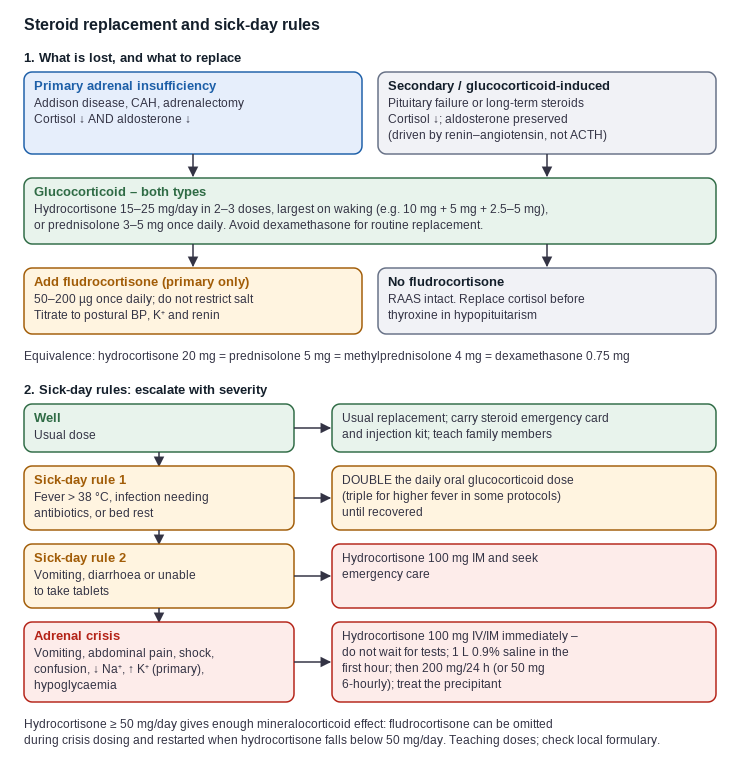
Adrenal insufficiency – primary (Addison disease, congenital adrenal hyperplasia, adrenalectomy), secondary (pituitary failure) or glucocorticoid-induced after long-term steroid therapy – needs lifelong, carefully dosed steroid replacement. Hydrocortisone 15–25 mg a day in two or three divided doses, with the largest dose on waking, mimics the natural cortisol rhythm; prednisolone 3–5 mg once daily is an alternative. In primary disease aldosterone is also lost, so fludrocortisone 50–200 µg daily is added and titrated to blood pressure, potassium and plasma renin; secondary adrenal insufficiency keeps its renin–angiotensin–aldosterone system and does not need it. Because these patients cannot mount a stress response, sick-day rules are vital: double the oral glucocorticoid dose during febrile illness, use injectable hydrocortisone when vomiting, and give 100 mg hydrocortisone IV or IM immediately in adrenal crisis. Surgery, labour and enzyme-inducing drugs also increase need. Over-replacement causes weight gain, diabetes and osteoporosis, while under-replacement causes fatigue, salt craving and crises. The Endocrine Society 2016 guideline and the 2024 ESE/Endocrine Society guideline on glucocorticoid-induced adrenal insufficiency guide practice.
Patient case, mechanism, investigations, management, flashcards and exam-style questions.Open the lesson →
Key facts
- Hydrocortisone 15–25 mg/day in 2–3 doses, largest on waking (for example 10 mg + 5 mg + 2.5–5 mg); prednisolone 3–5 mg once daily is an alternative (teaching doses; check local formulary)
- Fludrocortisone 50–200 µg once daily in primary adrenal insufficiency only; titrate to postural BP, potassium and renin
- Approximate glucocorticoid equivalence: hydrocortisone 20 mg = prednisolone 5 mg = methylprednisolone 4 mg = dexamethasone 0.75 mg
- Sick-day rule 1: double (or triple) the oral dose during fever or illness needing bed rest or antibiotics; rule 2: give 100 mg hydrocortisone IM/IV if vomiting or unable to take tablets
- Adrenal crisis: hydrocortisone 100 mg IV/IM immediately, then 200 mg/24 h (or 50 mg 6-hourly), plus 1 L 0.9% saline in the first hour
- Hydrocortisone 50 mg/day or more provides enough mineralocorticoid activity; fludrocortisone can be omitted during crisis dosing
- Enzyme inducers (rifampicin, carbamazepine, phenytoin) increase requirements; strong CYP3A4 inhibitors (ritonavir, cobicistat, itraconazole) cause iatrogenic Cushing
- ESE/ES 2024: after long-term supraphysiological glucocorticoids, taper to a physiological dose before testing morning cortisol for axis recovery
Differential diagnosis
| Condition | Clues | Key test |
|---|---|---|
| Under-replacement of glucocorticoid | Fatigue, nausea, weight loss, hypoglycaemia, rising pigmentation | Clinical review; consider dose timing and adherence |
| Under-replacement of mineralocorticoid | Salt craving, postural hypotension, hyperkalaemia, high renin | Lying and standing BP, potassium, plasma renin |
| Over-replacement of glucocorticoid | Weight gain, central fat, hyperglycaemia, insomnia, thin skin | Weight, HbA1c, BP, bone density |
| Over-replacement of fludrocortisone | Hypertension, oedema, hypokalaemia, suppressed renin | BP, potassium, renin |
| Glucocorticoid withdrawal syndrome | Myalgia, fatigue, mood change during taper with recovering axis | Morning cortisol; slow the taper |
| Hypothyroidism in autoimmune polyglandular syndrome | Persistent fatigue despite adequate steroids | TSH, free T4 |
| Malabsorption or drug interaction | Crises despite adherence; new rifampicin or antiepileptic | Medication review; coeliac screen |
Exam pearls
Guideline
Endocrine Society 2016 guideline on primary adrenal insufficiency; ESE/Endocrine Society 2024 joint guideline on glucocorticoid-induced adrenal insufficiency; Association of Anaesthetists/RCP/Society for Endocrinology 2020 perioperative guidance
References
- Bornstein SR, Allolio B, Arlt W, et al.. Diagnosis and treatment of primary adrenal insufficiency: an Endocrine Society clinical practice guideline. J Clin Endocrinol Metab 2016.
- Beuschlein F, Else T, Bancos I, et al.. European Society of Endocrinology and Endocrine Society joint clinical guideline: diagnosis and therapy of glucocorticoid-induced adrenal insufficiency. J Clin Endocrinol Metab 2024.
- Fleseriu M, Hashim IA, Karavitaki N, et al.. Hormonal replacement in hypopituitarism in adults: an Endocrine Society clinical practice guideline. J Clin Endocrinol Metab 2016.
- Woodcock T, Barker P, Daniel S, et al.. Guidelines for the management of glucocorticoids during the peri-operative period for patients with adrenal insufficiency. Anaesthesia 2020.
- Rushworth RL, Torpy DJ, Falhammar H.. Adrenal crisis. N Engl J Med 2019.
- Speiser PW, Arlt W, Auchus RJ, et al.. Congenital adrenal hyperplasia due to steroid 21-hydroxylase deficiency: an Endocrine Society clinical practice guideline. J Clin Endocrinol Metab 2018.
Related topics
By Dr Khalid Seidi (B.Sc., M.D.) · MedEd World Clinical Knowledge library. Original teaching content checked against current guidelines (November 2026); confirm the latest local guidance before clinical use. Not a substitute for clinical judgement.