Clinical Knowledge › Paediatrics › Paediatric infectious diseases
Bacterial meningitis in children
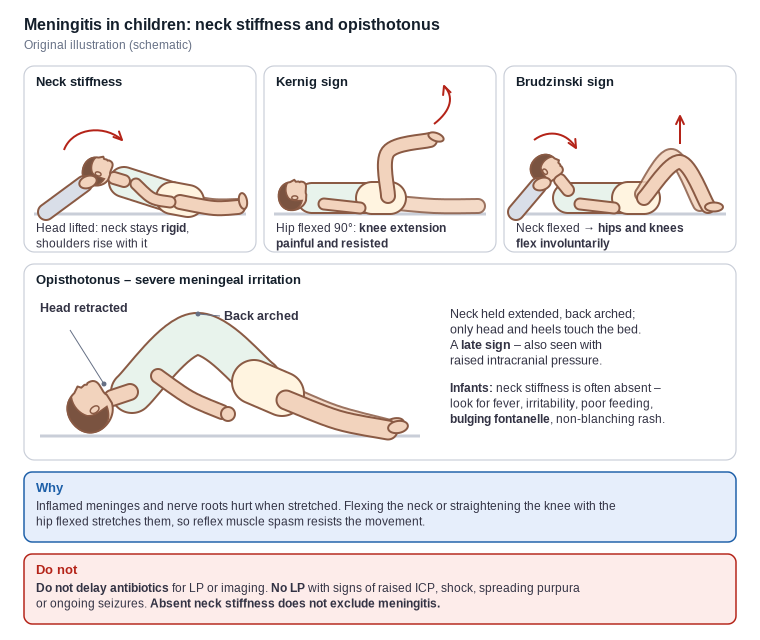
Bacterial meningitis is infection and inflammation of the meninges and subarachnoid space; in children it is an emergency with real mortality and lifelong sequelae. Incidence is highest in the first 3 months of life, when group B streptococcus, Escherichia coli and Listeria predominate; after infancy, Neisseria meningitidis and Streptococcus pneumoniae are the main causes; Hib has almost vanished where vaccination is routine. Classic neck stiffness, headache and photophobia are often absent in infants, who present with fever or hypothermia, poor feeding, irritability, lethargy, a bulging fontanelle or seizures. Lumbar puncture is key but must not delay antibiotics and is deferred in shock, coagulopathy or raised intracranial pressure. NICE NG240 (2024) recommends cefotaxime plus amoxicillin under 3 months and ceftriaxone from 3 months, with dexamethasone for older infants and children when CSF suggests bacterial meningitis. Survivors need a hearing test within 4 weeks and developmental follow-up, and close contacts of meningococcal disease need prophylaxis.
Patient case, mechanism, investigations, management, flashcards and exam-style questions.Open the lesson →
Key facts
- Highest incidence under 3 months: group B streptococcus (about half of cases), E. coli, Listeria; older children: meningococcus and pneumococcus
- Infants rarely show neck stiffness: look for fever or hypothermia, poor feeding, irritability, lethargy, high-pitched cry, apnoea, bulging fontanelle and seizures
- Do not delay antibiotics for lumbar puncture or imaging; give within 1 hour of arrival
- Empirical treatment (NICE NG240): under 3 months cefotaxime plus amoxicillin (or ampicillin); 3 months and over ceftriaxone
- Dexamethasone 0.15 mg/kg (max 10 mg) 6-hourly for 4 days in children 3 months and over with CSF evidence of bacterial meningitis, ideally before or with the first antibiotic dose
- CSF in bacterial meningitis: high neutrophil count, high protein, low glucose (CSF to blood ratio below about 0.4), organisms on Gram stain or PCR
- Sensorineural hearing loss is the commonest sequela (especially pneumococcal); formal audiology within 4 weeks
- Meningococcal disease is notifiable; close contacts get single-dose ciprofloxacin (or rifampicin) prophylaxis
Differential diagnosis
| Condition | Clues | Key test |
|---|---|---|
| Viral (enteroviral) meningitis | Milder illness, summer epidemics, lymphocytic CSF with normal glucose | CSF enterovirus PCR |
| Herpes simplex encephalitis | Altered behaviour, focal seizures, neonatal vesicles | CSF HSV PCR, MRI, EEG; start aciclovir |
| Tuberculous meningitis | Subacute onset over weeks, cranial nerve palsies, TB contact | CSF lymphocytes, very high protein, low glucose; GeneXpert, culture |
| Febrile seizure | Brief generalised seizure, rapid full recovery, well between | Clinical; LP only if meningism or incomplete recovery |
| Brain abscess or subdural empyema | Focal neurology, persistent fever, sinusitis or otitis | Contrast CT or MRI |
| Septicaemia without meningitis | Shock and purpura, normal mental state early | Blood culture, PCR |
| Non-accidental head injury | Irritable infant, bulging fontanelle, retinal haemorrhages, bruises | CT head, ophthalmology, skeletal survey |
Exam pearls
Guideline
NICE NG240 Meningitis (bacterial) and meningococcal disease (2024), WHO guidelines on meningitis diagnosis, treatment and care (2025), and ESCMID acute bacterial meningitis guideline (2016)
References
- National Institute for Health and Care Excellence. Meningitis (bacterial) and meningococcal disease: recognition, diagnosis and management (NG240). NICE guideline 2024.
- World Health Organization. WHO guidelines on meningitis diagnosis, treatment and care. WHO guideline 2025.
- van de Beek D, Cabellos C, Dzupova O, et al.. ESCMID guideline: diagnosis and treatment of acute bacterial meningitis. Clin Microbiol Infect 2016.
- Brouwer MC, McIntyre P, Prasad K, et al.. Corticosteroids for acute bacterial meningitis. Cochrane Database Syst Rev 2015.
- Okike IO, Johnson AP, Henderson KL, et al.. Incidence, etiology, and outcome of bacterial meningitis in infants aged <90 days in the United kingdom and Republic of Ireland: prospective, enhanced, national population-based surveillance. Clin Infect Dis 2014.
- Okike IO, Ladhani SN, Johnson AP, et al.. Clinical Characteristics and Risk Factors for Poor Outcome in Infants Less Than 90 Days of Age With Bacterial Meningitis in the United Kingdom and Ireland. Pediatr Infect Dis J 2018.
Related topics
By Dr Khalid Seidi (B.Sc., M.D.) · MedEd World Clinical Knowledge library. Original teaching content checked against current guidelines (November 2026); confirm the latest local guidance before clinical use. Not a substitute for clinical judgement.