Clinical Knowledge › Paediatrics › Paediatric infectious diseases
Hand, foot and mouth disease
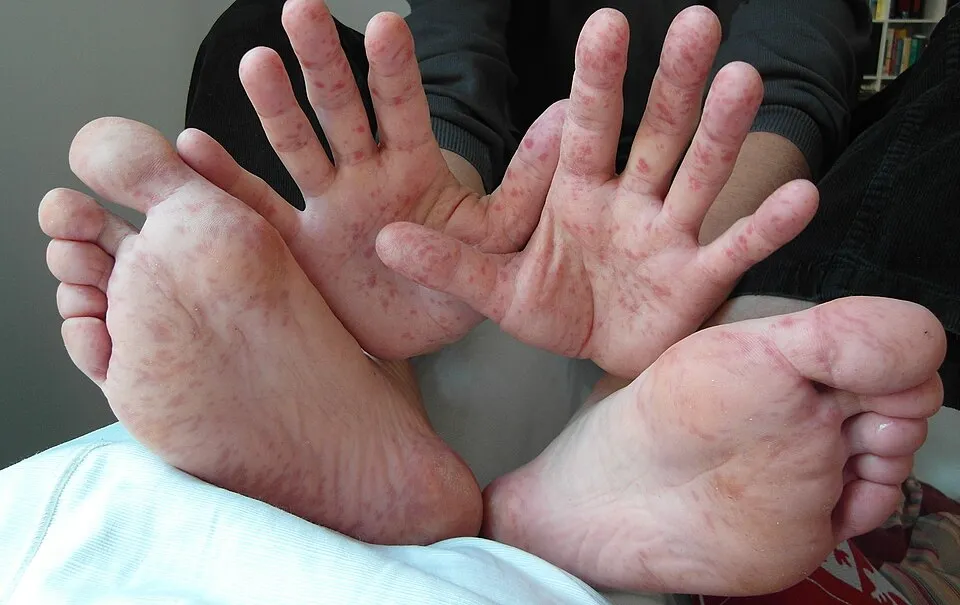
Hand, foot and mouth disease (HFMD) is a common, usually mild enteroviral infection of young children, mostly under 5 years. Coxsackievirus A16, enterovirus A71 (EV-A71), coxsackievirus A6 and A10 are the main causes. After an incubation period of 3–6 days, children develop low-grade fever, sore mouth and painful oral ulcers on the tongue, buccal mucosa and palate, followed by oval grey vesicles on an erythematous base on the palms, soles, buttocks and sometimes knees. Spread is faecal–oral and by respiratory droplets and vesicle fluid; virus is shed in stool for weeks. Diagnosis is clinical; PCR of vesicle fluid, throat swab or stool is used for severe or atypical cases and outbreaks. Treatment is supportive: analgesia, fluids and observation for dehydration, the commonest reason for admission. Coxsackievirus A6 causes widespread atypical rashes, eczema coxsackium and later nail shedding (onychomadesis). In the Asia-Pacific region, EV-A71 epidemics cause brainstem encephalitis, acute flaccid paralysis, neurogenic pulmonary oedema and cardiorespiratory failure, so red flags such as myoclonic jerks, lethargy, persistent high fever and tachycardia need urgent hospital care. Inactivated EV-A71 vaccines are used in China.
Patient case, mechanism, investigations, management, flashcards and exam-style questions.Open the lesson →
Key facts
- Mostly children under 5 years; outbreaks in nurseries in summer and autumn in temperate areas, year-round peaks in tropical Asia
- Main causes: coxsackievirus A16 (mild), enterovirus A71 (neurological complications), coxsackievirus A6 (atypical extensive rash, onychomadesis)
- Incubation 3–6 days; spread faecal–oral, respiratory and via vesicle fluid; stool shedding for several weeks
- Painful oral ulcers on tongue and buccal mucosa plus vesicles on palms, soles and buttocks
- Diagnosis clinical; enterovirus PCR (vesicle, throat, stool, CSF) for severe, atypical or outbreak cases
- Treatment supportive: paracetamol or ibuprofen, cold fluids, monitor hydration; no specific antiviral
- EV-A71 red flags: myoclonic jerks, lethargy, vomiting, persistent fever over 39 °C, tachycardia, tachypnoea, hyperglycaemia
- Children who are well do not need to be excluded from school in the UK; good hand hygiene and nappy hygiene limit spread
Differential diagnosis
| Condition | Clues | Key test |
|---|---|---|
| Herpangina | Vesicles and ulcers on posterior pharynx and soft palate only, high fever, no hand or foot lesions | Clinical; enterovirus PCR if needed |
| Herpetic gingivostomatitis (HSV-1) | Swollen bleeding gums, anterior oral and perioral vesicles, high fever, drooling | HSV PCR of lesion swab |
| Varicella | Itchy crops of vesicles in different stages, central distribution, scalp involved | Clinical; VZV PCR |
| Eczema herpeticum | Clustered punched-out erosions on eczematous skin, unwell child | HSV PCR; urgent aciclovir |
| Erythema multiforme / Stevens–Johnson syndrome | Target lesions; mucosal erosions; drug or HSV trigger | Clinical; skin biopsy if severe |
| Aphthous ulcers | Recurrent oral ulcers without fever or skin rash | Clinical history |
| Scabies | Itchy papules and burrows on hands and feet, family itch | Dermoscopy or skin scraping |
| Kawasaki disease | Prolonged fever, conjunctivitis, red cracked lips, hand oedema, no vesicles | Clinical criteria; echocardiogram |
Exam pearls
Guideline
WHO guide to clinical management and public health response for HFMD (2011), UKHSA health protection in children and young people settings (exclusion guidance, current edition) and national EV-A71 management protocols (e.g. China HFMD diagnosis and treatment guideline, 2018)
References
- World Health Organization, Regional Office for the Western Pacific. A guide to clinical management and public health response for hand, foot and mouth disease (HFMD). WHO 2011.
- UK Health Security Agency. Health protection in children and young people settings, including education. GOV.UK 2022.
- Solomon T, Lewthwaite P, Perera D, et al.. Virology, epidemiology, pathogenesis, and control of enterovirus 71. Lancet Infect Dis 2010.
- Zhu F, Xu W, Xia J, et al.. Efficacy, safety, and immunogenicity of an enterovirus 71 vaccine in China. N Engl J Med 2014.
- Mathes EF, Oza V, Frieden IJ, et al.. "Eczema coxsackium" and unusual cutaneous findings in an enterovirus outbreak. Pediatrics 2013.
- Esposito S, Principi N.. Hand, foot and mouth disease: current knowledge on clinical manifestations, epidemiology, aetiology and prevention. Eur J Clin Microbiol Infect Dis 2018.
Related topics
By Dr Khalid Seidi (B.Sc., M.D.) · MedEd World Clinical Knowledge library. Original teaching content checked against current guidelines (November 2026); confirm the latest local guidance before clinical use. Not a substitute for clinical judgement.