Clinical Knowledge › Paediatrics › Paediatric infectious diseases
Roseola infantum
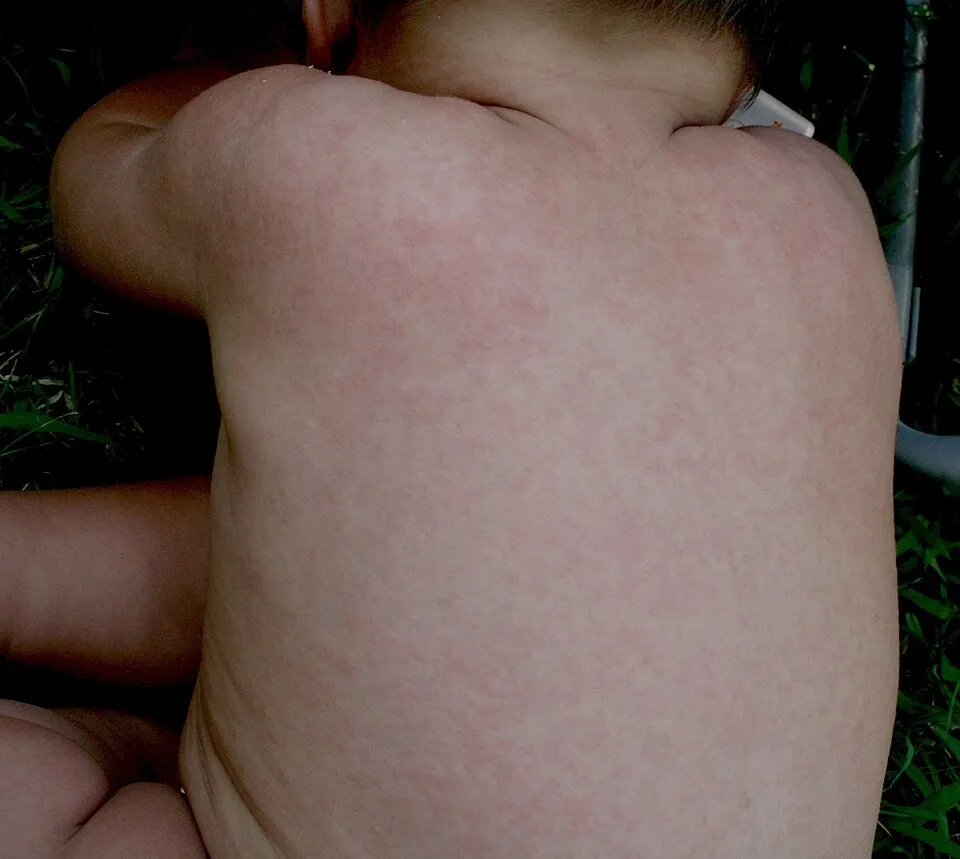
Roseola infantum (exanthem subitum, sixth disease) is the classic clinical form of primary infection with human herpesvirus 6B and, less often, human herpesvirus 7. Almost all children are infected by 2–3 years, with a peak between 6 and 24 months, usually from the saliva of asymptomatic family members. The typical course is 3–5 days of high fever, often above 39.5 °C, in an infant who looks surprisingly well, followed by an abrupt fall in temperature and the appearance of a pink, blanching maculopapular rash on the trunk and neck that fades within 1–2 days. Associated features include irritability, mild diarrhoea, cervical or suboccipital lymphadenopathy, eyelid oedema, a bulging fontanelle and red papules on the soft palate (Nagayama spots). Primary HHV-6 infection is a major cause of febrile seizures in infants and is an occasional cause of encephalitis. Diagnosis is clinical and often made in retrospect when the rash appears. Treatment is supportive. The key clinical task during the febrile phase is to exclude serious bacterial infection using age-appropriate assessment such as the NICE traffic-light system, and to support worried parents, particularly after a febrile seizure.
Patient case, mechanism, investigations, management, flashcards and exam-style questions.Open the lesson →
Key facts
- Cause: primary human herpesvirus 6B infection (most cases); human herpesvirus 7 causes some, often later in childhood
- Peak age 6–24 months; nearly all children seropositive by 3 years; spread by saliva from asymptomatic carers
- Incubation about 9–10 days (range 5–15)
- High fever for 3–5 days in a relatively well child, then rash as fever settles
- Rash: rose-pink blanching macules and papules on trunk and neck, non-itchy, lasts 1–2 days
- Primary HHV-6 infection causes a large share of febrile seizures in children under 2 years
- HHV-6 establishes lifelong latency; about 1% of people carry chromosomally integrated HHV-6, which confuses PCR results
- Treatment is supportive; no exclusion is needed once the rash appears; antivirals are reserved for encephalitis or immunocompromise
Differential diagnosis
| Condition | Clues | Key test |
|---|---|---|
| Measles | Rash appears at the height of fever with cough, coryza, conjunctivitis and Koplik spots; child unwell | Measles IgM or PCR |
| Rubella | Mild fever with rash at the same time, postauricular and suboccipital nodes, arthralgia in adolescents | Rubella IgM or PCR |
| Drug eruption (e.g. amoxicillin) | Rash after antibiotic given for the fever; may be itchy | History; resolves on stopping drug |
| Enteroviral exanthem | Rash with fever, often summer; may have mouth or hand lesions | Enterovirus PCR |
| Urinary tract infection or other serious bacterial infection | Fever without source in an infant; may look unwell | Urine dipstick and culture; blood tests per NICE |
| Erythema infectiosum | Slapped cheeks then lacy limb rash in school-age child | Parvovirus B19 IgM |
| Kawasaki disease | Fever 5 days or more with conjunctivitis, oral changes, extremity changes; rash during fever | Clinical criteria; CRP; echocardiogram |
Exam pearls
Guideline
NICE NG143 Fever in under 5s: assessment and initial management (2019, updated 2021), AAP febrile seizure guidance (2011 neurodiagnostic evaluation) and AAP Red Book (2024–2027) HHV-6/7 chapter
References
- Yamanishi K, Okuno T, Shiraki K, et al.. Identification of human herpesvirus-6 as a causal agent for exanthem subitum. Lancet 1988.
- Hall CB, Long CE, Schnabel KC, et al.. Human herpesvirus-6 infection in children. A prospective study of complications and reactivation. N Engl J Med 1994.
- Zerr DM, Meier AS, Selke SS, et al.. A population-based study of primary human herpesvirus 6 infection. N Engl J Med 2005.
- Agut H, Bonnafous P, Gautheret-Dejean A.. Laboratory and clinical aspects of human herpesvirus 6 infections. Clin Microbiol Rev 2015.
- National Institute for Health and Care Excellence. Fever in under 5s: assessment and initial management (NG143). NICE guideline 2019.
- American Academy of Pediatrics, Subcommittee on Febrile Seizures. Neurodiagnostic evaluation of the child with a simple febrile seizure. Pediatrics 2011.
Related topics
By Dr Khalid Seidi (B.Sc., M.D.) · MedEd World Clinical Knowledge library. Original teaching content checked against current guidelines (November 2026); confirm the latest local guidance before clinical use. Not a substitute for clinical judgement.