Clinical Knowledge › Paediatrics › Neonatology
Bronchopulmonary dysplasia
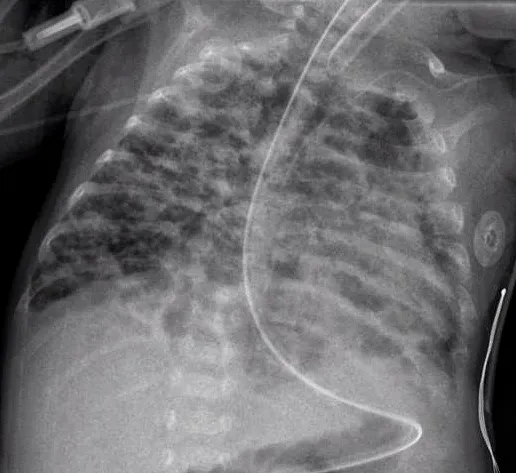
Bronchopulmonary dysplasia (BPD) is the chronic lung disease of prematurity and the commonest serious respiratory complication of birth before 28 weeks, affecting roughly 4 in 10 such infants. It is diagnosed when a very preterm infant still needs respiratory support or oxygen at 36 weeks' postmenstrual age. The modern ('new') form reflects interrupted lung development in the canalicular and saccular stages: fewer, larger alveoli and an abnormal pulmonary vasculature, rather than the scarring of the pre-surfactant era. Ventilation, oxygen toxicity, infection and inflammation injure a lung that should still be in the womb. Infants have tachypnoea, recession, an oxygen requirement and poor growth; some develop pulmonary hypertension. Prevention comes first: antenatal steroids, non-invasive support from birth, gentle surfactant delivery, caffeine, careful oxygen targets and good nutrition, with low-dose dexamethasone for ventilator-dependent infants. Survivors need oxygen weaning, RSV immunisation, growth support and long-term respiratory and developmental follow-up.
Patient case, mechanism, investigations, management, flashcards and exam-style questions.Open the lesson →
Key facts
- Definition (NICHD): supplemental oxygen for at least 28 days, with severity graded at 36 weeks' postmenstrual age for infants born before 32 weeks
- Jensen 2019 grading by support at 36 weeks: grade 1 nasal cannula up to 2 L/min; grade 2 nasal cannula above 2 L/min or non-invasive positive pressure; grade 3 invasive ventilation
- 'New BPD' = arrested alveolar and vascular development (simplified, larger alveoli); 'old BPD' = fibrosis and airway injury from barotrauma and oxygen
- Major risk factors: low gestation and birth weight, fetal growth restriction, mechanical ventilation, hyperoxia, chorioamnionitis, sepsis, PDA and male sex
- Caffeine for apnoea of prematurity reduced BPD (36% versus 47% in the CAP trial)
- Low-dose dexamethasone after the first week facilitates extubation; early (under 7 days) high-dose dexamethasone increases cerebral palsy and gut perforation
- Screen moderate–severe BPD for pulmonary hypertension with echocardiography around 36 weeks; BPD with pulmonary hypertension carries high mortality
- RSV immunisation (nirsevimab or palivizumab per national policy) is recommended for infants with chronic lung disease of prematurity
Differential diagnosis
| Condition | Clues | Key test |
|---|---|---|
| Respiratory distress syndrome | Onset at birth, improves over first week with surfactant | Chest X-ray: ground-glass with air bronchograms |
| Ventilator-associated pneumonia or sepsis | Acute rise in oxygen need, new infiltrate, raised CRP | Blood and tracheal cultures, CRP, chest X-ray |
| Patent ductus arteriosus with pulmonary overcirculation | Bounding pulses, wide pulse pressure, murmur | Echocardiography |
| Congenital heart disease or pulmonary vein stenosis | Disproportionate oxygen need or pulmonary hypertension | Echocardiography; CT angiography |
| Tracheobronchomalacia or subglottic stenosis | Stridor, collapse episodes, failed extubation | Bronchoscopy |
| Recurrent aspiration or gastro-oesophageal reflux | Desaturation with feeds, coughing | Feeding assessment, videofluoroscopy |
| Interstitial lung disease of infancy (for example surfactant protein disorders) | Term or near-term infant, persistent hypoxaemia | CT chest, genetic testing |
Exam pearls
Guideline
European Consensus Guidelines on the Management of RDS (2022 update), ATS Clinical Practice Guideline on post-prematurity respiratory disease (2021), and BPD definitions (NICHD 2001; Jensen 2019)
References
- Jensen EA, Dysart K, Gantz MG, et al.. The Diagnosis of Bronchopulmonary Dysplasia in Very Preterm Infants. An Evidence-based Approach. Am J Respir Crit Care Med 2019.
- Thébaud B, Goss KN, Laughon M, et al.. Bronchopulmonary dysplasia. Nat Rev Dis Primers 2019.
- Sweet DG, Carnielli VP, Greisen G, et al.. European Consensus Guidelines on the Management of Respiratory Distress Syndrome: 2022 Update. Neonatology 2023.
- Schmidt B, Roberts RS, Davis P, et al.. Caffeine therapy for apnea of prematurity. N Engl J Med 2006.
- Doyle LW, Davis PG, Morley CJ, et al.. Low-dose dexamethasone facilitates extubation among chronically ventilator-dependent infants: a multicenter, international, randomized, controlled trial. Pediatrics 2006.
- Watterberg KL, Walsh MC, Li L, et al.. Hydrocortisone to Improve Survival without Bronchopulmonary Dysplasia. N Engl J Med 2022.
Related topics
By Dr Khalid Seidi (B.Sc., M.D.) · MedEd World Clinical Knowledge library. Original teaching content checked against current guidelines (November 2026); confirm the latest local guidance before clinical use. Not a substitute for clinical judgement.