Clinical Knowledge › Paediatrics › Neonatology
Meconium aspiration syndrome
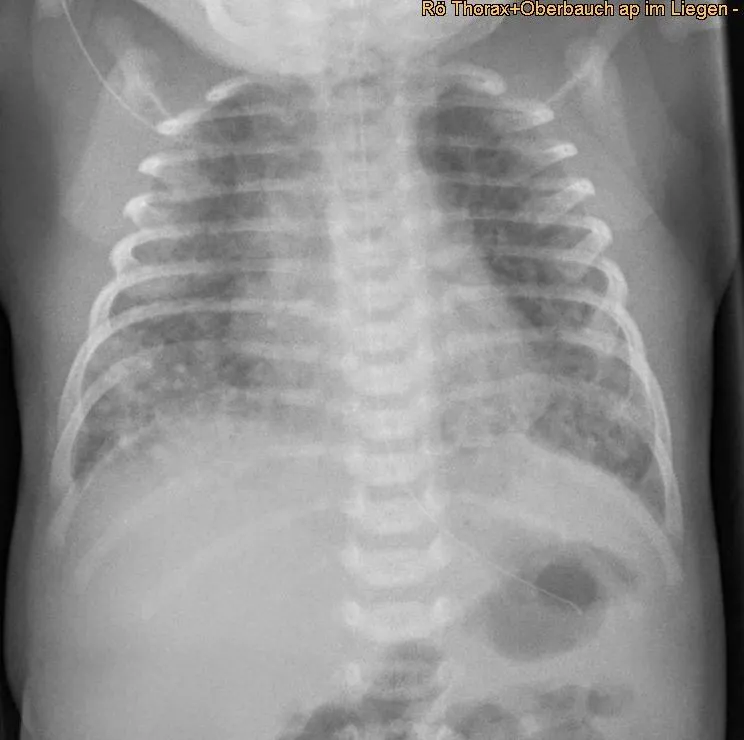
Meconium aspiration syndrome (MAS) is otherwise unexplained respiratory distress in a baby born through meconium-stained liquor. Meconium stains the liquor in about 1 in 8 births, mostly at or after term, and about 1 in 20 of those babies develop MAS. Fetal hypoxia triggers meconium passage and in-utero gasping; aspirated meconium then obstructs airways (causing air trapping and air leak), inactivates surfactant and causes chemical pneumonitis, and the hypoxia and acidosis drive persistent pulmonary hypertension of the newborn (PPHN). Babies are often post-term, growth restricted or asphyxiated, with meconium-stained skin, nails and cord, distress from birth, a barrel chest and patchy X-ray changes. Current resuscitation guidance (ERC and AHA/AAP 2025) no longer recommends routine suctioning – the priority is effective ventilation within the first minute. Treatment ranges from oxygen to CPAP, ventilation, surfactant, inhaled nitric oxide and ECMO, with antibiotics when infection cannot be excluded and cooling if hypoxic-ischaemic encephalopathy coexists.
Patient case, mechanism, investigations, management, flashcards and exam-style questions.Open the lesson →
Key facts
- Meconium-stained liquor in about 10–15% of births, rising after 40 weeks; MAS develops in roughly 3–5% of these babies
- Risk factors: post-term pregnancy, fetal growth restriction, fetal hypoxia (abnormal CTG), thick meconium, maternal hypertension or pre-eclampsia
- Four mechanisms: airway obstruction with ball-valve air trapping, surfactant inactivation, chemical pneumonitis and PPHN
- Chest X-ray: coarse patchy opacities, hyperinflation with flat diaphragms, and air leak (pneumothorax) in about 1 in 10
- ERC and AHA/AAP 2025: do not routinely suction the mouth or trachea at birth; start ventilation within 60 seconds if the baby is not breathing effectively
- Severity is judged by oxygen need and the oxygenation index (OI = mean airway pressure × FiO2 × 100 / PaO2); OI 25 or more suggests need for nitric oxide
- Treatment: oxygen, CPAP or ventilation, surfactant, inhaled nitric oxide for PPHN, high-frequency ventilation and ECMO for refractory hypoxaemia
- Meconium passage before 34 weeks is unusual and should raise suspicion of Listeria infection
Differential diagnosis
| Condition | Clues | Key test |
|---|---|---|
| Transient tachypnoea of the newborn | Planned caesarean birth, clear liquor, mild course | CXR: fluid in fissures; resolves in 24–72 h |
| Early-onset sepsis / congenital pneumonia | Maternal risk factors, temperature instability, shock | Blood culture, CRP; treat per NICE NG195 |
| Respiratory distress syndrome | Preterm, clear liquor, ground-glass lungs | CXR: diffuse ground-glass, low volumes |
| Isolated PPHN (idiopathic) | Labile hypoxaemia with relatively clear lungs | Echocardiography; pre/post-ductal gradient |
| Cyanotic congenital heart disease | Cyanosis without lung disease, murmur, poor oxygen response | Echocardiography |
| Pneumothorax | Sudden deterioration, asymmetric chest | Transillumination or CXR |
| Congenital diaphragmatic hernia | Scaphoid abdomen, displaced apex beat | CXR: bowel in chest |
Exam pearls
Guideline
ERC 2025 Newborn Resuscitation and Support of Transition at Birth; AHA/AAP 2025 Neonatal Resuscitation; NICE NG235 Intrapartum care (2023); NICE NG195 Neonatal infection (2021, updated 2026)
References
- Vain NE, Szyld EG, Prudent LM, et al.. Oropharyngeal and nasopharyngeal suctioning of meconium-stained neonates before delivery of their shoulders: multicentre, randomised controlled trial. Lancet 2004.
- Chettri S, Adhisivam B, Bhat BV.. Endotracheal suction for nonvigorous neonates born through meconium stained amniotic fluid: a randomized controlled trial. J Pediatr 2015.
- El Shahed AI, Dargaville PA, Ohlsson A, Soll R.. Surfactant for meconium aspiration syndrome in term and late preterm infants. Cochrane Database Syst Rev 2014.
- Neonatal Inhaled Nitric Oxide Study Group. Inhaled nitric oxide in full-term and nearly full-term infants with hypoxic respiratory failure. N Engl J Med 1997.
- Hogeveen M, Monnelly V, Binkhorst M, et al.. European Resuscitation Council Guidelines 2025 Newborn Resuscitation and Support of Transition of Infants at Birth. Resuscitation 2025.
- National Institute for Health and Care Excellence. Neonatal infection: antibiotics for prevention and treatment (NG195). NICE guideline 2021.
Related topics
By Dr Khalid Seidi (B.Sc., M.D.) · MedEd World Clinical Knowledge library. Original teaching content checked against current guidelines (November 2026); confirm the latest local guidance before clinical use. Not a substitute for clinical judgement.