Clinical Knowledge › Paediatrics › Neonatology
Intraventricular haemorrhage of prematurity
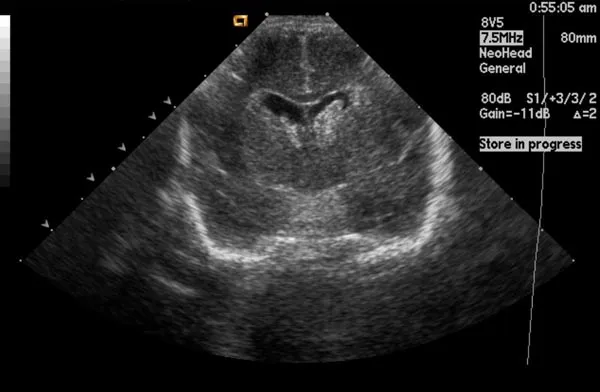
Intraventricular haemorrhage (IVH) is bleeding that starts in the germinal matrix, a fragile, highly vascular layer beneath the lining of the lateral ventricles that involutes by about 32–34 weeks' gestation. It is a disease of very preterm infants: any IVH affects roughly a quarter of babies born before 28 weeks, and the risk rises steeply at the limits of viability. Most bleeds occur in the first 72 hours, when a pressure-passive cerebral circulation meets swings in blood pressure and carbon dioxide. Many are clinically silent and are found on screening cranial ultrasound; a large bleed can cause sudden collapse with apnoea, a bulging fontanelle, seizures and a falling haematocrit. Papile grading (I–IV) describes extent; periventricular haemorrhagic infarction and post-haemorrhagic ventricular dilatation drive long-term harm such as cerebral palsy and cognitive impairment. No treatment stops a bleed, so prevention matters most: antenatal corticosteroids, magnesium sulfate, delivery in a tertiary centre, deferred cord clamping and gentle, stable intensive care.
Patient case, mechanism, investigations, management, flashcards and exam-style questions.Open the lesson →
Key facts
- Origin: germinal matrix over the head of the caudate nucleus; it involutes by about 32–34 weeks, so IVH is mainly a problem below 32 weeks
- About 50% of bleeds occur on day 1 and about 90% within the first 72 hours of life
- Papile grades: I germinal matrix only; II blood in the ventricle without dilatation; III blood with ventricular dilatation; IV parenchymal haemorrhage (now called periventricular haemorrhagic infarction)
- Clinical course may be silent (most), saltatory (subtle stepwise changes) or catastrophic (collapse, bulging fontanelle, seizures, falling haematocrit)
- Cranial ultrasound through the anterior fontanelle is the screening and diagnostic test; MRI at term-equivalent age refines prognosis
- Post-haemorrhagic ventricular dilatation (PHVD) follows severe IVH in a substantial proportion; track ventricular index, anterior horn width and head circumference
- Prevention: antenatal corticosteroids, magnesium sulfate for neuroprotection before 30 weeks, in-utero transfer, deferred cord clamping and avoiding swings in blood pressure and CO2
- Unilateral periventricular haemorrhagic infarction usually leads to contralateral spastic hemiplegia
Differential diagnosis
| Condition | Clues | Key test |
|---|---|---|
| Periventricular leukomalacia | Ischaemic white matter injury; echodensities evolve into cysts at 2–6 weeks | Serial cranial ultrasound; term MRI |
| Hypoxic-ischaemic encephalopathy | Term or near-term infant with perinatal asphyxia and encephalopathy | Cord gas, aEEG, MRI day 4–7 |
| Neonatal sepsis or meningitis | Temperature instability, apnoea, poor perfusion, raised CRP | Blood culture, CRP, lumbar puncture when stable |
| Cerebellar haemorrhage | Extremely preterm infant; missed on standard anterior fontanelle views | Mastoid fontanelle ultrasound; MRI |
| Subdural or subarachnoid haemorrhage | Term infant after instrumental delivery; consider non-accidental injury later in infancy | Cranial ultrasound, CT or MRI |
| Congenital hydrocephalus (aqueduct stenosis) | Ventricles enlarged without preceding haemorrhage, often antenatal finding | Antenatal scans, MRI |
| Hypoglycaemia or electrolyte disturbance | Jitteriness or seizures with normal scan | Blood glucose, sodium, calcium, magnesium |
Exam pearls
Guideline
AAP clinical report 'Routine neuroimaging of the preterm brain' (2020), European Consensus Guidelines on RDS (2022 update) and NICE NG25 Preterm labour and birth (2015, updated 2022)
References
- Papile LA, Burstein J, Burstein R, et al.. Incidence and evolution of subependymal and intraventricular hemorrhage: a study of infants with birth weights less than 1,500 gm. J Pediatr 1978.
- Hand IL, Shellhaas RA, Milla SS.. Routine Neuroimaging of the Preterm Brain. Pediatrics 2020.
- Sweet DG, Carnielli VP, Greisen G, et al.. European Consensus Guidelines on the Management of Respiratory Distress Syndrome: 2022 Update. Neonatology 2023.
- National Institute for Health and Care Excellence. Preterm labour and birth (NG25). NICE guideline 2015.
- McGoldrick E, Stewart F, Parker R, et al.. Antenatal corticosteroids for accelerating fetal lung maturation for women at risk of preterm birth. Cochrane Database Syst Rev 2020.
- Shepherd ES, Goldsmith S, Doyle LW, et al.. Magnesium sulphate for women at risk of preterm birth for neuroprotection of the fetus. Cochrane Database Syst Rev 2026.
Related topics
By Dr Khalid Seidi (B.Sc., M.D.) · MedEd World Clinical Knowledge library. Original teaching content checked against current guidelines (November 2026); confirm the latest local guidance before clinical use. Not a substitute for clinical judgement.