Clinical Knowledge › Paediatrics › Neonatology
Hypoxic-ischaemic encephalopathy
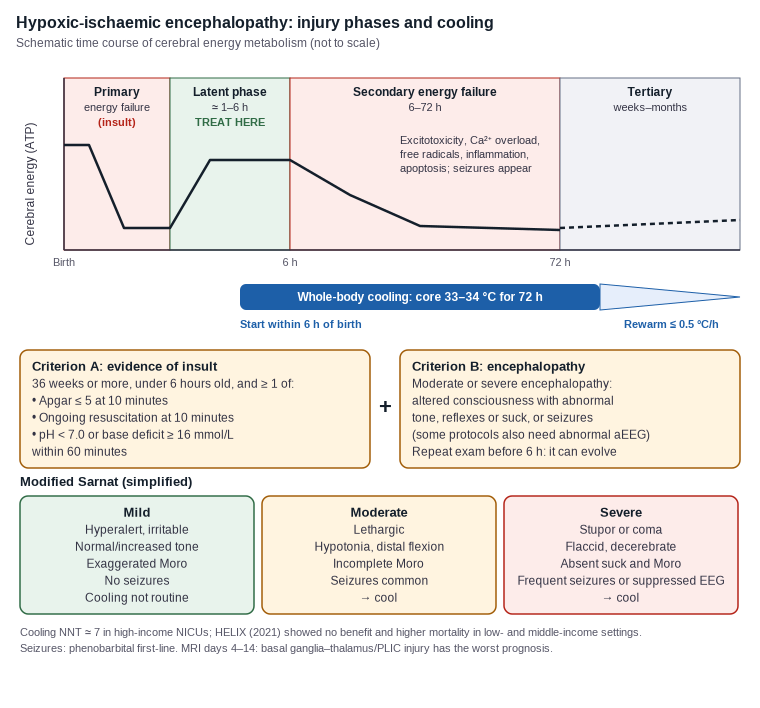
Hypoxic-ischaemic encephalopathy (HIE) is brain dysfunction in a term or near-term newborn caused by reduced oxygen delivery and blood flow around the time of birth. It affects about 1–3 per 1000 term births in high-income countries and many more where intrapartum care is limited. Injury evolves in phases: primary energy failure during the insult, a latent period of about 6 hours, then secondary energy failure over the next days driven by excitotoxicity, oxidative stress, inflammation and apoptosis. The latent phase is the window for therapeutic hypothermia. Babies show evidence of a perinatal insult (low Apgar scores, prolonged resuscitation, severe acidosis) and encephalopathy graded by Sarnat stage, often with kidney, heart, liver and clotting injury. Whole-body cooling to 33–34 °C for 72 hours, started within 6 hours for infants of 36 weeks or more with moderate or severe HIE, reduces death and disability in well-resourced intensive care, alongside meticulous supportive care, seizure treatment, MRI-based prognosis and family-centred communication.
Patient case, mechanism, investigations, management, flashcards and exam-style questions.Open the lesson →
Key facts
- Incidence about 1–3 per 1000 term births in high-income countries; much higher in low- and middle-income countries
- Injury phases: primary energy failure, latent phase (about 6 hours – the treatment window), secondary energy failure (6–72 hours), tertiary phase
- Cooling criteria (TOBY/BAPM-type): 36 weeks or more, under 6 hours old, evidence of asphyxia (Apgar 5 or less at 10 minutes, ongoing resuscitation at 10 minutes, or pH under 7.0 / base deficit 16 mmol/L or more within an hour) plus moderate or severe encephalopathy
- Therapeutic hypothermia: core (rectal or oesophageal) temperature 33–34 °C for 72 hours, then rewarming no faster than 0.5 °C per hour
- Cooling reduces death or major disability (number needed to treat about 7) in high-income intensive care; HELIX showed no benefit and higher mortality in low- and middle-income settings
- Sarnat staging: mild (hyperalert), moderate (lethargy, hypotonia, seizures), severe (stupor or coma, flaccid, absent reflexes)
- Seizures: phenobarbital is first-line (ILAE 2023); treat electrographic seizures; aEEG/EEG monitoring during cooling
- MRI with diffusion and spectroscopy (about days 4–14) predicts outcome: basal ganglia–thalamus and posterior limb of internal capsule injury carries the worst prognosis
Differential diagnosis
| Condition | Clues | Key test |
|---|---|---|
| Neonatal sepsis or meningitis | Maternal risk factors, temperature instability; encephalopathy may develop later | Blood culture, CRP, LP |
| Perinatal arterial ischaemic stroke | Focal seizures on day 1–3 in an otherwise well baby | MRI diffusion in an arterial territory |
| Inborn error of metabolism | Well period then encephalopathy, acidosis, hyperammonaemia | Ammonia, lactate, amino and organic acids |
| Neonatal hypoglycaemia | Infant of diabetic mother or SGA; glucose low | Laboratory glucose |
| Intracranial haemorrhage (subdural, subgaleal) | Instrumental birth, falling haematocrit, boggy scalp swelling | Cranial ultrasound or CT/MRI, coagulation |
| Neuromuscular disorder (myotonic dystrophy, SMA) | Hypotonia with alert face or maternal myotonia; no acidosis | Maternal examination, genetic testing |
| Maternal drug exposure (opioids, magnesium, general anaesthesia) | Depressed respiration and tone without acidosis | History; response to support over hours |
Exam pearls
Guideline
BAPM Therapeutic Hypothermia for Neonatal Encephalopathy: a framework for practice (2020); ERC 2025 Newborn Resuscitation; ILAE Task Force neonatal seizure treatment guideline (2023)
References
- British Association of Perinatal Medicine. Therapeutic hypothermia for neonatal encephalopathy: a framework for practice. BAPM 2020.
- Azzopardi DV, Strohm B, Edwards AD, et al.. Moderate hypothermia to treat perinatal asphyxial encephalopathy. N Engl J Med 2009.
- Shankaran S, Laptook AR, Ehrenkranz RA, et al.. Whole-body hypothermia for neonates with hypoxic-ischemic encephalopathy. N Engl J Med 2005.
- Jacobs SE, Berg M, Hunt R, et al.. Cooling for newborns with hypoxic ischaemic encephalopathy. Cochrane Database Syst Rev 2013.
- Thayyil S, Pant S, Montaldo P, et al.. Hypothermia for moderate or severe neonatal encephalopathy in low-income and middle-income countries (HELIX): a randomised controlled trial in India, Sri Lanka, and Bangladesh. Lancet Glob Health 2021.
- Wu YW, Comstock BA, Gonzalez FF, et al.. Trial of erythropoietin for hypoxic-ischemic encephalopathy in newborns. N Engl J Med 2022.
Related topics
By Dr Khalid Seidi (B.Sc., M.D.) · MedEd World Clinical Knowledge library. Original teaching content checked against current guidelines (November 2026); confirm the latest local guidance before clinical use. Not a substitute for clinical judgement.