Clinical Knowledge › Paediatrics › Neonatology
Neonatal hypoglycaemia
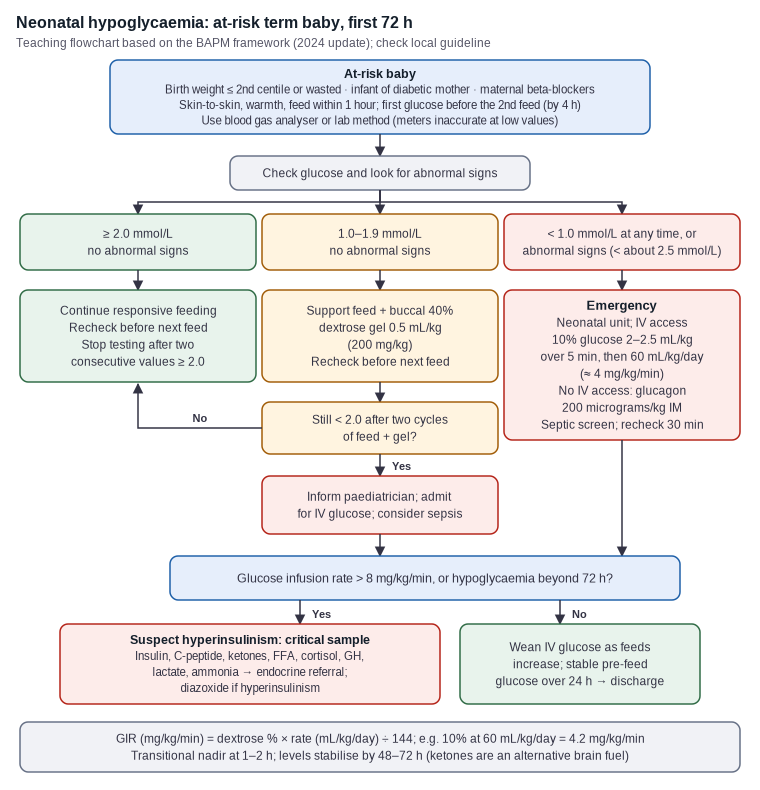
After the cord is clamped the newborn loses its placental glucose supply. In healthy babies glucose falls to a nadir at 1–2 hours and recovers over 48–72 hours as glycogenolysis, gluconeogenesis and ketogenesis switch on and feeding establishes – transitional hypoglycaemia, usually harmless because ketones fuel the brain. Babies who are small for gestational age, born to diabetic mothers, exposed to maternal beta-blockers, preterm, septic, cold or asphyxiated are at risk of pathological hypoglycaemia, which can injure the brain, classically the parieto-occipital cortex and white matter. Many have no symptoms; others are jittery, floppy, feed poorly or seize. Because there is no single safe level, guidelines use operational thresholds: the BAPM framework for term babies (updated 2024) targets 2.0 mmol/L or more in the first 72 hours, with urgent IV glucose below 1.0 mmol/L or with abnormal signs. Treatment escalates from early feeding to 40% dextrose gel, IV glucose and glucagon. Persistent hypoglycaemia needing more than 8 mg/kg/min of glucose suggests hyperinsulinism.
Patient case, mechanism, investigations, management, flashcards and exam-style questions.Open the lesson →
Key facts
- Transitional glucose nadir at 1–2 hours after birth; levels stabilise by 48–72 hours; healthy term babies use ketones as alternative brain fuel
- BAPM (term, birth–72 h): routine testing for babies at risk – birth weight at or below the 2nd centile or clinically wasted, infant of a diabetic mother, maternal beta-blockers in the third trimester or at delivery
- Operational target 2.0 mmol/L or more in the first 72 hours; below 1.0 mmol/L at any time, or below about 2.5 mmol/L with abnormal neurological signs, is an emergency
- First feed within the first hour; first glucose before the second feed (and no later than 4 hours)
- Buccal 40% dextrose gel 0.5 mL/kg (200 mg/kg) with a feed reduces treatment failure and admission (Sugar Babies trial)
- IV 10% glucose bolus 2–2.5 mL/kg then infusion from 60 mL/kg/day (about 4 mg/kg/min); glucose infusion rate (mg/kg/min) = % dextrose × mL/kg/day ÷ 144
- Glucose requirement above 8 mg/kg/min, or hypoglycaemia with low ketones, suggests hyperinsulinism – take a 'critical sample' at the time of hypoglycaemia
- Point-of-care meters are inaccurate at low values; confirm with a blood gas analyser or laboratory method without delaying treatment
Differential diagnosis
| Condition | Clues | Key test |
|---|---|---|
| Neonatal sepsis | Temperature instability, poor perfusion, maternal risk factors | Blood culture, CRP; often coexists with hypoglycaemia |
| Hypocalcaemia | Jitteriness or seizures in IDM or asphyxia; glucose normal | Ionised calcium, magnesium |
| Hypoxic-ischaemic encephalopathy | Perinatal asphyxia, encephalopathy from birth | Cord gas, neurological examination, aEEG |
| Neonatal abstinence syndrome | Jitteriness, high-pitched cry, sneezing; maternal opioids | Maternal history, scoring, urine/meconium toxicology |
| Inborn error of metabolism (e.g. fatty acid oxidation defect, glycogen storage disease) | Hypoglycaemia with acidosis, hepatomegaly or abnormal ketones | Lactate, ammonia, ketones, acylcarnitines |
| Hypopituitarism or adrenal insufficiency | Micropenis, midline defects, prolonged (conjugated) jaundice, hyponatraemia | Cortisol, GH in critical sample; TSH/fT4 |
| Benign jitteriness | Stops with passive flexion, no eye signs, normal glucose | Clinical; glucose and calcium normal |
Exam pearls
Guideline
BAPM Identification and Management of Neonatal Hypoglycaemia in the Full Term Infant (birth–72 hours) framework (2024 revision of the 2017 framework); Pediatric Endocrine Society recommendations (2015); NICE NG3 Diabetes in pregnancy (2015, updated 2020)
References
- British Association of Perinatal Medicine. Identification and management of neonatal hypoglycaemia in the full term infant (birth–72 hours): a framework for practice. BAPM 2024.
- Thornton PS, Stanley CA, De Leon DD, et al.. Recommendations from the Pediatric Endocrine Society for evaluation and management of persistent hypoglycemia in neonates, infants, and children. J Pediatr 2015.
- Adamkin DH; Committee on Fetus and Newborn.. Postnatal glucose homeostasis in late-preterm and term infants. Pediatrics 2011.
- Harris DL, Weston PJ, Signal M, et al.. Dextrose gel for neonatal hypoglycaemia (the Sugar Babies Study): a randomised, double-blind, placebo-controlled trial. Lancet 2013.
- van Kempen AAMW, Eskes PF, Nuytemans DHGM, et al.. Lower versus traditional treatment threshold for neonatal hypoglycemia. N Engl J Med 2020.
- Hogeveen M, Monnelly V, Binkhorst M, et al.. European Resuscitation Council Guidelines 2025 Newborn Resuscitation and Support of Transition of Infants at Birth. Resuscitation 2025.
Related topics
By Dr Khalid Seidi (B.Sc., M.D.) · MedEd World Clinical Knowledge library. Original teaching content checked against current guidelines (November 2026); confirm the latest local guidance before clinical use. Not a substitute for clinical judgement.