Clinical Knowledge › Paediatrics › Neonatology
Transient tachypnoea of the newborn
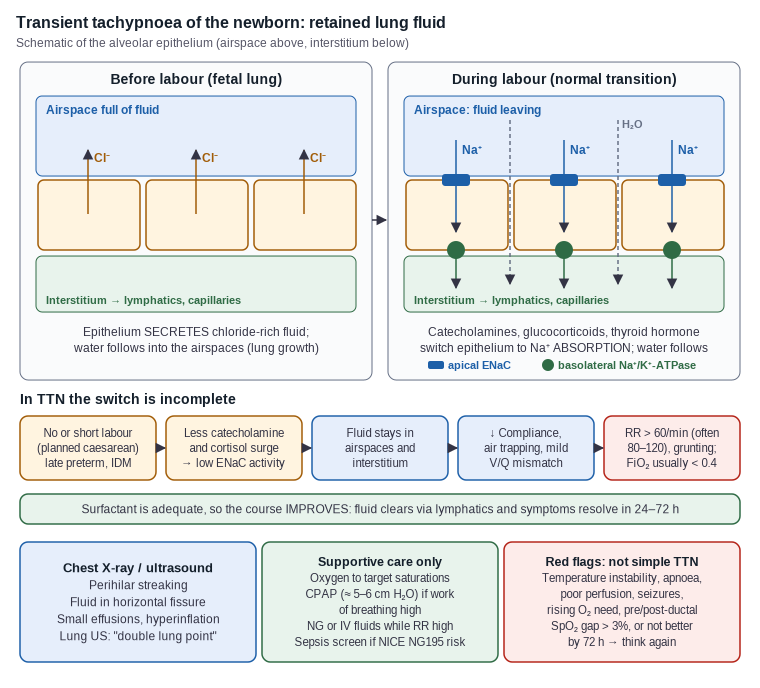
Transient tachypnoea of the newborn (TTN) is a self-limiting respiratory disorder of term and late preterm babies caused by delayed clearance of fetal lung fluid. Before birth the lung is filled with fluid secreted by the epithelium; during labour, catecholamines and glucocorticoids switch the epithelium to sodium absorption through epithelial sodium channels (ENaC), so fluid leaves the airspaces. When this switch is incomplete – classically after planned caesarean birth without labour, in late preterm babies, or in infants of diabetic mothers – residual fluid lowers lung compliance. Tachypnoea above 60/min starts within hours, often with grunting and a modest oxygen need. Chest X-ray shows perihilar streaking, fluid in the horizontal fissure and hyperinflation. TTN is a diagnosis of exclusion: early-onset sepsis, surfactant-deficient respiratory distress syndrome, meconium aspiration, pneumothorax and congenital heart disease must be considered. Care is supportive – oxygen, CPAP if needed, and careful feeding – and symptoms settle within 24–72 hours with an excellent prognosis.
Patient case, mechanism, investigations, management, flashcards and exam-style questions.Open the lesson →
Key facts
- Commonest cause of respiratory distress in term newborns: about 4–6 per 1000 term births, higher after planned caesarean birth and in late preterm infants
- Mechanism: delayed absorption of fetal lung fluid because the labour-related catecholamine and cortisol surge that activates ENaC is reduced
- Onset within 2 hours of birth: respiratory rate above 60/min (often 80–120), grunting, mild recession; oxygen need usually below 40%
- Chest X-ray: perihilar streaking, fluid in the horizontal fissure, small pleural effusions, hyperinflation; lung ultrasound shows a 'double lung point'
- Normal newborn respiratory rate is 40–60/min and heart rate 100–160/min; persistent rate above 60/min needs assessment
- Diagnosis of exclusion: always consider early-onset sepsis (NICE NG195 risk factors and clinical indicators) and treat if indicated
- Supportive care only: oxygen to target saturations, CPAP for work of breathing, nasogastric or IV fluids while tachypnoea is marked; resolves in 24–72 hours
- Planned caesarean birth at or after 39 weeks reduces TTN; worsening or persistent distress beyond 72 hours suggests another diagnosis
Differential diagnosis
| Condition | Clues | Key test |
|---|---|---|
| Respiratory distress syndrome (surfactant deficiency) | Preterm, worsening over first 24–48 h, higher FiO2 | CXR: diffuse ground-glass, air bronchograms, low volumes |
| Early-onset sepsis / congenital pneumonia (GBS) | Maternal risk factors, temperature instability, poor perfusion, apnoea | Blood culture, CRP; treat per NICE NG195 |
| Meconium aspiration syndrome | Meconium-stained liquor, post-term, patchy infiltrates | CXR: coarse patchy opacities, hyperinflation, air leak |
| Pneumothorax | Sudden deterioration, asymmetric breath sounds | Transillumination, CXR or lung ultrasound |
| Cyanotic congenital heart disease | Cyanosis out of proportion to distress, murmur, failed oxygen response | Pre/post-ductal saturations, echocardiography |
| Persistent pulmonary hypertension of the newborn | Labile hypoxaemia, pre/post-ductal gradient | Echocardiography |
| Congenital malformation (diaphragmatic hernia, CPAM) | Scaphoid abdomen, displaced heart sounds | CXR: bowel loops in chest or cystic lesion |
| Metabolic or neurological cause (hypoglycaemia, acidosis, HIE) | Tachypnoea without lung signs; lethargy | Blood glucose, gas, lactate |
Exam pearls
Guideline
ERC 2025 Newborn Resuscitation and Support of Transition at Birth; NICE NG195 Neonatal infection (2021, updated May 2026); NICE NG192 Caesarean birth (2021)
References
- Jain L, Eaton DC.. Physiology of fetal lung fluid clearance and the effect of labor. Semin Perinatol 2006.
- Tita AT, Landon MB, Spong CY, et al.. Timing of elective repeat cesarean delivery at term and neonatal outcomes. N Engl J Med 2009.
- Stutchfield P, Whitaker R, Russell I, et al.. Antenatal betamethasone and incidence of neonatal respiratory distress after elective caesarean section: pragmatic randomised trial. BMJ 2005.
- Moresco L, Bruschettini M, Macchi M, et al.. Salbutamol for transient tachypnea of the newborn. Cochrane Database Syst Rev 2021.
- Moresco L, Romantsik O, Calevo MG, et al.. Non-invasive respiratory support for the management of transient tachypnea of the newborn. Cochrane Database Syst Rev 2020.
- Gupta N, Bruschettini M, Chawla D.. Fluid restriction in the management of transient tachypnea of the newborn. Cochrane Database Syst Rev 2021.
Related topics
By Dr Khalid Seidi (B.Sc., M.D.) · MedEd World Clinical Knowledge library. Original teaching content checked against current guidelines (November 2026); confirm the latest local guidance before clinical use. Not a substitute for clinical judgement.