Clinical Knowledge › Obstetrics and gynaecology › Labour and delivery
Caesarean section
Caesarean section (caesarean birth) is delivery of the baby through an abdominal and uterine incision. It is the most common major operation performed on women worldwide, with about one in five births globally and higher rates in many middle- and high-income countries. Indications may be planned (previous caesarean, breech after declined or failed external cephalic version, placenta praevia or accreta spectrum, high HIV viral load, primary genital herpes in the third trimester, maternal request) or unplanned (suspected fetal compromise, delay in labour, failed operative vaginal birth, cord prolapse, abruption). Urgency is graded into four categories; category 1 (immediate threat to the life of the woman or fetus) aims for birth within 30 minutes of the decision and category 2 within 75 minutes. Planned caesarean should not be carried out before 39+0 weeks without a reason, because of neonatal respiratory morbidity. Core safety steps are regional anaesthesia where possible, left lateral tilt, prophylactic antibiotics before skin incision, a transverse lower-segment incision, oxytocin after birth, VTE risk assessment and early recovery. Long-term consequences, especially placenta accreta spectrum and uterine rupture in later pregnancies, rise with each caesarean.
Patient case, mechanism, investigations, management, flashcards and exam-style questions.Open the lesson →
Key facts
- Urgency (NICE/Lucas): category 1 immediate threat to life of woman or fetus (birth within 30 minutes of decision); category 2 compromise not immediately life-threatening (within 75 minutes); category 3 needs early birth, no compromise; category 4 planned
- Planned caesarean: not before 39+0 weeks unless clinically indicated, because neonatal respiratory morbidity (transient tachypnoea, respiratory distress) is higher at 37–38 weeks
- Most common indications for a first caesarean: delay in labour, suspected fetal compromise, malpresentation (breech); most common planned indication overall: previous caesarean
- Prophylactic antibiotics (for example cefazolin 2 g IV; teaching dose; check local protocol) are given before skin incision, not after cord clamping
- Standard technique: Joel-Cohen (transverse) skin incision, transverse lower uterine segment incision, oxytocin 5 IU slow IV after birth, delivery of the placenta by controlled cord traction, two-layer uterine closure
- Classical (vertical upper-segment) incision: very preterm with no lower segment, transverse lie with back down, some praevia or accreta cases, perimortem; it carries a high rupture risk in later labour, so future births are by planned caesarean
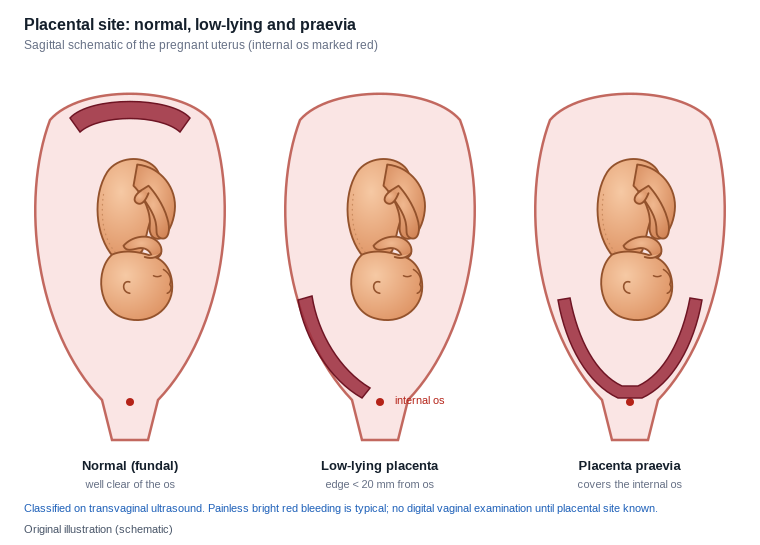
- Placenta accreta spectrum risk with a placenta praevia rises sharply with each previous caesarean (roughly 3% at a first caesarean, 11% with one previous, 40% with two previous and over 60% with three previous caesareans)
- Thromboprophylaxis (RCOG): LMWH for 10 days after any caesarean in labour, and after a planned caesarean if there is at least one additional risk factor
Differential diagnosis
| Condition | Clues | Key test |
|---|---|---|
| Operative vaginal birth (forceps or ventouse) | Fully dilated, head 0/5 to 1/5 palpable, at or below the spines, position known | Abdominal and vaginal examination by an experienced operator; may need trial in theatre |
| Continued labour with augmentation | Delay in first stage without fetal compromise, cephalic, no disproportion | Partogram, amniotomy and oxytocin with continuous CTG |
| Planned vaginal breech birth | Breech at term, suitable case, skilled attendant available, woman informed | Ultrasound for estimated weight, flexed neck and type of breech |
| External cephalic version | Uncomplicated breech from 36–37 weeks | Ultrasound before ECV; offer ECV before planning caesarean |
| Vaginal birth after caesarean | One previous lower-segment caesarean, no contraindication | Review of previous operation note; counselling on success and rupture risk |
| Induction of labour | Indication to end pregnancy with no contraindication to labour | Bishop score; membrane sweep, prostaglandin or balloon |
Exam pearls
Guideline
NICE NG192 Caesarean birth (2021, updated 2024); WHO recommendations: non-clinical interventions to reduce unnecessary caesarean sections (2018) and WHO statement on caesarean section rates (2015); RCOG Green-top Guideline No. 37a Reducing the risk of venous thromboembolism during pregnancy and the puerperium (2015); ACOG/SMFM Obstetric Care Consensus No. 1 (2014, reaffirmed)
References
- National Institute for Health and Care Excellence. Caesarean birth (NG192). NICE guideline NG192 2021.
- World Health Organization. WHO recommendations: non-clinical interventions to reduce unnecessary caesarean sections. World Health Organization, Geneva 2018.
- World Health Organization. WHO statement on caesarean section rates. World Health Organization, Geneva 2015.
- CORONIS Collaborative Group; Abalos E, Addo V, Brocklehurst P, et al.. Caesarean section surgical techniques (CORONIS): a fractional, factorial, unmasked, randomised controlled trial. Lancet 2013.
- Lucas DN, Yentis SM, Kinsella SM, et al.. Urgency of caesarean section: a new classification. J R Soc Med 2000.
- Royal College of Obstetricians and Gynaecologists. Reducing the risk of venous thromboembolism during pregnancy and the puerperium (Green-top Guideline No. 37a). RCOG, London 2015.
Related topics
By Dr Khalid Seidi (B.Sc., M.D.) · MedEd World Clinical Knowledge library. Original teaching content checked against current guidelines (November 2026); confirm the latest local guidance before clinical use. Not a substitute for clinical judgement.