Clinical Knowledge › Obstetrics and gynaecology › Labour and delivery
Malposition (occipitoposterior position)
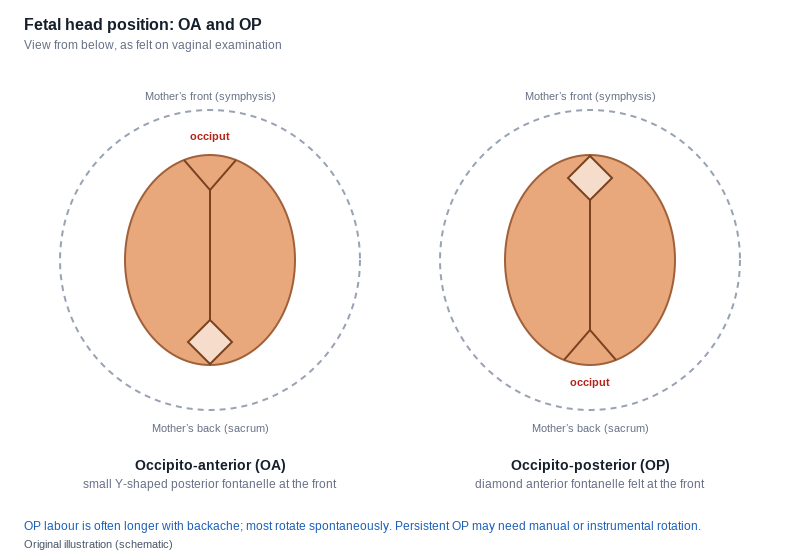
Malposition is a cephalic (vertex) presentation in which the occiput is not anterior: occipitoposterior (OP) or occipitotransverse (OT). About one in five fetuses is OP at the start of labour, but most rotate anteriorly; only about 5–8% are still OP at birth (persistent OP). The OP head tends to be deflexed, so it presents the larger occipitofrontal diameter (about 11.5 cm) instead of the suboccipitobregmatic (9.5 cm), which slows descent and rotation. Risk factors include nulliparity, epidural analgesia and an android pelvis. Women typically have severe backache, an early urge to push and prolonged labour. Diagnosis relies on vaginal examination of the fontanelles and sutures, but this is often wrong in the second stage, so ultrasound is advised when position is uncertain before assisted birth. Management is supportive (analgesia, hydration, oxytocin for delay); in the second stage options are waiting, spontaneous OP birth, manual or instrumental rotation by a skilled operator, or caesarean birth. Persistent OP increases operative birth, obstetric anal sphincter injury and postpartum haemorrhage.
Patient case, mechanism, investigations, management, flashcards and exam-style questions.Open the lesson →
Key facts
- Occipitoposterior: occiput towards the maternal sacrum; occipitotransverse: occiput towards the side wall; both are malpositions of a vertex presentation
- About 15–20% of fetuses are OP in early labour; most rotate anteriorly; 5–8% remain OP at birth
- Deflexed OP head presents the occipitofrontal diameter (about 11.5 cm) versus the suboccipitobregmatic diameter (9.5 cm) of a well-flexed OA head
- Clinical clues: severe backache, early urge to push before full dilatation, flattened lower abdomen with fetal limbs palpable anteriorly, prolonged first and second stages
- Vaginal examination: anterior fontanelle (diamond, four sutures) felt anteriorly; posterior fontanelle (Y-shaped, three sutures) towards the sacrum; error rates are high in the second stage
- Intrapartum transabdominal ultrasound (orbits and face anterior, spine posterior) is more accurate than vaginal examination and is recommended when position is uncertain before assisted birth
- Second-stage options: spontaneous rotation, spontaneous face-to-pubes birth, manual rotation, rotational ventouse (posterior cup on the flexion point), Kielland forceps (skilled operator), or caesarean birth
- Persistent OP increases prolonged labour, epidural use, assisted birth, caesarean, OASI and PPH
Differential diagnosis
| Condition | Clues | Key test |
|---|---|---|
| Occipitoanterior with slow progress from weak contractions | Flexed head, posterior fontanelle anterior, poor contractions | Vaginal examination and tocography |
| Deep transverse arrest | OT position at or below the spines, no rotation, often android pelvis | Vaginal examination and ultrasound in second stage |
| Brow presentation | High head, anterior fontanelle and supraorbital ridges palpable; mentovertical 13 cm | Vaginal examination and ultrasound |
| Face presentation (mentoposterior) | Mouth, nose, malar bones and chin felt; mentoposterior cannot deliver vaginally at term | Vaginal examination; ultrasound |
| Cephalopelvic disproportion | Severe moulding and caput, head high despite good contractions | Abdominal fifths with vaginal assessment |
| Asynclitism | Sagittal suture deviated towards sacrum or symphysis, slows descent | Vaginal examination, ultrasound |
Exam pearls
Guideline
RCOG Green-top Guideline No. 26 Assisted vaginal birth (2020); NICE NG235 Intrapartum care (2023); ACOG Clinical Practice Guideline No. 8 First and second stage labor management (2024)
References
- Murphy DJ, Strachan BK, Bahl R; Royal College of Obstetricians and Gynaecologists. Assisted vaginal birth: Green-top Guideline No. 26. BJOG 2020.
- National Institute for Health and Care Excellence. Intrapartum care (NG235). NICE guideline NG235 2023.
- American College of Obstetricians and Gynecologists. First and second stage labor management: ACOG Clinical Practice Guideline No. 8. Obstet Gynecol 2024.
- Phipps H, Osborn DA, Zhang S, et al.. Prophylactic manual rotation of the fetal head (manual rotation alone) to reduce operative delivery and complications for mother and babies. Cochrane Database Syst Rev 2025.
- Bertholdt C, Morel O, Zuily S, et al.. Manual rotation of occiput posterior or transverse positions: a systematic review and meta-analysis of randomized controlled trials. Am J Obstet Gynecol 2022.
- Parris D, Napolitano R, Bishop K, et al.. Manual versus instrumental rotation of the fetal head in malposition at birth (ROTATE study): protocol for a randomized controlled trial. JMIR Res Protoc 2026.
Related topics
By Dr Khalid Seidi (B.Sc., M.D.) · MedEd World Clinical Knowledge library. Original teaching content checked against current guidelines (November 2026); confirm the latest local guidance before clinical use. Not a substitute for clinical judgement.