Clinical Knowledge › Obstetrics and gynaecology › Labour and delivery
Induction of labour
Induction of labour (IOL) is the artificial initiation of labour before it starts spontaneously. It is offered when continuing the pregnancy carries more risk to the woman or baby than birth: prolonged pregnancy (offered from 41+0 weeks), prelabour rupture of membranes, hypertensive disease, diabetes, fetal growth restriction, intrahepatic cholestasis and intrauterine fetal death are common indications. The cervix is assessed with the Bishop score; a score of 6 or less is unfavourable and needs ripening with a vaginal prostaglandin (dinoprostone), low-dose oral misoprostol or a mechanical balloon catheter, whereas a favourable cervix (more than 6) is managed with amniotomy and, if needed, intravenous oxytocin. Main risks are uterine tachysystole with fetal heart rate changes, failed induction, uterine rupture (especially after caesarean), cord prolapse at amniotomy and postpartum haemorrhage. Shared decision-making with absolute risks, a clear plan for monitoring and escalation and caution in the scarred uterus underpin safe practice.
Patient case, mechanism, investigations, management, flashcards and exam-style questions.Open the lesson →
Key facts
- IOL = starting labour artificially; indicated when the benefits of birth outweigh those of continuing the pregnancy, and only after a shared, informed discussion
- Uncomplicated pregnancy: discuss and offer induction from 41+0 weeks (NICE NG207); if declined, offer increased fetal monitoring from 42+0 weeks
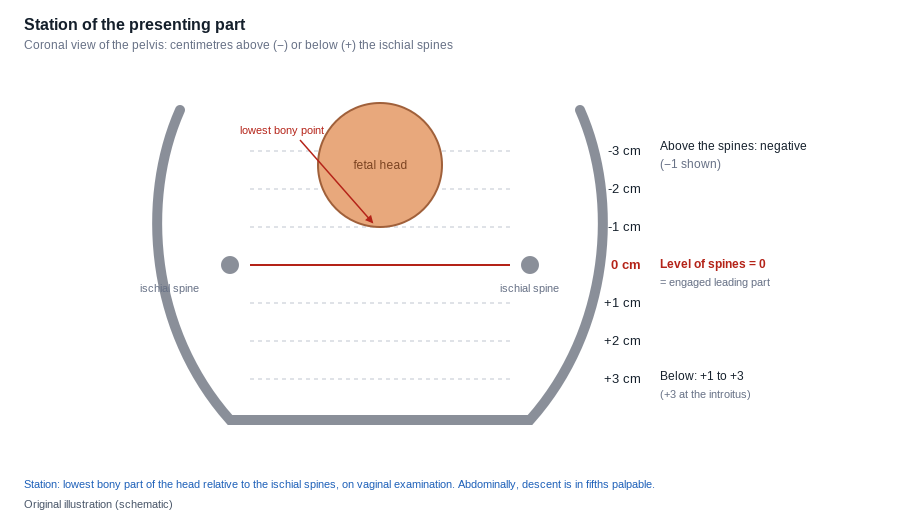
- Bishop score (0–13): dilatation, effacement/length, station, consistency, position; 6 or less = unfavourable (ripen first), more than 6 = favourable (amniotomy ± oxytocin)
- Ripening options: dinoprostone (vaginal gel, tablet or 10 mg 24-hour pessary), low-dose oral misoprostol (25 micrograms 2-hourly; teaching dose) or a balloon catheter
- Oxytocin: titrated IV infusion (e.g. start 1–2 milliunits/min, increase every 30 minutes, usual maximum 20 milliunits/min; teaching dose, check local protocol) aiming for 4–5 contractions in 10 minutes
- Tachysystole = more than 5 contractions in 10 minutes: stop oxytocin or remove the pessary, reposition, and give tocolysis (terbutaline 250 micrograms SC) if the CTG is abnormal
- Previous caesarean: induction roughly doubles to triples the risk of uterine rupture; prefer a mechanical method, avoid misoprostol, and use prostaglandins only with senior input
- Contraindications to vaginal birth (placenta or vasa praevia, transverse lie, cord presentation, active primary genital herpes, previous classical caesarean) contraindicate induction
Differential diagnosis
| Condition | Clues | Key test |
|---|---|---|
| Augmentation of labour | Labour has already started but is slow; oxytocin is used to strengthen contractions | Vaginal examination showing established labour with delay on the partogram |
| Latent first stage of labour | Painful irregular contractions with slow cervical change below 4 cm; not an indication for induction itself | Serial vaginal examination |
| Prelabour rupture of membranes at term | Fluid loss without contractions; induction or expectant management up to 24 hours | Speculum examination for pooling of liquor |
| Planned caesarean birth | Chosen when vaginal birth is contraindicated (praevia, transverse lie, two or more previous caesareans in some units) | Ultrasound for placental site and presentation |
| Spontaneous labour after a membrane sweep | Sweep can trigger labour within 48 hours and reduce the need for formal induction | Clinical review 48 hours later |
| Braxton Hicks tightenings during ripening | Irregular painless tightenings after prostaglandin without cervical change | CTG with tocography and vaginal examination |
Exam pearls
Guideline
NICE NG207 Inducing labour (2021); ACOG Clinical Practice Guideline No. 9 Cervical ripening in pregnancy (2025); WHO recommendations for induction of labour (2011, with 2018 and 2022 misoprostol updates)
References
- National Institute for Health and Care Excellence. Inducing labour (NG207). NICE guideline NG207 2021.
- American College of Obstetricians and Gynecologists. Cervical ripening in pregnancy: ACOG Clinical Practice Guideline No. 9. Obstet Gynecol 2025.
- World Health Organization. WHO recommendations for induction of labour. World Health Organization, Geneva 2011.
- Grobman WA, Rice MM, Reddy UM, et al.. Labor induction versus expectant management in low-risk nulliparous women. N Engl J Med 2018.
- Wennerholm UB, Saltvedt S, Wessberg A, et al.. Induction of labour at 41 weeks versus expectant management and induction of labour at 42 weeks (SWEdish Post-term Induction Study, SWEPIS): multicentre, open label, randomised, superiority trial. BMJ 2019.
- Bishop EH.. Pelvic scoring for elective induction. Obstet Gynecol 1964.
Related topics
By Dr Khalid Seidi (B.Sc., M.D.) · MedEd World Clinical Knowledge library. Original teaching content checked against current guidelines (November 2026); confirm the latest local guidance before clinical use. Not a substitute for clinical judgement.