Clinical Knowledge › Obstetrics and gynaecology › Labour and delivery
Vaginal birth after caesarean section
Vaginal birth after caesarean (VBAC) is planned labour and vaginal birth in a woman who has had one or more previous caesarean sections; the planned attempt is also called trial of labour after caesarean (TOLAC). Most women with one previous lower-segment transverse caesarean are suitable, and about three in four who plan VBAC give birth vaginally, rising to 85–90% if they have had a previous vaginal birth. The key risk is uterine rupture, about 1 in 200 (0.5%) with planned VBAC compared with roughly 1 in 3000 or less with elective repeat caesarean, and higher with induction or augmentation, two or more previous caesareans and a short birth interval. Planned VBAC is contraindicated after previous uterine rupture or a classical (upper-segment) incision. Counselling is individual, compares planned VBAC with elective repeat caesarean at 39 weeks, and uses the woman's history (previous vaginal birth, indication for the last caesarean, BMI, age) to estimate success. VBAC labour should be in a unit with continuous electronic fetal monitoring, immediate access to caesarean and blood, and staff who recognise early signs of rupture, which most often presents as an abnormal CTG.
Patient case, mechanism, investigations, management, flashcards and exam-style questions.Open the lesson →
Key facts
- Planned VBAC success: about 72–75% overall; about 85–90% after a previous vaginal birth (especially a previous VBAC)
- Uterine rupture risk: about 0.5% (1 in 200) with planned VBAC after one lower-segment transverse caesarean; much lower with elective repeat caesarean
- Induction or augmentation raises rupture risk two- to threefold; mechanical methods (balloon, amniotomy) are preferred and prostaglandins carry a higher risk; misoprostol is avoided at term with a uterine scar
- Contraindications to planned VBAC: previous uterine rupture, previous classical (upper-segment vertical) incision, and any contraindication to vaginal birth such as placenta praevia
- Factors that lower success: no previous vaginal birth, induction, previous caesarean for labour dystocia, BMI above 30, maternal age 40 or more, suspected macrosomia, gestation beyond 40 weeks
- Rupture risk is higher with two or more previous caesareans and a birth interval of less than 12–18 months
- In labour: continuous CTG, IV access, FBC and group and save, one-to-one midwifery care, senior obstetric and anaesthetic availability; epidural is not contraindicated
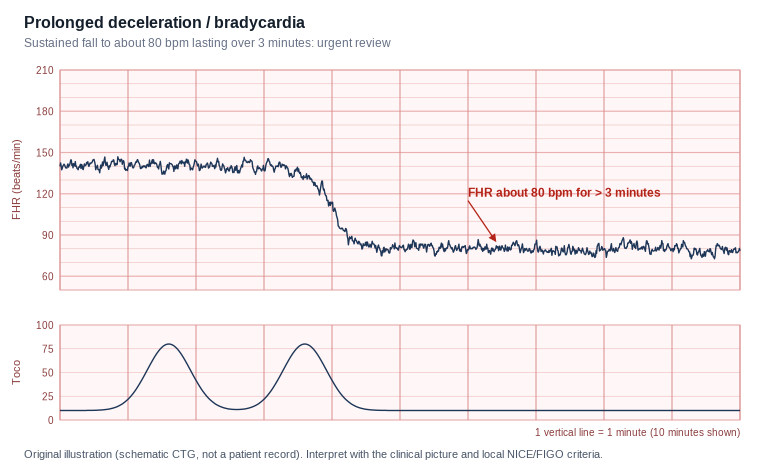
- An abnormal CTG (prolonged deceleration or bradycardia) is the most common first sign of uterine rupture
Differential diagnosis
| Condition | Clues | Key test |
|---|---|---|
| Elective repeat caesarean section | Woman prefers it, or VBAC contraindicated | Planned at 39+0 weeks after counselling |
| Uterine rupture in labour | Abnormal CTG, scar pain, bleeding, loss of station, maternal shock | Clinical diagnosis; immediate laparotomy |
| Scar dehiscence (incomplete separation) | Often asymptomatic; serosa intact | Found at repeat caesarean; ultrasound thinning of lower segment is not reliable alone |
| Placental abruption | Constant pain, tense uterus, bleeding, abnormal CTG | Clinical; coagulation screen; urgent birth |
| Placenta accreta spectrum in a scarred uterus | Low anterior placenta over the scar | Specialist ultrasound with or without MRI |
| Labour dystocia | Slow progress without signs of rupture | Partogram; careful senior review before oxytocin |
Exam pearls
Guideline
RCOG Green-top Guideline No. 45 Birth after previous caesarean birth (2015); NICE NG192 Caesarean birth (2021, updated 2024); ACOG Practice Bulletin No. 205 Vaginal birth after cesarean delivery (2019); SOGC Clinical Practice Guideline No. 382 Trial of labour after caesarean (2019)
References
- Royal College of Obstetricians and Gynaecologists. Birth after previous caesarean birth (Green-top Guideline No. 45). RCOG, London 2015.
- National Institute for Health and Care Excellence. Caesarean birth (NG192). NICE guideline NG192 2021.
- American College of Obstetricians and Gynecologists. Vaginal birth after cesarean delivery (Practice Bulletin No. 205). Obstet Gynecol 2019.
- Society of Obstetricians and Gynaecologists of Canada. Guideline No. 382: Trial of labour after caesarean. J Obstet Gynaecol Can 2019.
- Landon MB, Hauth JC, Leveno KJ, et al.. Maternal and perinatal outcomes associated with a trial of labor after prior cesarean delivery. N Engl J Med 2004.
- Fitzpatrick KE, Kurinczuk JJ, Alfirevic Z, Spark P, Brocklehurst P, Knight M.. Uterine rupture by intended mode of delivery in the UK: a national case-control study. PLoS Med 2012.
Related topics
By Dr Khalid Seidi (B.Sc., M.D.) · MedEd World Clinical Knowledge library. Original teaching content checked against current guidelines (November 2026); confirm the latest local guidance before clinical use. Not a substitute for clinical judgement.