Clinical Knowledge › Obstetrics and gynaecology › Labour and delivery
Shoulder dystocia
Shoulder dystocia is a vaginal cephalic birth that needs additional obstetric manoeuvres to deliver the body after gentle traction on the head has failed. It occurs in about 0.6–0.7% of vaginal births and happens when the anterior shoulder impacts behind the maternal symphysis pubis (or, less often, the posterior shoulder on the sacral promontory). Risk factors include fetal macrosomia, maternal diabetes and obesity, previous shoulder dystocia, induction or augmentation, a prolonged labour and operative vaginal birth, but most cases are unpredictable and occur in babies of normal weight. Warning signs are difficulty delivering the face and chin and the 'turtle sign', where the head retracts against the perineum. Management is a rehearsed sequence: call for help, stop pushing, avoid fundal pressure and downward traction, McRoberts' position with suprapubic pressure, then internal rotational manoeuvres, delivery of the posterior arm or the all-fours position, with third-line options only in extreme cases. Complications include postpartum haemorrhage and perineal trauma in the mother and brachial plexus injury, fractures, hypoxic-ischaemic encephalopathy and death in the baby. Multidisciplinary simulation training improves outcomes.
Patient case, mechanism, investigations, management, flashcards and exam-style questions.Open the lesson →
Key facts
- Definition (RCOG): vaginal cephalic birth requiring additional manoeuvres to deliver the fetus after the head has been born and gentle traction has failed
- Incidence about 0.6–0.7% of vaginal births; the anterior shoulder is impacted behind the symphysis pubis
- Most cases occur in babies of normal weight; estimated fetal weight and risk factors predict shoulder dystocia poorly
- Turtle sign: the delivered head retracts tightly against the perineum; difficulty delivering the face and chin is an early warning
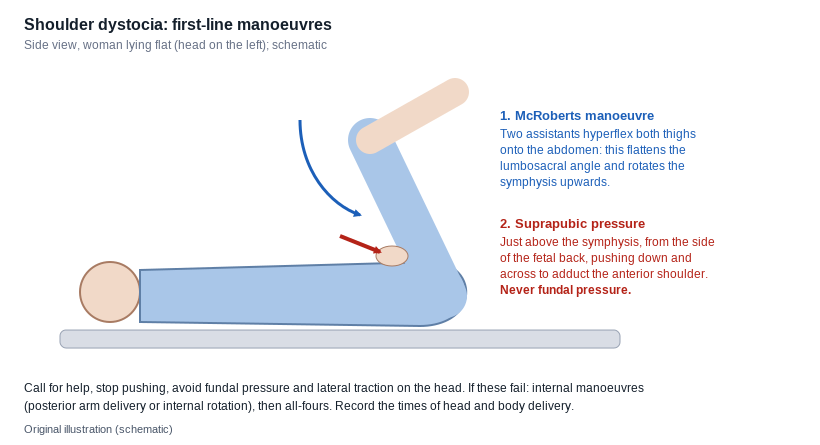
- First-line: call for help, McRoberts' position (hyperflexion and abduction of the hips) and suprapubic pressure; reported success of McRoberts alone varies widely (about 40% to as high as 90% in different series), and together with suprapubic pressure it resolves most cases
- Second-line: internal manoeuvres (Rubin II, Woods' screw, reverse Woods'), delivery of the posterior arm (highest success rate) or the all-fours (Gaskin) position
- Avoid fundal pressure, excessive or downward lateral traction and routine episiotomy (episiotomy only to make room for internal manoeuvres)
- Neonatal brachial plexus injury (most often Erb's palsy, C5–C6, 'waiter's tip') complicates about 2–16% of cases; most recover, fewer than 10% have permanent deficit
Differential diagnosis
| Condition | Clues | Key test |
|---|---|---|
| Short umbilical cord or tight nuchal cord | Head delivers but body is held back without bony impaction | Clamp and cut a tight nuchal cord only if it truly prevents birth; manoeuvres otherwise |
| Fetal anomaly (abdominal mass, conjoined twins, hydrops) | Body fails to deliver despite manoeuvres | Antenatal ultrasound; examination after birth |
| Bilateral shoulder dystocia | Both shoulders impacted above the inlet; very severe | Fails all manoeuvres; third-line measures |
| Delay in the second stage | Head not yet born; slow descent | Abdominal and vaginal examination; operative birth or caesarean |
| Normal restitution delay | Head born and shoulders deliver with the next contraction and gentle traction | No manoeuvres needed; not shoulder dystocia |
Exam pearls
Guideline
RCOG Green-top Guideline No. 42 Shoulder dystocia (2nd edition, 2012); ACOG Practice Bulletin No. 178 Shoulder dystocia (2017, reaffirmed); NICE NG235 Intrapartum care (2023)
References
- Royal College of Obstetricians and Gynaecologists. Shoulder dystocia (Green-top Guideline No. 42), 2nd edition. RCOG, London 2012.
- American College of Obstetricians and Gynecologists. Shoulder dystocia (Practice Bulletin No. 178). Obstet Gynecol 2017.
- National Institute for Health and Care Excellence. Intrapartum care (NG235). NICE guideline NG235 2023.
- Hoffman MK, Bailit JL, Branch DW, et al.. A comparison of obstetric maneuvers for the acute management of shoulder dystocia. Obstet Gynecol 2011.
- Draycott TJ, Crofts JF, Ash JP, et al.. Improving neonatal outcome through practical shoulder dystocia training. Obstet Gynecol 2008.
- Gardosi J, Ewington LJ, Booth K, et al.. Induction of labour versus standard care to prevent shoulder dystocia in fetuses suspected to be large for gestational age in the UK (the Big Baby trial): a multicentre, open-label, randomised controlled trial. Lancet 2025.
Related topics
By Dr Khalid Seidi (B.Sc., M.D.) · MedEd World Clinical Knowledge library. Original teaching content checked against current guidelines (November 2026); confirm the latest local guidance before clinical use. Not a substitute for clinical judgement.