Clinical Knowledge › Obstetrics and gynaecology › Labour and delivery
Failure to progress and obstructed labour
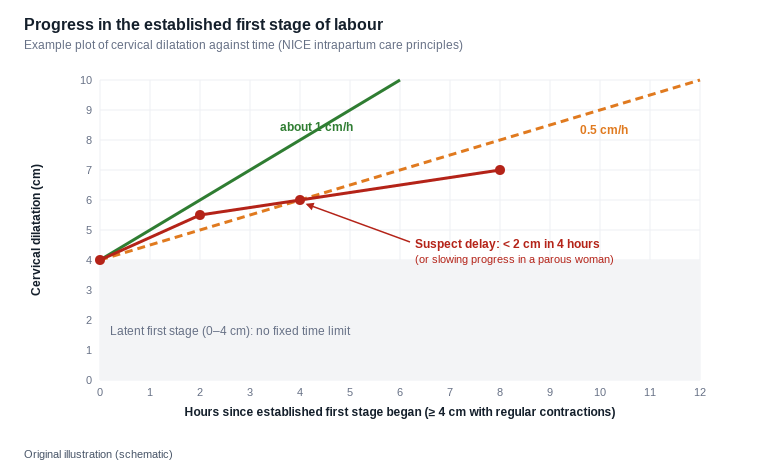
Failure to progress (labour dystocia) is slower progress than expected in the first or second stage and a leading reason for caesarean birth. Causes are grouped as the powers (inadequate contractions, the commonest cause in nulliparous women), the passenger (malposition, malpresentation, macrosomia) and the passage (cephalopelvic disproportion, pelvic masses). NICE suspects first-stage delay when dilatation is less than 2 cm in 4 hours and confirms it if progress is less than 1 cm 2 hours after amniotomy; oxytocin is then offered. Second-stage delay is diagnosed after 2 hours of active pushing in nulliparous and 1 hour in parous women. ACOG/SMFM, using contemporary labour curves, define the active phase from 6 cm and allow longer before diagnosing arrest. Obstructed labour, in contrast, is failure of descent despite good contractions because of a mechanical barrier; it causes uterine rupture, fistula and maternal death where care is delayed. Signs include a high head with severe moulding and caput, haematuria and a Bandl's ring; oxytocin is contraindicated and caesarean birth is urgent.
Patient case, mechanism, investigations, management, flashcards and exam-style questions.Open the lesson →
Key facts
- Suspected first-stage delay (NICE): less than 2 cm dilatation in 4 hours in established labour, or slowing progress in parous women; also consider descent and rotation
- Confirmed delay: less than 1 cm progress 2 hours after amniotomy → obstetric review, offer oxytocin with continuous CTG, offer epidural
- After starting oxytocin, re-examine at 4 hours: less than 2 cm progress → obstetric review for caesarean birth
- Second-stage delay: 2 hours of active pushing (nulliparous) or 1 hour (parous); birth expected within 3 and 2 hours respectively of starting active pushing
- ACOG/SMFM (2024): active phase from 6 cm; first-stage arrest = 6 cm or more with ruptured membranes and no change for 4 hours despite adequate contractions, or for 6 hours with inadequate contractions despite oxytocin
- Obstructed labour signs: head 3/5 or more palpable, moulding +3, caput, oedematous cervix, haematuria, Bandl's ring, maternal tachycardia, dehydration and fever
- Oxytocin is contraindicated in obstructed labour and used with great caution in multiparous women (risk of uterine rupture)
- Complications of obstructed labour: uterine rupture, PPH, sepsis, vesicovaginal or rectovaginal fistula, foot drop, fetal hypoxia and death
Differential diagnosis
| Condition | Clues | Key test |
|---|---|---|
| Latent first stage (false diagnosis of arrest) | Cervix below 4 cm (NICE) or 6 cm (ACOG) with slow change | Re-examination over time; avoid intervention |
| Inefficient uterine activity (hypotonic) | Fewer than 3 contractions in 10 minutes, weak on palpation, commonest in nulliparous women | Palpation or tocography; responds to amniotomy and oxytocin |
| Occipitoposterior malposition | Backache, early urge to push, deflexed head, slow descent | Vaginal examination of fontanelles; intrapartum ultrasound |
| Malpresentation (brow, face, shoulder) | High head, unusual landmarks on vaginal examination | Vaginal examination and ultrasound |
| Cephalopelvic disproportion | Good contractions but no descent, severe moulding and caput | Clinical assessment of fifths, moulding, caput |
| Uterine rupture | Contractions stop, constant pain, loss of station, abnormal CTG | Clinical; immediate laparotomy |
Exam pearls
Guideline
NICE NG235 Intrapartum care (2023); ACOG Clinical Practice Guideline No. 8 First and second stage labor management (2024); WHO recommendations: intrapartum care for a positive childbirth experience (2018) and WHO Labour Care Guide (2020)
References
- National Institute for Health and Care Excellence. Intrapartum care (NG235). NICE guideline NG235 2023.
- American College of Obstetricians and Gynecologists. First and second stage labor management: ACOG Clinical Practice Guideline No. 8. Obstet Gynecol 2024.
- World Health Organization. WHO recommendations: intrapartum care for a positive childbirth experience. World Health Organization, Geneva 2018.
- World Health Organization. WHO labour care guide: user's manual. World Health Organization, Geneva 2020.
- Zhang J, Landy HJ, Ware Branch D, et al.. Contemporary patterns of spontaneous labor with normal neonatal outcomes. Obstet Gynecol 2010.
- National Institute for Health and Care Excellence. Caesarean birth (NG192). NICE guideline NG192 2021.
Related topics
By Dr Khalid Seidi (B.Sc., M.D.) · MedEd World Clinical Knowledge library. Original teaching content checked against current guidelines (November 2026); confirm the latest local guidance before clinical use. Not a substitute for clinical judgement.