Clinical Knowledge › Internal medicine › Gastroenterology and hepatology › Diseases of the small intestine
Coeliac disease
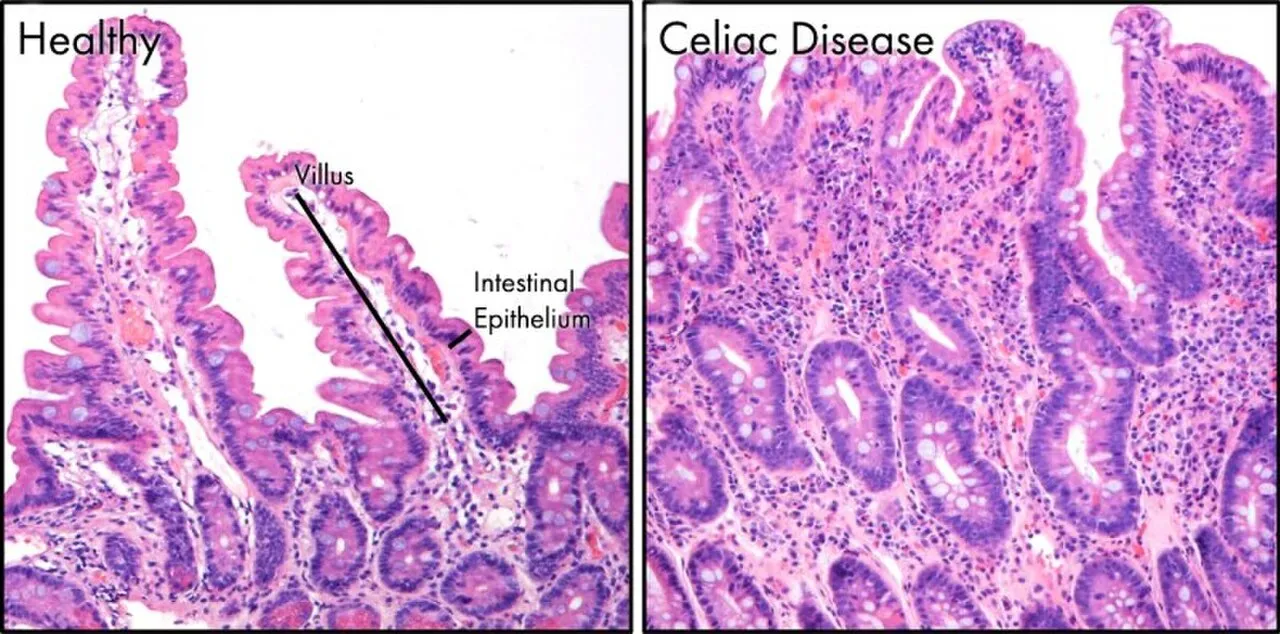
Coeliac disease is a lifelong immune-mediated enteropathy triggered by dietary gluten (from wheat, barley and rye) in people who carry HLA-DQ2 or HLA-DQ8. It affects about 1% of people in most regions, yet most cases remain undiagnosed. Tissue transglutaminase deamidates gliadin peptides, which then bind DQ2/DQ8 strongly and drive a T-cell response that flattens the duodenal villi and stimulates IgA anti-transglutaminase antibodies. Presentation ranges from diarrhoea and weight loss to iron deficiency anaemia, fatigue, osteoporosis, abnormal liver tests, dermatitis herpetiformis or no symptoms at all. Diagnosis starts with IgA tissue transglutaminase antibody and total IgA while the patient still eats gluten, followed by duodenal biopsy; in selected symptomatic adults with very high titres (at least 10 times the upper limit), recent European and British guidelines allow a no-biopsy diagnosis. Treatment is a lifelong strict gluten-free diet with specialist dietitian support, correction of deficiencies, bone health assessment and pneumococcal vaccination.
Patient case, mechanism, investigations, management, flashcards and exam-style questions.Open the lesson →
Key facts
- Prevalence about 1%; most people with coeliac disease are undiagnosed
- Almost all patients carry HLA-DQ2 or HLA-DQ8: a negative HLA test virtually excludes coeliac disease
- First-line test: IgA tissue transglutaminase antibody plus total IgA, while eating gluten
- Duodenal biopsy: at least four from D2 and one or two from the bulb; Marsh–Oberhuber grading
- No-biopsy pathway: symptomatic adults in secondary care with IgA-tTG at least 10 × ULN (BSG 2026, ESsCD 2025); children per ESPGHAN 2020
- Gluten challenge before testing if already gluten-free: about 3–6 g gluten daily for at least 6 weeks
- Treatment is a lifelong strict gluten-free diet; ongoing gluten exposure is the commonest cause of persistent symptoms
- Complications: osteoporosis, hyposplenism, refractory coeliac disease, enteropathy-associated T-cell lymphoma and small bowel adenocarcinoma
Differential diagnosis
| Condition | Clues | Key test |
|---|---|---|
| Irritable bowel syndrome | Bloating and altered bowel habit without anaemia or weight loss | Negative coeliac serology on a gluten-containing diet |
| Non-coeliac gluten or wheat sensitivity (or fructan intolerance) | Symptoms with wheat but normal serology and histology | Exclude coeliac disease first while still eating gluten |
| Tropical sprue | Residence in the tropics, folate deficiency, villous atrophy | Negative coeliac serology; response to folate and tetracycline |
| Giardiasis | Travel or untreated water, bloating, malabsorption | Stool antigen or PCR |
| Drug-induced enteropathy (olmesartan, mycophenolate, immune checkpoint inhibitors) | Villous atrophy with negative serology on a culprit drug | Drug history; improvement after withdrawal |
| Common variable immunodeficiency | Recurrent infections, low immunoglobulins, villous atrophy without plasma cells | Serum immunoglobulins; histology |
| Crohn disease | Abdominal pain, raised calprotectin and CRP, perianal disease | Ileocolonoscopy and MR enterography |
| Small intestinal bacterial overgrowth | Bloating, diarrhoea, risk factors such as surgery or dysmotility | Glucose breath test; normal serology |
Exam pearls
Guideline
BSG guidelines on adult coeliac disease (2026), ESsCD updated guidelines (2025), ACG guideline update (2023) and ESPGHAN paediatric diagnostic guideline (2020)
References
- Penny HA, Shiha MG, Raju SA, et al.. The 2026 British Society of Gastroenterology guidelines on the diagnosis and management of adult coeliac disease. Gut 2026.
- Al-Toma A, Zingone F, Branchi F, et al.. European Society for the Study of Coeliac Disease 2025 updated guidelines on the diagnosis and management of coeliac disease in adults. Part 1: diagnostic approach. United European Gastroenterol J 2025.
- Rubio-Tapia A, Hill ID, Semrad C, et al.. American College of Gastroenterology guidelines update: diagnosis and management of celiac disease. Am J Gastroenterol 2023.
- Husby S, Koletzko S, Korponay-Szabó I, et al.. European Society Paediatric Gastroenterology, Hepatology and Nutrition guidelines for diagnosing coeliac disease 2020. J Pediatr Gastroenterol Nutr 2020.
- Singh P, Arora A, Strand TA, et al.. Global prevalence of celiac disease: systematic review and meta-analysis. Clin Gastroenterol Hepatol 2018.
- Lebwohl B, Sanders DS, Green PHR.. Coeliac disease. Lancet 2018.
Related topics
By Dr Khalid Seidi (B.Sc., M.D.) · MedEd World Clinical Knowledge library. Original teaching content checked against current guidelines (November 2026); confirm the latest local guidance before clinical use. Not a substitute for clinical judgement.