Clinical Knowledge › Internal medicine › Gastroenterology and hepatology › Diseases of the small intestine
Malabsorption: approach to the patient
Malabsorption is the failure to digest or absorb nutrients normally, causing loss of fat, carbohydrate, protein, vitamins or minerals in the stool and, eventually, deficiency states. Causes fall into three groups: luminal (maldigestion from pancreatic insufficiency or bile acid deficiency and bacterial overgrowth), mucosal (coeliac disease, Crohn disease, Whipple disease, tropical sprue, giardiasis, drug enteropathy) and post-mucosal (lymphatic obstruction). Clues come from steatorrhoea, weight loss, bloating, specific deficiencies such as iron, folate, B12, vitamin D or K, and the history of surgery, alcohol, diabetes, travel or medicines. A practical work-up starts with blood tests for deficiencies and inflammation, coeliac serology and faecal elastase, then targets the site: duodenal biopsy for mucosal disease, pancreatic imaging, breath testing for overgrowth, SeHCAT or a bile acid sequestrant trial for bile acid diarrhoea, and small bowel imaging. Treatment aims at the cause together with nutritional repletion.
Patient case, mechanism, investigations, management, flashcards and exam-style questions.Open the lesson →
Key facts
- Malabsorption = maldigestion (luminal) + impaired mucosal absorption + post-mucosal (lymphatic) transport failure
- Steatorrhoea: pale, bulky, offensive, greasy stools that are hard to flush; faecal fat above 7 g/day on a 100 g fat diet
- Commonest causes in practice: coeliac disease, exocrine pancreatic insufficiency, bile acid diarrhoea, SIBO, Crohn disease and post-surgical states
- First-line tests: FBC, ferritin, folate, B12, albumin, calcium, magnesium, vitamin D, INR, CRP, coeliac serology (with total IgA) and faecal elastase
- Faecal elastase-1 below 200 µg/g suggests and below 100 µg/g strongly supports exocrine pancreatic insufficiency (watery stool can give false lows)
- SeHCAT 7-day retention below 15% indicates bile acid diarrhoea (below 10% moderate, below 5% severe)
- Pancreatic enzyme replacement: start about 40,000–50,000 lipase units with each meal and half with snacks, taken with food
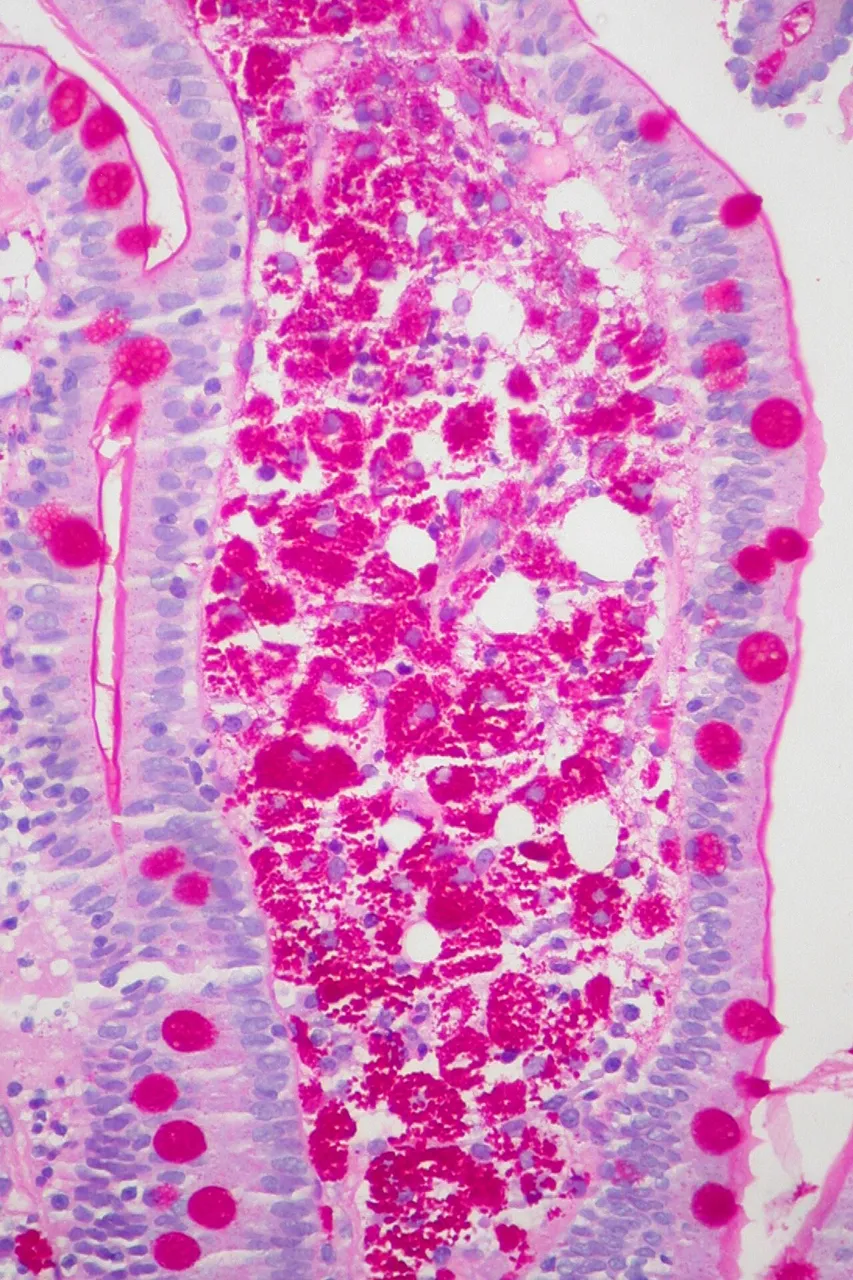
- Whipple disease: PAS-positive macrophages; treat with IV ceftriaxone then 12 months of co-trimoxazole
Differential diagnosis
| Condition | Clues | Key test |
|---|---|---|
| Coeliac disease | Iron and folate deficiency, bloating, autoimmune associations | IgA-tTG with total IgA; duodenal biopsy |
| Exocrine pancreatic insufficiency | Steatorrhoea, weight loss, alcohol, chronic pancreatitis, diabetes or pancreatic surgery | Faecal elastase-1; CT or MRI pancreas |
| Bile acid diarrhoea | Watery diarrhoea after ileal resection, cholecystectomy or in IBS-D picture | SeHCAT scan or serum C4; response to colestyramine |
| Small intestinal bacterial overgrowth | Bloating, diarrhoea, B12 deficiency with high folate; blind loops, dysmotility | Glucose or lactulose hydrogen breath test; duodenal aspirate |
| Crohn disease of the small bowel | Pain, weight loss, raised CRP and calprotectin, perianal disease | Ileocolonoscopy, MR enterography |
| Lactose intolerance | Bloating and diarrhoea after dairy; normal nutrition | Dietary exclusion or lactose hydrogen breath test |
| Giardiasis | Travel, untreated water, bloating, foul belching | Stool antigen or PCR |
| Hyperthyroidism or laxative misuse | Diarrhoea and weight loss without true malabsorption | Thyroid function; stool osmotic gap, laxative screen |
Exam pearls
Guideline
BSG guidelines for the investigation of chronic diarrhoea in adults (3rd edition, 2018), AGA clinical practice update on exocrine pancreatic insufficiency (2023), ACG guideline on small intestinal bacterial overgrowth (2020) and BSG adult coeliac disease guidelines (2026)
References
- Arasaradnam RP, Brown S, Forbes A, et al.. Guidelines for the investigation of chronic diarrhoea in adults: British Society of Gastroenterology, 3rd edition. Gut 2018.
- Whitcomb DC, Buchner AM, Forsmark CE.. AGA clinical practice update on the epidemiology, evaluation, and management of exocrine pancreatic insufficiency: expert review. Gastroenterology 2023.
- Pimentel M, Saad RJ, Long MD, Rao SSC.. ACG clinical guideline: small intestinal bacterial overgrowth. Am J Gastroenterol 2020.
- Penny HA, Shiha MG, Raju SA, et al.. The 2026 British Society of Gastroenterology guidelines on the diagnosis and management of adult coeliac disease. Gut 2026.
- Löhr JM, Dominguez-Munoz E, Rosendahl J, et al.. United European Gastroenterology evidence-based guidelines for the diagnosis and therapy of chronic pancreatitis (HaPanEU). United European Gastroenterol J 2017.
- Fenollar F, Puéchal X, Raoult D.. Whipple's disease. N Engl J Med 2007.
Related topics
By Dr Khalid Seidi (B.Sc., M.D.) · MedEd World Clinical Knowledge library. Original teaching content checked against current guidelines (November 2026); confirm the latest local guidance before clinical use. Not a substitute for clinical judgement.