Clinical Knowledge › Internal medicine › Gastroenterology and hepatology › Diseases of the small intestine
Whipple disease
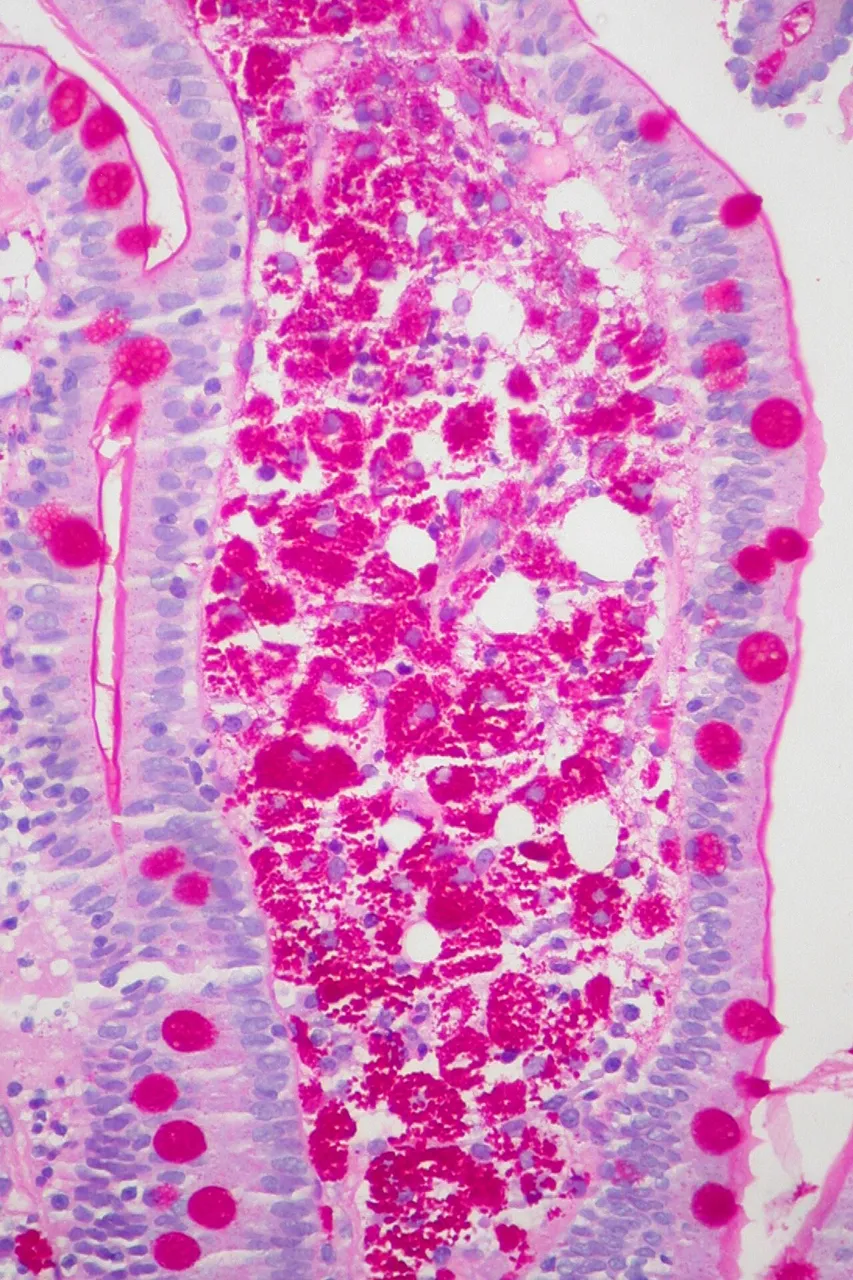
Whipple disease is a rare, chronic, multisystem infection caused by Tropheryma whipplei, a Gram-positive actinomycete found widely in soil and sewage. Most people exposed clear it or carry it harmlessly; classic disease develops in a small number with a subtle defect in macrophage killing, typically middle-aged white men. Seronegative migratory arthralgia or arthritis often precedes the gastrointestinal phase by years; diarrhoea, steatorrhoea, weight loss, abdominal pain, fever, lymphadenopathy and skin pigmentation follow. The bacterium can also infect the heart (culture-negative endocarditis), eyes and brain, where cognitive change, supranuclear gaze palsy and oculomasticatory myorhythmia occur. Diagnosis rests on duodenal biopsy showing foamy macrophages full of PAS-positive, diastase-resistant material, confirmed by T. whipplei PCR or immunohistochemistry; CSF PCR is checked in all patients. Treatment is IV ceftriaxone for 2 weeks followed by oral co-trimoxazole for 12 months (or doxycycline with hydroxychloroquine); untreated disease is fatal.
Patient case, mechanism, investigations, management, flashcards and exam-style questions.Open the lesson →
Key facts
- Cause: Tropheryma whipplei, Gram-positive actinomycete; ubiquitous in the environment, with asymptomatic carriage common
- Classic patient: middle-aged white man (often outdoor or farm work) with arthralgia, diarrhoea, weight loss and lymphadenopathy
- Arthralgia or seronegative arthritis of large joints precedes gut symptoms by a median of about 6 years
- Duodenal biopsy: lamina propria packed with foamy macrophages containing PAS-positive, diastase-resistant inclusions; Ziehl–Neelsen negative
- Confirm with T. whipplei PCR or immunohistochemistry; test CSF by PCR in every patient because CNS infection may be silent
- Oculomasticatory myorhythmia (rhythmic eye convergence with jaw contraction) is virtually pathognomonic of CNS Whipple disease
- Treatment: ceftriaxone 2 g IV daily for 14 days, then co-trimoxazole 960 mg twice daily for 12 months (teaching doses; check local formulary)
- Immunosuppression (steroids, TNF inhibitors) given for presumed inflammatory arthritis can unmask or accelerate the disease
Differential diagnosis
| Condition | Clues | Key test |
|---|---|---|
| Coeliac disease | Villous atrophy and malabsorption without arthritis or PAS macrophages | IgA-tTG; duodenal histology |
| Mycobacterium avium complex enteritis | Advanced HIV, low CD4; foamy macrophages | Ziehl–Neelsen positive; mycobacterial culture |
| Seronegative spondyloarthritis or rheumatoid arthritis | Inflammatory arthritis, no diarrhoea initially | Response to therapy; T. whipplei PCR if atypical or worsening on immunosuppression |
| Intestinal lymphoma | Weight loss, lymphadenopathy, fever | Biopsy with immunohistochemistry; CT |
| Sarcoidosis | Lymphadenopathy, arthritis, uveitis | Non-caseating granulomas; ACE |
| Tuberculosis | Fever, weight loss, lymphadenopathy, ileocaecal disease | Caseating granulomas, AFB, culture and PCR |
| Culture-negative endocarditis of other cause (Bartonella, Coxiella) | Valve vegetations with negative blood cultures | Serology; valve PCR |
| Progressive supranuclear palsy or dementia | Vertical gaze palsy and cognitive decline | CSF T. whipplei PCR; MRI |
Exam pearls
Guideline
No formal society guideline; expert recommendations (Clin Microbiol Rev 2017; Lancet Infect Dis 2016) based on randomised trials of ceftriaxone or meropenem induction followed by co-trimoxazole (2010, 2013) and the doxycycline–hydroxychloroquine regimen (2014), with BSG chronic diarrhoea guideline (2018) for work-up
References
- Fenollar F, Puéchal X, Raoult D.. Whipple's disease. N Engl J Med 2007.
- Marth T, Moos V, Müller C, Biagi F, Schneider T.. Tropheryma whipplei infection and Whipple's disease. Lancet Infect Dis 2016.
- Dolmans RAV, Boel CHE, Lacle MM, Kusters JG.. Clinical manifestations, treatment, and diagnosis of Tropheryma whipplei infections. Clin Microbiol Rev 2017.
- Feurle GE, Junga NS, Marth T.. Efficacy of ceftriaxone or meropenem as initial therapies in Whipple's disease. Gastroenterology 2010.
- Feurle GE, Moos V, Bläker H, et al.. Intravenous ceftriaxone, followed by 12 or three months of oral treatment with trimethoprim-sulfamethoxazole in Whipple's disease. J Infect 2013.
- Lagier JC, Fenollar F, Lepidi H, et al.. Treatment of classic Whipple's disease: from in vitro results to clinical outcome. J Antimicrob Chemother 2014.
Related topics
By Dr Khalid Seidi (B.Sc., M.D.) · MedEd World Clinical Knowledge library. Original teaching content checked against current guidelines (November 2026); confirm the latest local guidance before clinical use. Not a substitute for clinical judgement.