Clinical Knowledge › Internal medicine › Gastroenterology and hepatology › Diseases of the small intestine
Small bowel obstruction
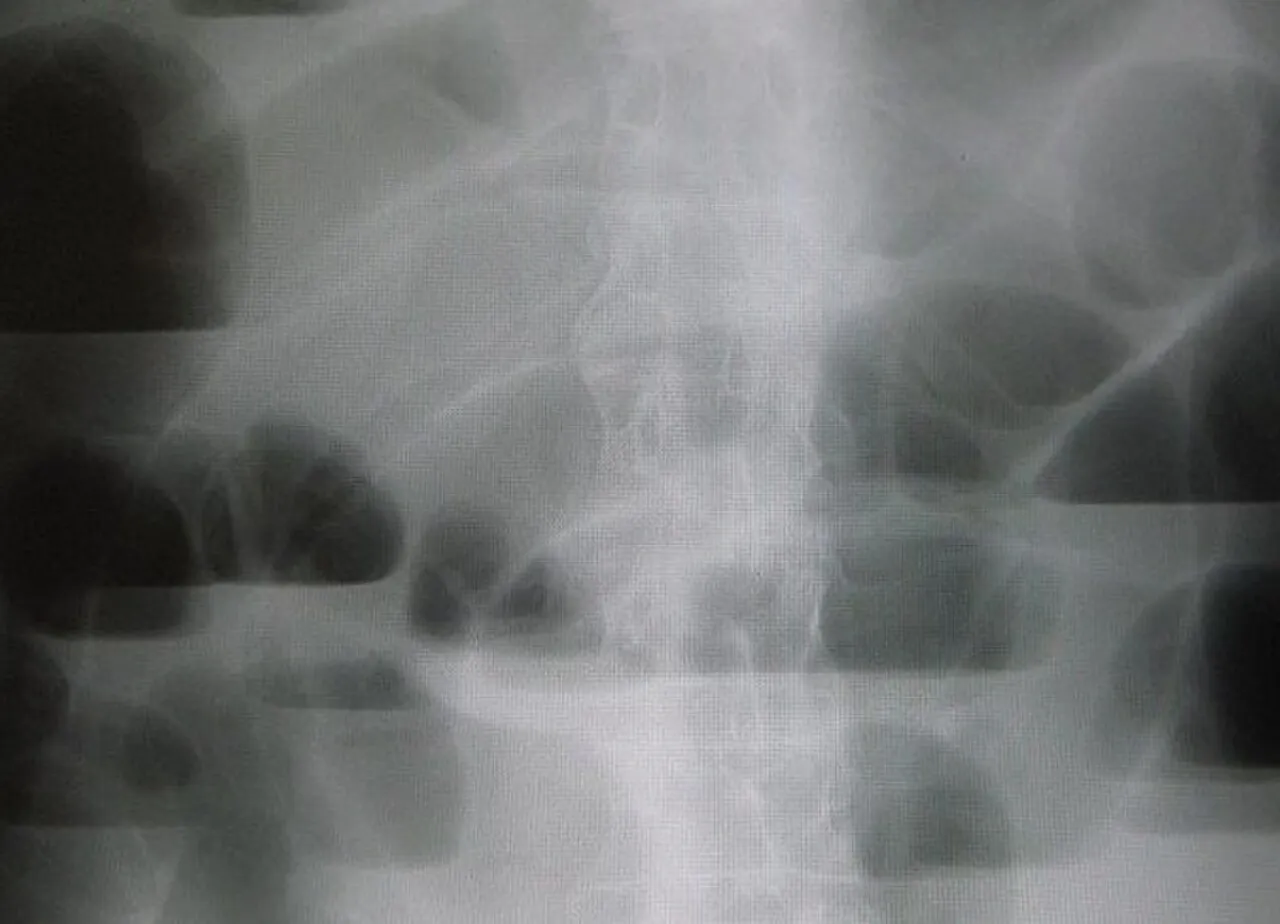
Small bowel obstruction (SBO) is a mechanical blockage of the small intestine that stops the onward passage of gas and contents. Adhesions from previous surgery cause most cases in high-income countries, while external hernias dominate where elective hernia repair is less available; other causes include malignancy, Crohn strictures, gallstone ileus, intussusception, volvulus and bezoars. Patients present with colicky central pain, early bilious vomiting, distension and, later, absolute constipation. The key danger is strangulation – compromised blood supply leading to ischaemia and perforation – suggested by constant pain, fever, tachycardia, peritonism, raised lactate and specific CT signs. Plain films show dilated central loops with valvulae conniventes and air–fluid levels, but CT with intravenous contrast is the investigation of choice. Uncomplicated adhesive SBO is managed non-operatively with fasting, intravenous fluids, nasogastric decompression, electrolyte correction and a water-soluble contrast challenge; surgery is needed for strangulation, closed-loop obstruction, irreducible hernia or failure to resolve within about 72 hours.
Patient case, mechanism, investigations, management, flashcards and exam-style questions.Open the lesson →
Key facts
- Commonest causes: adhesions (about 60–75% in high-income settings), hernias (leading cause in many low-income settings and in a 'virgin abdomen'), tumours, Crohn strictures
- Cardinal features: colicky central abdominal pain, vomiting (early and bilious in proximal SBO), distension, constipation and failure to pass flatus
- Strangulation warning signs: constant pain, fever, tachycardia, peritonism, leucocytosis, raised lactate (insensitive); never rely on a single marker
- '3-6-9 rule': small bowel above 3 cm, colon above 6 cm and caecum above 9 cm are dilated
- CT with IV contrast is the investigation of choice: confirms obstruction, finds the transition point and cause, and detects closed loop or ischaemia
- Initial care: nil by mouth, IV crystalloid, nasogastric decompression, analgesia, correct potassium, urinary catheter and fluid balance, VTE prophylaxis
- Water-soluble contrast (e.g. 100 mL diatrizoate via NG tube): contrast in the colon on X-ray within 24 hours predicts resolution and reduces need for surgery
- Operate urgently for strangulation, peritonitis, closed-loop obstruction or irreducible hernia; consider surgery if no resolution after about 72 hours of non-operative care
Differential diagnosis
| Condition | Clues | Key test |
|---|---|---|
| Paralytic (adynamic) ileus | Postoperative or electrolyte or drug-related; absent bowel sounds, no transition point | CT: diffuse dilatation of small bowel and colon without transition |
| Large bowel obstruction | Gradual distension, later vomiting, change in bowel habit, older patient | CT: dilated colon to a transition point |
| Acute mesenteric ischaemia | Pain out of proportion to signs, atrial fibrillation | CT angiography; lactate |
| Gastric outlet obstruction | Non-bilious vomiting of old food, succussion splash | CT; endoscopy |
| Colonic pseudo-obstruction | Massive colonic dilatation in a frail inpatient | CT without mechanical obstruction |
| Acute pancreatitis | Epigastric pain to the back, sentinel loop | Serum lipase; CT |
| Gastroenteritis | Diarrhoea with vomiting, no distension | Clinical; stool tests |
| Diabetic ketoacidosis or hypokalaemia causing ileus | Metabolic disturbance, vomiting | Glucose, ketones, potassium |
Exam pearls
Guideline
WSES Bologna guidelines for adhesive small bowel obstruction (2017 update, published 2018) and ACR Appropriateness Criteria for suspected small-bowel obstruction (2020)
References
- ten Broek RPG, Krielen P, Di Saverio S, et al.. Bologna guidelines for diagnosis and management of adhesive small bowel obstruction (ASBO): 2017 update of the evidence-based guidelines from the World Society of Emergency Surgery ASBO working group. World J Emerg Surg 2018.
- Chang KJ, Marin D, Kim DH, et al.. ACR Appropriateness Criteria: suspected small-bowel obstruction. J Am Coll Radiol 2020.
- Branco BC, Barmparas G, Schnüriger B, et al.. Systematic review and meta-analysis of the diagnostic and therapeutic role of water-soluble contrast agent in adhesive small bowel obstruction. Br J Surg 2010.
- Ceresoli M, Coccolini F, Catena F, et al.. Water-soluble contrast agent in adhesive small bowel obstruction: a systematic review and meta-analysis of diagnostic and therapeutic value. Am J Surg 2016.
- ten Broek RPG, Issa Y, van Santbrink EJ, et al.. Burden of adhesions in abdominal and pelvic surgery: systematic review and meta-analysis. BMJ 2013.
- Behman R, Nathens AB, Mason S, et al.. Association of surgical intervention for adhesive small-bowel obstruction with the risk of recurrence. JAMA Surg 2019.
Related topics
By Dr Khalid Seidi (B.Sc., M.D.) · MedEd World Clinical Knowledge library. Original teaching content checked against current guidelines (November 2026); confirm the latest local guidance before clinical use. Not a substitute for clinical judgement.