Clinical Knowledge › Internal medicine › Gastroenterology and hepatology › Diseases of the small intestine
Lactose intolerance
Lactose intolerance is the development of abdominal symptoms after eating lactose in a person with lactose malabsorption, which is caused by deficiency of the brush-border enzyme lactase in the small intestine. The commonest form is primary adult-type hypolactasia (lactase non-persistence), a genetically programmed fall in lactase after weaning that affects about two-thirds of the world's adults, with the highest rates in East Asia, West Africa and the Middle East. Secondary lactase deficiency follows mucosal injury such as gastroenteritis, coeliac disease, Crohn disease, giardiasis or chemotherapy and recovers when the mucosa heals; congenital lactase deficiency is very rare. Undigested lactose draws water into the bowel and is fermented by colonic bacteria to gas and short-chain fatty acids, causing bloating, cramps, flatulence and osmotic diarrhoea within a few hours of dairy. Diagnosis is clinical, supported by a dietary exclusion and rechallenge or a hydrogen breath test; secondary causes such as coeliac disease should be considered. Management is dietary: most people tolerate about 12 g of lactose (a cup of milk) at a time, so restriction rather than elimination is advised, with lactose-free products, lactase supplements and attention to calcium and vitamin D.
Patient case, mechanism, investigations, management, flashcards and exam-style questions.Open the lesson →
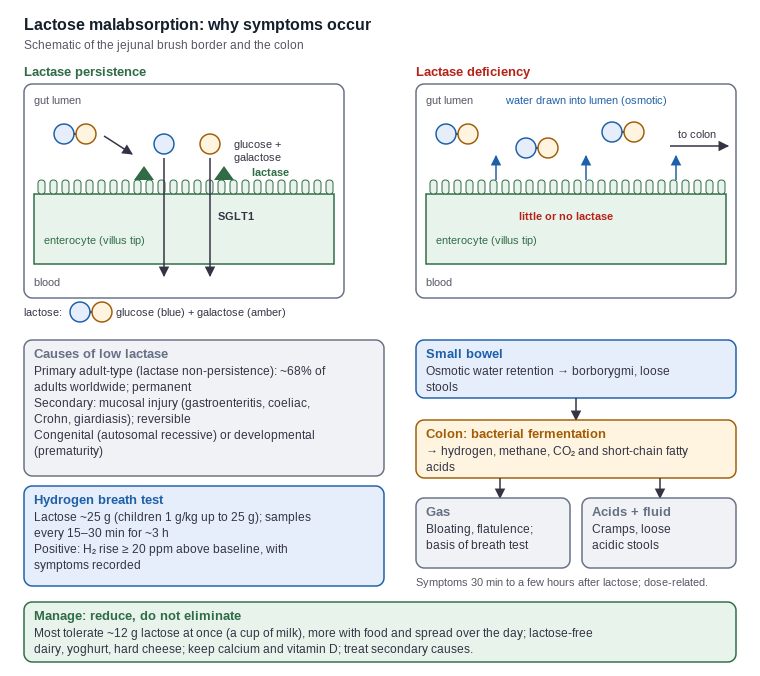
Key facts
- Lactose malabsorption is due to low lactase activity; lactose intolerance means symptoms are also present
- Primary adult-type hypolactasia (lactase non-persistence) is the commonest cause and affects about two-thirds of adults worldwide
- Lactase persistence in Europeans is linked to the LCT -13910C>T variant in an MCM6 enhancer; other variants confer persistence in Africa and the Middle East
- Secondary lactase deficiency follows mucosal injury (gastroenteritis, coeliac disease, Crohn disease, giardiasis, chemotherapy) and is reversible
- Symptoms (bloating, cramps, flatulence, osmotic diarrhoea) start 30 minutes to a few hours after lactose and are dose-related
- Hydrogen breath test: rise of 20 ppm or more above baseline after a standard lactose load (about 25 g in adults), with symptoms during the test
- Most people with lactase deficiency tolerate about 12 g lactose (one cup of milk) at a time, more when spread through the day and taken with food
- Treat by reducing, not eliminating, lactose; maintain calcium and vitamin D intake
Differential diagnosis
| Condition | Clues | Key test |
|---|---|---|
| Irritable bowel syndrome | Bloating and altered bowel habit not consistently linked to dairy | Rome criteria; symptoms persist on lactose-free diet |
| Coeliac disease | Diarrhoea, iron deficiency, weight loss; may cause secondary lactase deficiency | tTG-IgA with total IgA; duodenal biopsy |
| Cow's milk protein allergy | Infant with vomiting, rash, eczema or blood in stool; immune-mediated | Clinical response to exclusion; specific IgE or skin prick test for IgE type |
| Small intestinal bacterial overgrowth | Bloating and diarrhoea with many carbohydrates; early hydrogen rise | Glucose or lactulose breath test |
| Giardiasis | Travel or water exposure; greasy diarrhoea | Stool antigen or PCR |
| Inflammatory bowel disease | Bloody diarrhoea, nocturnal symptoms, raised inflammatory markers | Faecal calprotectin; colonoscopy |
| Fructose or sorbitol malabsorption | Symptoms after fruit, juices or sugar-free sweets | Dietary history; fructose breath test |
Exam pearls
Guideline
European guideline on hydrogen and methane breath tests (UEG, ESNM and ESPGHAN, 2022), North American consensus on breath testing (2017), NIH Consensus Development Conference on lactose intolerance and health (2010) and AAP clinical report on lactose intolerance in infants, children and adolescents (2006)
References
- Hammer HF, Fox MR, Keller J, et al.. European guideline on indications, performance, and clinical impact of hydrogen and methane breath tests in adult and pediatric patients. United European Gastroenterol J 2022.
- Rezaie A, Buresi M, Lembo A, et al.. Hydrogen and Methane-Based Breath Testing in Gastrointestinal Disorders: The North American Consensus. Am J Gastroenterol 2017.
- Suchy FJ, Brannon PM, Carpenter TO, et al.. National Institutes of Health Consensus Development Conference: lactose intolerance and health. Ann Intern Med 2010.
- Heyman MB.. Lactose intolerance in infants, children, and adolescents. Pediatrics 2006.
- Misselwitz B, Butter M, Verbeke K, Fox MR.. Update on lactose malabsorption and intolerance: pathogenesis, diagnosis and clinical management. Gut 2019.
- Storhaug CL, Fosse SK, Fadnes LT.. Country, regional, and global estimates for lactose malabsorption in adults: a systematic review and meta-analysis. Lancet Gastroenterol Hepatol 2017.
Related topics
By Dr Khalid Seidi (B.Sc., M.D.) · MedEd World Clinical Knowledge library. Original teaching content checked against current guidelines (November 2026); confirm the latest local guidance before clinical use. Not a substitute for clinical judgement.