Clinical Knowledge › Internal medicine › Gastroenterology and hepatology › Diseases of the small intestine
Meckel diverticulum
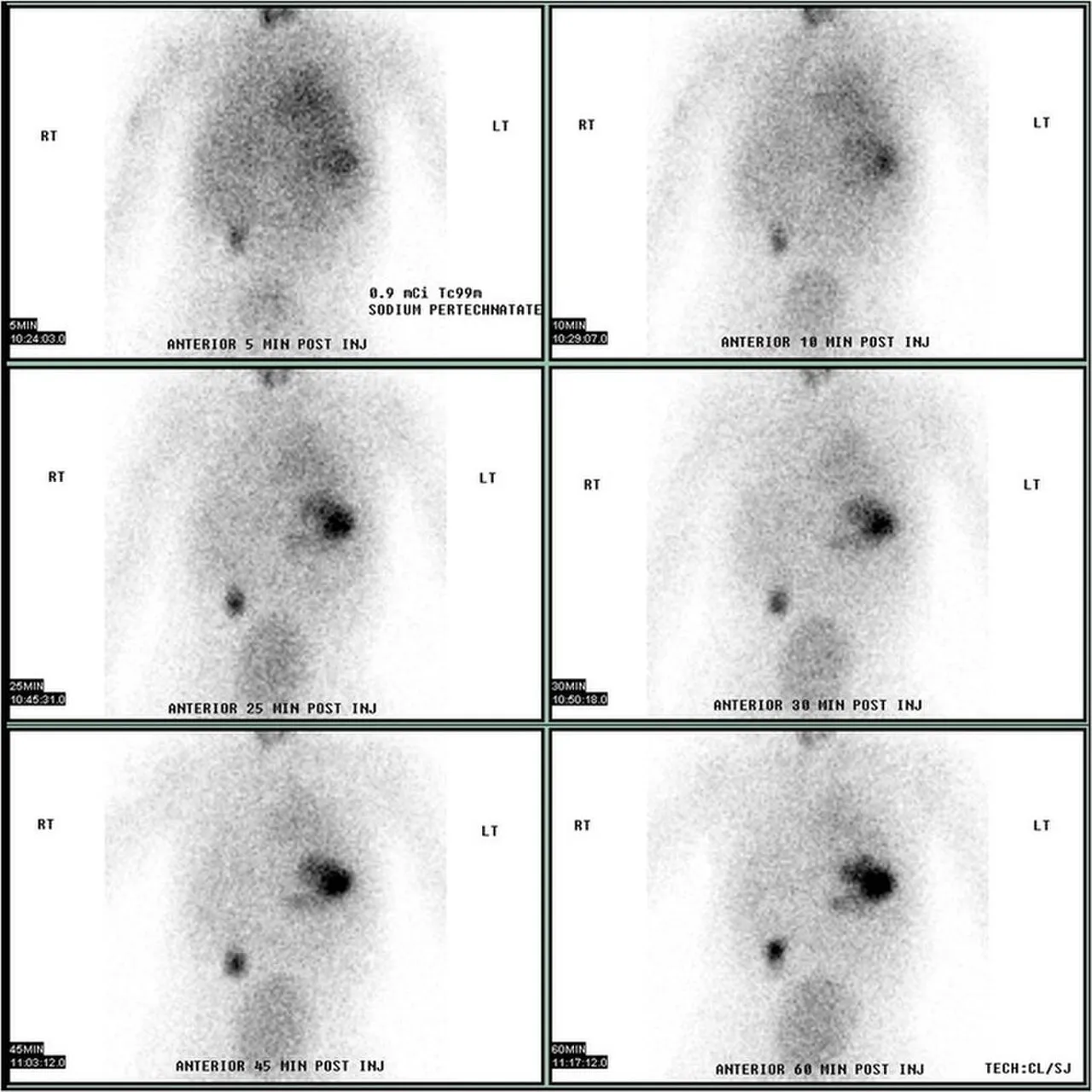
Meckel diverticulum is the most common congenital anomaly of the gastrointestinal tract. It is a true diverticulum on the antimesenteric border of the distal ileum, left behind when the vitellointestinal (omphalomesenteric) duct fails to obliterate in early fetal life. About 2% of people have one, but the lifetime risk of complications is only about 4%. Symptomatic cases are usually young and male. Ectopic tissue, most often gastric and sometimes pancreatic, explains the classic presentation in toddlers: painless, large-volume, maroon or brick-red rectal bleeding from acid ulceration of the adjacent ileum. Other complications are obstruction (intussusception, volvulus around a fibrous band, Littre hernia), diverticulitis that mimics appendicitis, perforation and, rarely, tumours such as neuroendocrine tumours. Technetium-99m pertechnetate scintigraphy (the Meckel scan) detects ectopic gastric mucosa and is the key test in children. Symptomatic diverticula are resected, usually laparoscopically. Removing an incidental diverticulum is debated and depends on risk factors.
Patient case, mechanism, investigations, management, flashcards and exam-style questions.Open the lesson →
Key facts
- Most common congenital GI anomaly: a true diverticulum (all bowel wall layers) on the antimesenteric border of the ileum, a remnant of the vitellointestinal duct
- 'Rule of twos': about 2% of people, about 2 feet (60 cm) from the ileocaecal valve, about 2 inches long, 2 types of common ectopic tissue (gastric, pancreatic), often presents before age 2; male predominance
- Lifetime complication risk about 4%; risk is higher in males, people under about 40–50 years and diverticula longer than 2 cm or containing palpable ectopic tissue
- Classic paediatric presentation: painless, large-volume maroon or brick-red rectal bleeding from acid-induced ulceration of adjacent ileal mucosa
- Obstruction is the commonest complication overall: intussusception (diverticulum as lead point), volvulus around a mesodiverticular or vitelline band, Littre hernia
- Diverticulitis mimics appendicitis; if the appendix is normal at surgery, inspect the distal ileum
- Technetium-99m pertechnetate scan detects ectopic gastric mucosa (sensitivity about 85–90% in children, lower in adults); H2-receptor antagonist premedication can improve it
- Treatment of symptomatic disease is surgical resection: diverticulectomy or segmental ileal resection when the base is broad or the bleeding ulcer lies in adjacent ileum
Differential diagnosis
| Condition | Clues | Key test |
|---|---|---|
| Juvenile polyp | Painless bright red bleeding in a child aged 2–10, small volume | Colonoscopy with polypectomy |
| Intussusception (idiopathic) | Infant 6–36 months, colicky pain, drawing up legs, redcurrant-jelly stool, sausage-shaped mass | Ultrasound (target sign); air or contrast enema reduction |
| Anal fissure | Small streaks of bright red blood with painful defecation, constipation | Perianal inspection |
| Acute appendicitis | Periumbilical pain migrating to right iliac fossa, fever | Clinical scoring, ultrasound or CT; normal appendix prompts search for Meckel |
| Infectious colitis | Bloody diarrhoea, fever, contacts | Stool culture or multiplex PCR |
| Small-bowel angiodysplasia or Dieulafoy lesion | Older adult with obscure bleeding | Capsule endoscopy, CT angiography, enteroscopy |
| Inflammatory bowel disease | Chronic diarrhoea, weight loss, raised calprotectin | Ileocolonoscopy and biopsy |
| Intestinal duplication cyst | Can also contain gastric mucosa and bleed or obstruct | Ultrasound or MRI; surgical histology |
Exam pearls
Guideline
No disease-specific guideline; recommendations draw on the ACG small bowel bleeding guideline (2015), ESGE small-bowel capsule endoscopy and device-assisted enteroscopy guideline (2022 update), ACG acute lower GI bleeding guideline (2023) and systematic reviews of Meckel diverticulum (2006, 2018)
References
- Hansen CC, Søreide K.. Systematic review of epidemiology, presentation, and management of Meckel's diverticulum in the 21st century. Medicine (Baltimore) 2018.
- Sagar J, Kumar V, Shah DK.. Meckel's diverticulum: a systematic review. J R Soc Med 2006.
- Gerson LB, Fidler JL, Cave DR, Leighton JA.. ACG Clinical Guideline: Diagnosis and Management of Small Bowel Bleeding. Am J Gastroenterol 2015.
- Pennazio M, Rondonotti E, Despott EJ, et al.. Small-bowel capsule endoscopy and device-assisted enteroscopy for diagnosis and treatment of small-bowel disorders: European Society of Gastrointestinal Endoscopy (ESGE) Guideline - Update 2022. Endoscopy 2023.
- Sengupta N, Feuerstein JD, Jairath V, Shergill AK, Strate LL, Wong RJ, Wan D.. Management of Patients With Acute Lower Gastrointestinal Bleeding: An Updated ACG Guideline. Am J Gastroenterol 2023.
- Lequet J, Menahem B, Alves A, Fohlen A, Mulliri A.. Meckel's diverticulum in the adult. J Visc Surg 2017.
Related topics
By Dr Khalid Seidi (B.Sc., M.D.) · MedEd World Clinical Knowledge library. Original teaching content checked against current guidelines (November 2026); confirm the latest local guidance before clinical use. Not a substitute for clinical judgement.