Clinical Knowledge › Surgery › Paediatric surgery
Congenital diaphragmatic hernia
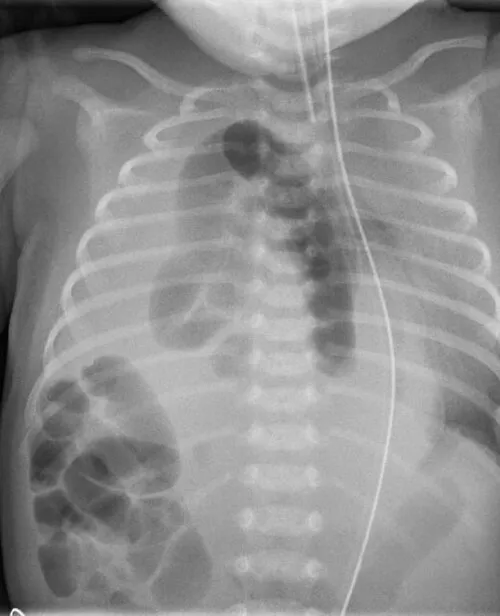
Congenital diaphragmatic hernia (CDH) is a developmental defect of the diaphragm, usually posterolateral (Bochdalek) and left-sided, through which abdominal organs enter the chest during fetal life. It affects about 1 in 3000 births. The real problem is not the hole but the lungs: compression and abnormal development cause pulmonary hypoplasia and pulmonary hypertension, often with left ventricular dysfunction. Most are found at the mid-trimester scan; lung-to-head ratio and liver position predict survival, and fetoscopic tracheal occlusion helps severe left CDH. At birth the baby has respiratory distress, a scaphoid abdomen, displaced heart sounds and reduced breath sounds. Management is intubation at birth without bag-mask ventilation, gastric decompression, gentle ventilation with permissive hypercapnia and preductal saturation targets, and treatment of pulmonary hypertension, with ECMO for refractory cases. Surgical repair is delayed until the baby is physiologically stable. Survival is about 70–80% in expert centres, with long-term lung, feeding and developmental problems.
Patient case, mechanism, investigations, management, flashcards and exam-style questions.Open the lesson →
Key facts
- About 1 in 3000 births; about 80–85% left-sided posterolateral (Bochdalek); Morgagni hernias are anterior and usually present later
- Mortality and morbidity are driven by pulmonary hypoplasia and pulmonary hypertension, not the diaphragmatic defect itself
- Antenatal severity: observed-to-expected lung-to-head ratio (O/E LHR) and liver herniation; O/E LHR below 25% = severe
- TOTAL trial (2021): FETO at 27–29 weeks raised survival in severe left CDH from 15% to 40%, at the cost of more preterm rupture of membranes
- Birth: intubate immediately, avoid bag-mask ventilation, place a large-bore gastric tube on suction
- Gentle ventilation: preductal SpO2 80–95%, postductal >70%, PaCO2 50–70 mmHg (permissive hypercapnia), conventional ventilation first
- Surgery is NOT an emergency: repair after cardiorespiratory stabilisation, primarily or with a patch
- Long term: chronic lung disease, pulmonary hypertension, reflux, poor growth, hernia recurrence (especially with patch), scoliosis, neurodevelopmental delay
Differential diagnosis
| Condition | Clues | Key test |
|---|---|---|
| Congenital pulmonary airway malformation (CPAM) | Cystic lung lesion; abdomen not scaphoid | Normal diaphragm and stomach position on imaging; CT |
| Bronchopulmonary sequestration | Solid lesion with systemic arterial supply | Doppler or CT angiography |
| Diaphragmatic eventration | Thin, elevated but intact diaphragm | Ultrasound or fluoroscopy showing paradoxical or reduced movement |
| Tension pneumothorax | Sudden deterioration, hyperlucent hemithorax | Chest X-ray: no bowel loops; transillumination |
| Respiratory distress syndrome | Preterm, ground-glass lungs | Bilateral ground-glass X-ray; gastric tube below diaphragm |
| Cyanotic congenital heart disease | Cyanosis with little respiratory distress | Echocardiogram; hyperoxia test |
| Oesophageal atresia | Respiratory distress with frothy saliva | Tube coils in upper pouch; normal diaphragm |
Exam pearls
Guideline
CDH EURO Consortium consensus 2015 update (published 2016) and Canadian CDH Collaborative clinical practice guideline (2018), with TOTAL fetal surgery trials (2021)
References
- Snoek KG, Reiss IK, Greenough A, Capolupo I, et al.. Standardized postnatal management of infants with congenital diaphragmatic hernia in Europe: the CDH EURO Consortium consensus - 2015 update. Neonatology 2016.
- Puligandla PS, Skarsgard ED, Offringa M, et al.. Diagnosis and management of congenital diaphragmatic hernia: a clinical practice guideline. CMAJ 2018.
- Deprest JA, Nicolaides KH, Benachi A, Gratacos E, et al.. Randomized trial of fetal surgery for severe left diaphragmatic hernia. N Engl J Med 2021.
- Deprest JA, Benachi A, Gratacos E, Nicolaides KH, et al.. Randomized trial of fetal surgery for moderate left diaphragmatic hernia. N Engl J Med 2021.
- Pertierra Cortada A, Carrasco Carrasco C.. Congenital diaphragmatic hernia requiring ECMO: current evidence, controversies, and unresolved questions. Children (Basel) 2026.
- Holcomb GW III, Murphy JP, St Peter SD, eds.. Holcomb and Ashcraft's Pediatric Surgery. 2020.
Related topics
By Dr Khalid Seidi (B.Sc., M.D.) · MedEd World Clinical Knowledge library. Original teaching content checked against current guidelines (November 2026); confirm the latest local guidance before clinical use. Not a substitute for clinical judgement.