Clinical Knowledge › Surgery › Paediatric surgery
Pyloric stenosis
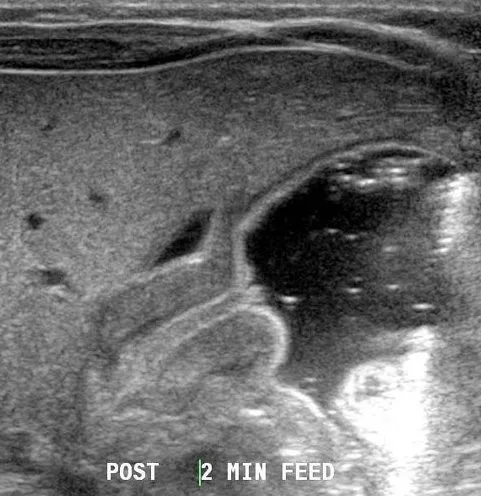
Infantile hypertrophic pyloric stenosis is progressive thickening of the circular muscle of the pylorus that obstructs gastric emptying in the first weeks of life. It affects about 2 per 1000 infants, mostly first-born boys aged 2–8 weeks, with family history and early macrolide exposure as risk factors. The classic picture is forceful, projectile, non-bilious vomiting after feeds in a hungry baby, with weight loss and dehydration; a firm 'olive' may be felt in the right upper quadrant during a test feed. Loss of gastric acid causes hypochloraemic, hypokalaemic metabolic alkalosis, sometimes with paradoxical aciduria. Ultrasound confirms the diagnosis (muscle thickness 3 mm or more, channel length 15 mm or more). It is a medical before a surgical emergency: stop feeds, decompress the stomach if needed, and correct dehydration and electrolytes with intravenous fluids before surgery, because operating on an alkalotic infant risks postoperative apnoea. Ramstedt pyloromyotomy, open or laparoscopic, is curative; feeding restarts within hours and outcomes are excellent.
Patient case, mechanism, investigations, management, flashcards and exam-style questions.Open the lesson →
Key facts
- Incidence about 2 per 1000 live births; male to female about 4:1; often first-born; presents at 2–8 weeks (peak 3–6 weeks)
- Projectile, non-bilious vomiting after every feed in a hungry infant; bilious vomiting suggests a different, more dangerous diagnosis
- Palpable 'olive' in the right upper quadrant or epigastrium during a test feed; visible gastric peristalsis left to right
- Biochemistry: hypochloraemic, hypokalaemic metabolic alkalosis; late paradoxical aciduria
- Ultrasound criteria: pyloric muscle thickness 3 mm or more and channel length 15 mm or more, with failure of the pylorus to open
- Resuscitate first: correct dehydration, chloride and bicarbonate before surgery (common targets chloride at least 100 mmol/L and bicarbonate under 28 mmol/L)
- Ramstedt pyloromyotomy splits the hypertrophied muscle down to the mucosa; open and laparoscopic approaches are both safe
- Erythromycin or azithromycin in the first 2 weeks of life increases the risk several-fold
Differential diagnosis
| Condition | Clues | Key test |
|---|---|---|
| Gastro-oesophageal reflux | Effortless, non-projectile posseting in a thriving baby | Clinical; normal ultrasound if done |
| Malrotation with volvulus | Bilious (green) vomiting, any age, may be shocked | Urgent upper GI contrast study |
| Duodenal atresia | Bilious vomiting in first day of life; Down syndrome | AXR: double bubble |
| Congenital adrenal hyperplasia (salt-wasting) | Vomiting at 1–3 weeks with hyponatraemia, hyperkalaemia, acidosis | 17-hydroxyprogesterone; electrolytes |
| Overfeeding | Large-volume feeds, vomiting after feeds, gaining weight | Feeding history |
| Infection (UTI, sepsis, meningitis) | Fever or lethargy, poor feeding | Urine, blood cultures, LP as indicated |
| Cow's milk protein allergy | Vomiting with eczema, blood in stool, irritability | Trial of extensively hydrolysed formula |
| Raised intracranial pressure or inborn error of metabolism | Bulging fontanelle, lethargy; acidosis, hypoglycaemia, hyperammonaemia | Cranial ultrasound; metabolic screen |
Exam pearls
Guideline
NICE NG1 GORD in children (2015, updated 2019) red flags, NICE NG29 IV fluid therapy in children and young people in hospital (2015, updated 2020), and consensus paediatric surgical practice
References
- Hall NJ, Pacilli M, Eaton S, et al.. Recovery after open versus laparoscopic pyloromyotomy for pyloric stenosis: a double-blind multicentre randomised controlled trial. Lancet 2009.
- National Institute for Health and Care Excellence. Intravenous fluid therapy in children and young people in hospital (NG29). NICE guideline 2015.
- National Institute for Health and Care Excellence. Gastro-oesophageal reflux disease in children and young people: diagnosis and management (NG1). NICE guideline 2015.
- Eberly MD, Eide MB, Thompson JL, Nylund CM.. Azithromycin in early infancy and pyloric stenosis. Pediatrics 2015.
- Obaid YY, Toubasi AA, Albakri KA, et al.. Perinatal risk factors for infantile hypertrophic pyloric stenosis: a systematic review and meta-analysis. J Pediatr Surg 2023.
- Al-Ansari AN, et al.. Minimally invasive versus open pyloromyotomy for infantile hypertrophic pyloric stenosis: insights from an updated systematic review and meta-analysis. Pediatr Rep 2025.
Related topics
By Dr Khalid Seidi (B.Sc., M.D.) · MedEd World Clinical Knowledge library. Original teaching content checked against current guidelines (November 2026); confirm the latest local guidance before clinical use. Not a substitute for clinical judgement.