Clinical Knowledge › Surgery › Paediatric surgery
Necrotising enterocolitis
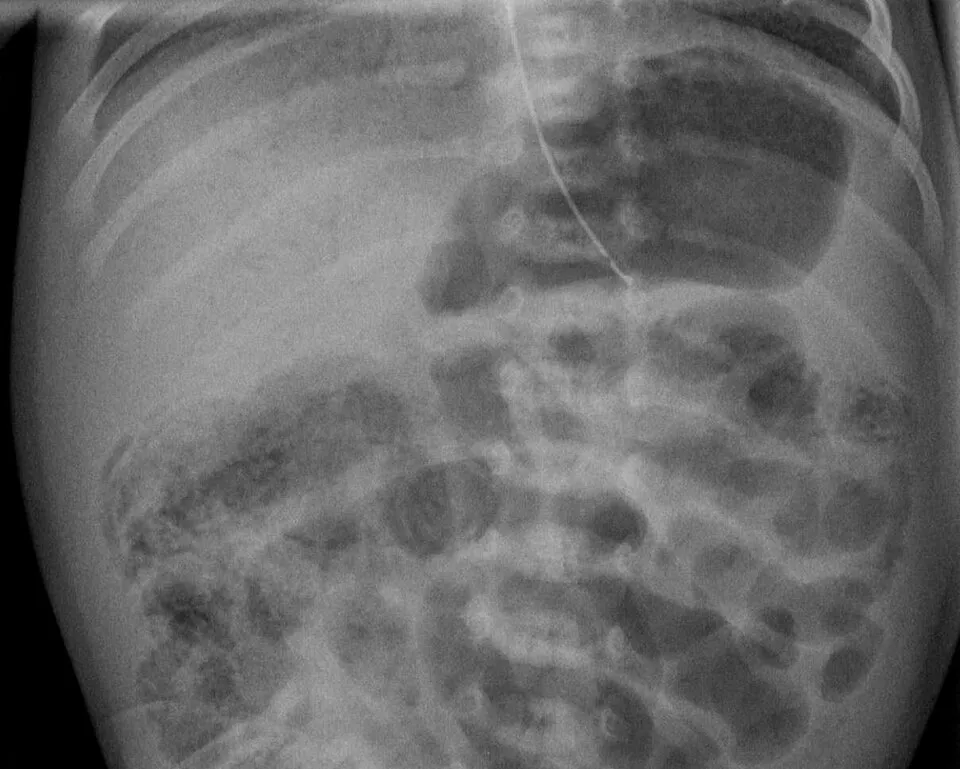
Necrotising enterocolitis (NEC) is inflammatory necrosis of the intestine that mainly affects preterm infants, most often the terminal ileum and proximal colon. It is the commonest neonatal gastrointestinal emergency, affecting about 5–10% of very low birth weight babies, usually 2–6 weeks after birth. Prematurity, formula feeding, abnormal gut bacteria and intestinal hypoxia–ischaemia combine to injure an immature mucosal barrier. Signs are bilious aspirates, distension, bloody stools, apnoea and shock, with thrombocytopenia and acidosis. The abdominal X-ray shows pneumatosis intestinalis (diagnostic), portal venous gas or free air. Modified Bell staging guides care. Medical treatment is bowel rest, gastric decompression, parenteral nutrition, broad-spectrum antibiotics and support. Perforation is the absolute indication for surgery (laparotomy or a peritoneal drain); deterioration despite medical therapy is a relative one. Mortality is 20–30%; survivors risk strictures, short bowel syndrome and developmental impairment. Human milk is the best prevention.
Patient case, mechanism, investigations, management, flashcards and exam-style questions.Open the lesson →
Key facts
- About 90% of cases are preterm; risk rises as gestational age and birth weight fall; onset usually 2–6 weeks after birth
- Term NEC suggests an underlying cause: congenital heart disease, gastroschisis, asphyxia or polycythaemia
- Classic triad: feed intolerance with bilious aspirates, abdominal distension, bloody stools; systemic signs (apnoea, bradycardia, instability)
- Pneumatosis intestinalis is the radiological hallmark; portal venous gas indicates more severe disease; pneumoperitoneum means perforation
- Modified Bell staging: I suspected, II definite (pneumatosis), III advanced (IIIA intact bowel, IIIB perforated)
- Medical treatment: nil by mouth, gastric decompression, IV fluids/PN, broad-spectrum IV antibiotics (including anaerobic cover), serial X-rays
- Absolute surgical indication: pneumoperitoneum; relative: deterioration despite maximal therapy, fixed loop, abdominal wall erythema, mass
- Exclusive human milk (mother's own, or donor milk) is the most effective prevention; probiotics are recommended by some bodies but not others
Differential diagnosis
| Condition | Clues | Key test |
|---|---|---|
| Spontaneous intestinal perforation | ELBW in first 1–2 weeks, often after indometacin and steroids; little systemic illness before | Pneumoperitoneum without pneumatosis |
| Late-onset sepsis with ileus | Distension and instability without bowel wall changes | Blood culture positive; X-ray without pneumatosis |
| Malrotation with volvulus | Sudden bilious vomiting; may be term | Upper GI contrast study |
| Hirschsprung-associated enterocolitis | Term baby with delayed meconium, distension, diarrhoea | Contrast enema and rectal biopsy |
| Cow's milk protein allergy | Bloody stools in a well infant | Normal X-ray; resolves on hydrolysed formula |
| Anal fissure or swallowed maternal blood | Small amount of fresh blood in a well baby | Examination; Apt test |
| Infectious colitis | Bloody diarrhoea with outbreak | Stool culture and viral PCR |
Exam pearls
Guideline
Modified Bell staging (Walsh and Kliegman 1986); probiotic guidance from ESPGHAN (2020 position paper; 2024 ESPGHAN/EFCNI statement) and AAP (2021); Cochrane review 2023; NEST surgical trial (2021)
References
- Walsh MC, Kliegman RM.. Necrotizing enterocolitis: treatment based on staging criteria. Pediatr Clin North Am 1986.
- Neu J, Walker WA.. Necrotizing enterocolitis. N Engl J Med 2011.
- Blakely ML, Tyson JE, Lally KP, Hintz SR, et al.. Initial laparotomy versus peritoneal drainage in extremely low birthweight infants with surgical necrotizing enterocolitis or isolated intestinal perforation: a multicenter randomized clinical trial. Ann Surg 2021.
- Sharif S, Meader N, Oddie SJ, Rojas-Reyes MX, McGuire W.. Probiotics to prevent necrotising enterocolitis in very preterm or very low birth weight infants. Cochrane Database Syst Rev 2023.
- Poindexter B; Committee on Fetus and Newborn.. Use of probiotics in preterm infants. Pediatrics 2021.
- van den Akker CHP, van Goudoever JB, Shamir R, et al.. Probiotics and preterm infants: a position paper by the ESPGHAN Committee on Nutrition and the ESPGHAN Working Group for Probiotics and Prebiotics. J Pediatr Gastroenterol Nutr 2020.
Related topics
By Dr Khalid Seidi (B.Sc., M.D.) · MedEd World Clinical Knowledge library. Original teaching content checked against current guidelines (November 2026); confirm the latest local guidance before clinical use. Not a substitute for clinical judgement.