Clinical Knowledge › Surgery › Paediatric surgery
Intussusception
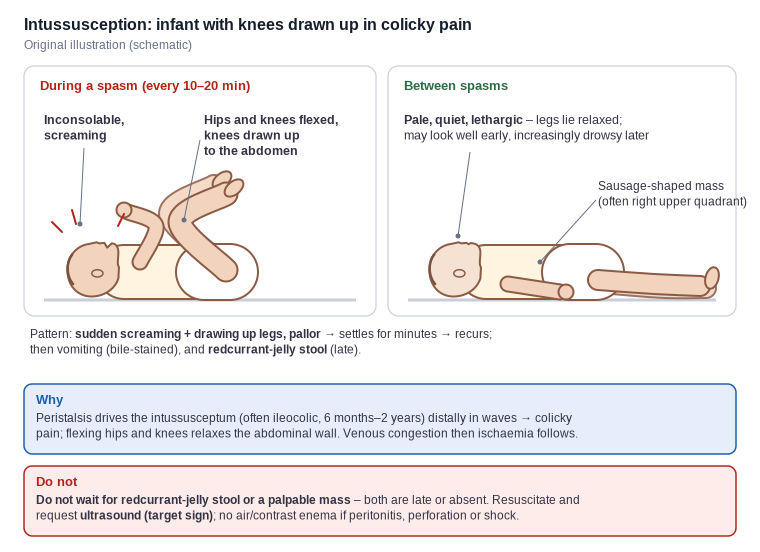
Intussusception is the telescoping of a proximal segment of bowel (the intussusceptum) into the adjacent distal bowel (the intussuscipiens), causing obstruction and, if untreated, venous congestion, ischaemia, perforation and death. It is the commonest cause of bowel obstruction in children aged 3 months to 3 years, peaking at 6–18 months. Most cases are ileocolic and idiopathic, with hypertrophied Peyer patches after a viral infection acting as the lead point; a pathological lead point (Meckel diverticulum, polyp, duplication cyst, lymphoma, IgA vasculitis haematoma) is more likely outside the usual age range, and adult intussusception usually has a tumour. The child has episodes of colicky pain with drawing up of the legs and pallor, vomiting (later bilious), lethargy and, late, redcurrant-jelly stool; a sausage-shaped mass may be felt. Ultrasound (target sign) is the diagnostic test of choice. After resuscitation, image-guided air or saline enema reduces most cases; surgery is needed for peritonitis, perforation, shock or failed reduction.
Patient case, mechanism, investigations, management, flashcards and exam-style questions.Open the lesson →
Key facts
- Commonest cause of intestinal obstruction from 3 months to 3 years; peak 6–18 months; boys more than girls
- About 90% are ileocolic and idiopathic, often after a viral illness (lymphoid hyperplasia of Peyer patches)
- Pathological lead points (Meckel diverticulum, polyp, duplication cyst, lymphoma, IgA vasculitis) are more likely under 3 months or over 5 years
- Classic triad of colicky pain, palpable sausage-shaped mass and redcurrant-jelly stool is present in a minority; lethargy and pallor may dominate
- Ultrasound is the investigation of choice (sensitivity and specificity near 100%): target or doughnut sign transversely, pseudokidney longitudinally
- Resuscitate first, then image-guided pneumatic (air) or hydrostatic (saline) enema reduction: success about 80–90%, perforation about 1%
- Contraindications to enema: peritonitis, perforation (free air) and shock not responding to resuscitation
- Recurrence after enema about 10%, often within 24–72 hours; most recurrences can be reduced again by enema
Differential diagnosis
| Condition | Clues | Key test |
|---|---|---|
| Acute gastroenteritis | Diarrhoea and vomiting, no pain-free lethargic intervals, no mass | Clinical; ultrasound if pain is episodic or blood in stool |
| Infantile colic | Crying in a thriving baby under 4 months, no vomiting or blood | Clinical |
| Malrotation with midgut volvulus | Bilious vomiting, often neonates, may be shocked | Upper GI contrast; Doppler whirlpool sign |
| Incarcerated inguinal hernia | Irreducible tender groin lump | Examination of groins |
| IgA vasculitis (Henoch–Schönlein purpura) | Purpuric rash on legs and buttocks, arthralgia, abdominal pain | Clinical; urinalysis; ultrasound for ileoileal intussusception |
| Meckel diverticulum bleeding | Painless large rectal bleed in a toddler | Technetium-99m pertechnetate scan |
| Acute appendicitis | Older child, migratory pain to right iliac fossa, fever | Ultrasound; inflammatory markers |
| Testicular torsion | Sudden scrotal pain and vomiting in a boy | Examine scrotum; urgent surgical exploration |
Exam pearls
Guideline
APSA Outcomes and Evidence-Based Practice Committee systematic review and recommendations on intussusception (2021), ESPR Abdominal Task Force procedural recommendations for intussusception reduction (2025–2026), and NICE NG29 IV fluids in children (2020 update)
References
- Kelley-Quon LI, Arthur LG, Williams RF, et al.. Management of intussusception in children: a systematic review. J Pediatr Surg 2021.
- Perucca G, Sofia C, Damasio MB, et al.. European Society of Paediatric Radiology abdominal task force procedural recommendations for intussusception reduction: what's the evidence?. Pediatr Radiol 2026.
- Patel MM, López-Collada VR, Bulhões MM, et al.. Intussusception risk and health benefits of rotavirus vaccination in Mexico and Brazil. N Engl J Med 2011.
- Bines JE, Kohl KS, Forster J, et al.. Acute intussusception in infants and children as an adverse event following immunization: case definition and guidelines of data collection, analysis, and presentation. Vaccine 2004.
- National Institute for Health and Care Excellence. Intravenous fluid therapy in children and young people in hospital (NG29). NICE guideline 2015.
- Holcomb GW III, Murphy JP, St Peter SD, eds.. Holcomb and Ashcraft's Pediatric Surgery. 2020.
Related topics
By Dr Khalid Seidi (B.Sc., M.D.) · MedEd World Clinical Knowledge library. Original teaching content checked against current guidelines (November 2026); confirm the latest local guidance before clinical use. Not a substitute for clinical judgement.