Clinical Knowledge › Surgery › Paediatric surgery
Testicular torsion
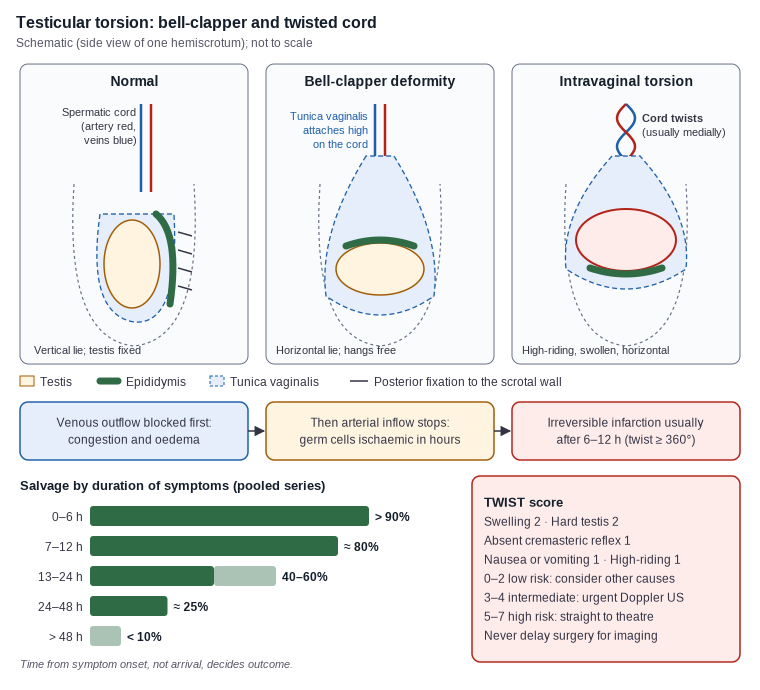
Testicular torsion is twisting of the spermatic cord that cuts off venous return and then arterial supply to the testis; it is a surgical emergency in which every hour counts. It has two peaks: adolescence, when intravaginal torsion occurs in boys with a 'bell-clapper' testis that hangs freely inside the tunica vaginalis, and the perinatal period, when the whole cord and tunica twist (extravaginal torsion). The typical story is sudden severe one-sided scrotal pain, often waking the boy from sleep, with nausea and vomiting; pain may be felt only in the lower abdomen, so the scrotum must be examined in every boy with abdominal pain. The testis is swollen, exquisitely tender, high-riding and horizontal, and the cremasteric reflex is usually absent. Salvage exceeds 90% if the testis is untwisted within 6 hours and then falls progressively (roughly 80% at 7–12 hours, 40–60% at 13–24 hours and about a quarter beyond 24 hours), so even a late presentation is explored. When clinical suspicion is high, the boy goes straight to theatre; Doppler ultrasound or a score such as TWIST helps only in equivocal cases and must never delay surgery. Exploration untwists the cord, removes a non-viable testis and fixes both testes to prevent recurrence or contralateral torsion.
Patient case, mechanism, investigations, management, flashcards and exam-style questions.Open the lesson →
Key facts
- Peak incidence age 12–18 years (intravaginal, bell-clapper deformity) with a smaller neonatal peak (extravaginal torsion)
- Sudden severe unilateral scrotal pain, often from sleep or after minor trauma, with nausea and vomiting in most
- Signs: swollen, tender, high-riding testis with a horizontal lie and absent cremasteric reflex
- Salvage over 90% if detorsion within 6 hours; about 80% at 7–12 hours, 40–60% at 13–24 hours, about 25% at 24–48 hours and under 10% after 48 hours
- High clinical suspicion = immediate scrotal exploration; do not wait for ultrasound
- TWIST score: swelling 2, hard testis 2, absent cremasteric reflex 1, nausea/vomiting 1, high-riding testis 1; 5 or more is high risk
- Surgery: detorsion, assess viability, bilateral orchidopexy (fixation); orchidectomy if necrotic, with contralateral fixation
- Manual detorsion ('open the book', outward rotation) is a temporising measure only and must be followed by exploration
Differential diagnosis
| Condition | Clues | Key test |
|---|---|---|
| Torsion of the appendix testis | Age 7–12, gradual focal upper-pole pain, 'blue dot' sign, cremasteric reflex present | Clinical; ultrasound with normal testicular flow |
| Epididymo-orchitis | Gradual onset, fever, dysuria or sexual history, tender epididymis; Prehn sign unreliable | Urinalysis and culture, NAAT for chlamydia and gonorrhoea; Doppler shows increased flow |
| Incarcerated inguinal hernia | Groin swelling extending to the scrotum, cannot get above it, bowel obstruction | Clinical; ultrasound or exploration |
| Testicular trauma or haematocele | Clear history of significant injury, bruising | Ultrasound for rupture of the tunica albuginea |
| Idiopathic scrotal oedema | Painless or mildly sore red scrotal oedema in a young child, testis not tender | Clinical |
| IgA vasculitis (Henoch–Schönlein purpura) | Purpuric rash on legs, arthralgia, abdominal pain, scrotal swelling | Clinical; urinalysis; Doppler if doubt |
| Testicular tumour | Painless hard mass, may bleed and present acutely | Ultrasound, tumour markers (AFP, beta-hCG, LDH) |
Exam pearls
Guideline
EAU/ESPU Guidelines on Paediatric Urology (2026 edition): acute scrotum in children
References
- Radmayr C, Bogaert G, Bujons A, Burgu B, et al.. EAU Guidelines on Paediatric Urology. EAU Guidelines Office, Arnhem (presented at the EAU Annual Congress, London 2026) 2026.
- Barbosa JA, Tiseo BC, Barayan GA, et al.. Development and initial validation of a scoring system to diagnose testicular torsion in children. J Urol 2013.
- Mellick LB, Sinex JE, Gibson RW, Mears K. A systematic review of testicle survival time after a torsion event. Pediatr Emerg Care 2019.
- Sharp VJ, Kieran K, Arlen AM. Testicular torsion: diagnosis, evaluation, and management. Am Fam Physician 2013.
- Holcomb GW III, Murphy JP, St Peter SD, eds.. Holcomb and Ashcraft's Pediatric Surgery. 2020.
- Partin AW, Dmochowski RR, Kavoussi LR, Peters CA, eds.. Campbell-Walsh-Wein Urology. 2020.
Related topics
By Dr Khalid Seidi (B.Sc., M.D.) · MedEd World Clinical Knowledge library. Original teaching content checked against current guidelines (November 2026); confirm the latest local guidance before clinical use. Not a substitute for clinical judgement.