Clinical Knowledge › Surgery › Paediatric surgery
Hirschsprung disease
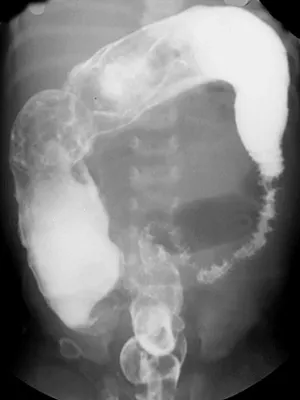
Hirschsprung disease is congenital absence of ganglion cells in the myenteric and submucosal plexuses of the distal bowel, caused by failed craniocaudal migration of neural crest cells. Aganglionosis always starts at the internal anal sphincter and extends proximally without skip areas: rectosigmoid in about 80%, total colonic in under 10%. The aganglionic segment cannot relax, causing functional obstruction. It affects about 1 in 5000 births, is commoner in boys and in trisomy 21, and is linked to RET mutations. Neonates fail to pass meconium within 48 hours, with distension and bilious vomiting; rectal examination may release explosive stool. Older children have lifelong constipation and poor growth. Hirschsprung-associated enterocolitis (fever, distension, foul explosive diarrhoea) is the main cause of death. A contrast enema shows a transition zone, but diagnosis needs a suction rectal biopsy showing no ganglion cells and absent calretinin staining. Rectal washouts decompress the bowel until a pull-through operation removes the aganglionic segment.
Patient case, mechanism, investigations, management, flashcards and exam-style questions.Open the lesson →
Key facts
- Failure of neural crest cells to migrate craniocaudally (weeks 5–12) leaves distal bowel without myenteric (Auerbach) and submucosal (Meissner) ganglia
- Aganglionosis starts at the internal anal sphincter and extends proximally continuously; rectosigmoid disease in about 75–80%
- Incidence about 1 in 5000; male:female about 4:1 in short-segment disease; trisomy 21 in about 10%
- Most healthy term neonates pass meconium within 24 hours; failure by 48 hours is a red flag
- Contrast enema: narrow distal rectum, cone-shaped transition zone, dilated proximal colon, reversed rectosigmoid index
- Gold standard: suction rectal biopsy above the dentate line showing absent ganglion cells, hypertrophic nerve trunks and absent calretinin staining
- Hirschsprung-associated enterocolitis (HAEC) can occur before or after surgery and is the leading cause of serious morbidity and death
- Definitive treatment is a pull-through (transanal endorectal, Duhamel or Swenson) with intraoperative levelling biopsies
Differential diagnosis
| Condition | Clues | Key test |
|---|---|---|
| Meconium ileus | Cystic fibrosis; distal ileal obstruction with thick meconium | Microcolon with pellets on contrast enema; immunoreactive trypsinogen, sweat test |
| Meconium plug or small left colon syndrome | Infant of diabetic mother; resolves after enema | Contrast enema with plug; rectal biopsy if symptoms persist |
| Ileal or colonic atresia | Bilious vomiting and distension from day 1 | Microcolon with no reflux into dilated ileum |
| Anorectal malformation | Abnormal or absent anus on inspection | Perineal examination, invertogram or ultrasound |
| Functional constipation | Onset after weaning or toilet training, large stools, soiling, full rectum | Clinical; biopsy only if red flags |
| Hypothyroidism | Prolonged jaundice, lethargy, macroglossia | TSH and free T4 (newborn screen) |
| Neonatal sepsis with ileus | Fever or instability, distension | Septic screen; normal biopsy |
Exam pearls
Guideline
ERNICA updated guidelines for rectosigmoid Hirschsprung disease (2025, published 2026); APSA HAEC and postoperative obstructive symptom guidelines (2017); ERNICA total colonic aganglionosis consensus (2024)
References
- Rossi D, Irvine W, Granström AL, Mutanen A, et al.. Updated ERNICA guidelines for the management of rectosigmoid Hirschsprung's disease 2025. J Pediatr Gastroenterol Nutr 2026.
- Kyrklund K, Sloots CEJ, de Blaauw I, et al.. ERNICA guidelines for the management of rectosigmoid Hirschsprung's disease. Orphanet J Rare Dis 2020.
- Gosain A, Frykman PK, Cowles RA, Horton J, et al.. Guidelines for the diagnosis and management of Hirschsprung-associated enterocolitis. Pediatr Surg Int 2017.
- Langer JC, Rollins MD, Levitt M, et al.. Guidelines for the management of postoperative obstructive symptoms in children with Hirschsprung disease. Pediatr Surg Int 2017.
- Granström AL, Irvine W, Hoel AT, Tabbers M, et al.. ERNICA clinical consensus statements on total colonic and intestinal aganglionosis. J Pediatr Surg 2024.
- Holcomb GW III, Murphy JP, St Peter SD, eds.. Holcomb and Ashcraft's Pediatric Surgery. 2020.
Related topics
By Dr Khalid Seidi (B.Sc., M.D.) · MedEd World Clinical Knowledge library. Original teaching content checked against current guidelines (November 2026); confirm the latest local guidance before clinical use. Not a substitute for clinical judgement.