Clinical Knowledge › Surgery › Paediatric surgery
Malrotation and midgut volvulus
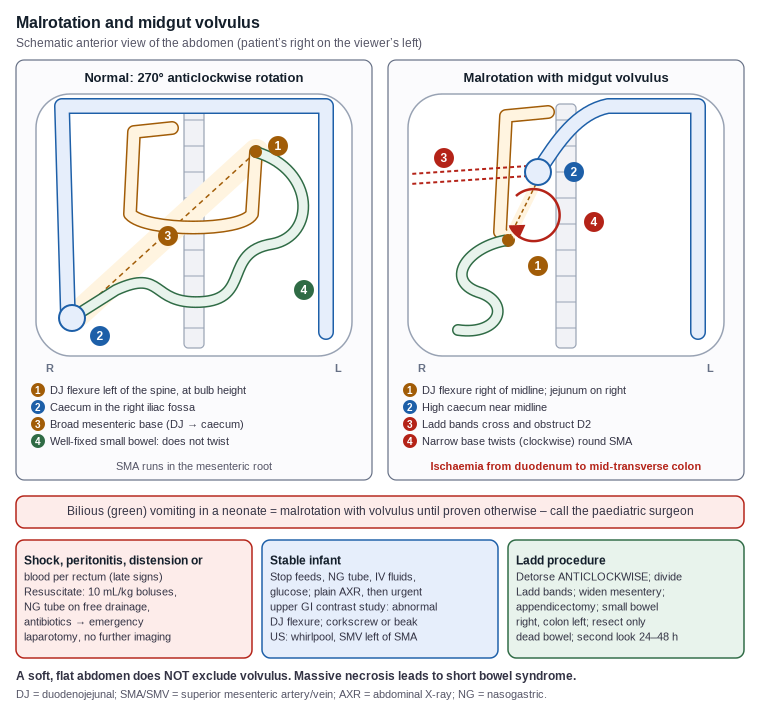
Malrotation is failure of the midgut to complete its 270° anticlockwise rotation around the superior mesenteric artery (SMA) and to fix normally. The duodenojejunal flexure lies right of the midline, the caecum lies high, Ladd bands cross the duodenum and the mesentery has a narrow base. That pedicle can twist (midgut volvulus), obstructing the duodenum and strangulating the SMA, so the midgut can die within hours. Most cases present in the first month with sudden bilious vomiting; the abdomen may be soft at first, and blood per rectum, distension or shock are late signs of ischaemia. Bilious vomiting in a newborn is a surgical emergency until proven otherwise. A stable infant needs an urgent upper gastrointestinal contrast study (abnormal duodenojejunal flexure, corkscrew or beak); an unstable or peritonitic infant goes straight to theatre. The Ladd procedure detorses the bowel anticlockwise, divides Ladd bands, widens the mesentery and removes the appendix. Massive necrosis leads to short bowel syndrome.
Patient case, mechanism, investigations, management, flashcards and exam-style questions.Open the lesson →
Key facts
- Normal midgut rotation is 270° anticlockwise around the SMA axis, returning to the abdomen by about 10–12 weeks' gestation
- Malrotation: duodenojejunal (DJ) flexure right of the left vertebral pedicle and below the duodenal bulb, high caecum, Ladd bands, narrow mesenteric base
- Midgut volvulus twists clockwise and can infarct bowel from duodenum to mid-transverse colon within hours
- Bilious (green) vomiting in a neonate = malrotation with volvulus until proven otherwise; about half to three quarters present in the first month
- A soft, non-distended abdomen does NOT exclude volvulus; blood per rectum, distension and shock are late
- Upper GI contrast study is the investigation of choice in a stable child; corkscrew or beaked duodenum indicates volvulus
- Ultrasound may show the whirlpool sign or reversal of the SMA–SMV relationship (SMV left of SMA)
- Ladd procedure: anticlockwise detorsion, division of Ladd bands, widening of the mesentery, appendicectomy, small bowel to the right and colon to the left
Differential diagnosis
| Condition | Clues | Key test |
|---|---|---|
| Duodenal atresia | Bilious vomiting from day 1, Down syndrome, polyhydramnios | Double bubble with NO distal gas on X-ray |
| Jejunoileal atresia | Bilious vomiting with progressive distension in first days | Multiple dilated loops; contrast enema shows microcolon |
| Hirschsprung disease | Delayed meconium beyond 48 h, distension, explosive stool after rectal exam | Contrast enema transition zone; suction rectal biopsy |
| Necrotising enterocolitis | Preterm, feeds established, bloody stools, distension | Pneumatosis intestinalis on X-ray |
| Meconium ileus | Cystic fibrosis, distended abdomen, no meconium | Soap-bubble appearance; Gastrografin enema; immunoreactive trypsinogen |
| Pyloric stenosis | Non-bilious projectile vomiting at 2–8 weeks | Ultrasound pyloric muscle thickness ≥3 mm, hypochloraemic alkalosis |
| Sepsis with ileus | Fever or instability, bilious aspirates, no mechanical obstruction | Septic screen; contrast study normal |
| Intussusception | Older infant (6–18 months), colicky pain, red-currant jelly stool | Ultrasound target sign |
Exam pearls
Guideline
ACR Appropriateness Criteria Vomiting in Infants (2020) with current paediatric surgical consensus (Seminars in Pediatric Surgery review 2022)
References
- Expert Panel on Pediatric Imaging; Alazraki AL, Rigsby CK, Iyer RS, et al.. ACR Appropriateness Criteria Vomiting in Infants. J Am Coll Radiol 2020.
- Svetanoff WJ, Srivatsa S, Diefenbach K, Nwomeh BC.. Diagnosis and management of intestinal rotational abnormalities with or without volvulus in the pediatric population. Semin Pediatr Surg 2022.
- Bingham G, Westwood E, Brennan K, Mohamed S, et al.. Malrotation after infancy - can we do better? A 10-year multi-centre retrospective review. Eur J Pediatr 2026.
- Menghwani H, Piplani R, Yhoshu E, Jagdish B, et al.. Delayed presentation of malrotation: case series and literature review. J Indian Assoc Pediatr Surg 2023.
- Holcomb GW III, Murphy JP, St Peter SD, eds.. Holcomb and Ashcraft's Pediatric Surgery. 2020.
- Lissauer T, Carroll W, eds.. Illustrated Textbook of Paediatrics. 2022.
Related topics
By Dr Khalid Seidi (B.Sc., M.D.) · MedEd World Clinical Knowledge library. Original teaching content checked against current guidelines (November 2026); confirm the latest local guidance before clinical use. Not a substitute for clinical judgement.