Clinical Knowledge › Surgery › Paediatric surgery
Gastroschisis and exomphalos
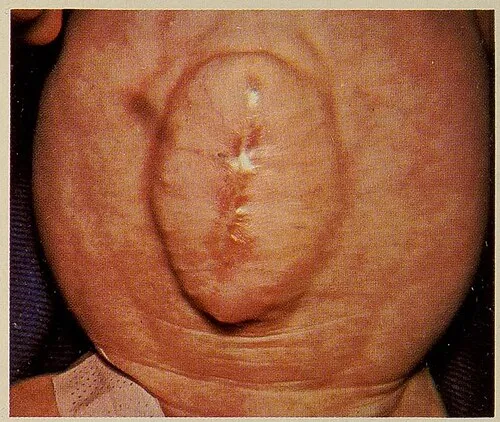
Gastroschisis and exomphalos (omphalocele) are the two main congenital abdominal wall defects, and the exam point is telling them apart. Gastroschisis is a small full-thickness defect, almost always to the right of a normally inserted umbilical cord, with uncovered bowel exposed to amniotic fluid, which leaves it thickened and matted. It occurs in young mothers (smoking and recreational drugs are risk factors) and usually has few anomalies apart from intestinal atresia. Exomphalos is a midline defect at the umbilicus with organs, often including liver, inside a membranous sac into which the cord inserts; half or more have major anomalies (cardiac, trisomies 13, 18 and 21, Beckwith–Wiedemann syndrome). Both are usually detected on antenatal ultrasound, often with raised maternal serum alpha-fetoprotein. At birth, cover the bowel or sac, decompress the stomach, and replace heat and fluid losses. Gastroschisis is closed primarily or after gradual reduction in a silo; small exomphalos is repaired early, giant exomphalos is often epithelialised ('paint and wait') and repaired later.
Patient case, mechanism, investigations, management, flashcards and exam-style questions.Open the lesson →
Key facts
- Gastroschisis: right of an intact cord, no sac, exposed inflamed bowel; exomphalos: midline, sac-covered, cord inserts into the sac
- Gastroschisis is linked to young maternal age, smoking and vasoactive or recreational drugs; incidence has risen worldwide
- Gastroschisis has few associated anomalies except intestinal atresia (about 10%); exomphalos has major anomalies in about half or more
- Exomphalos associations: cardiac defects, trisomies 13, 18, 21, Beckwith–Wiedemann syndrome, pentalogy of Cantrell, OEIS complex
- Both raise maternal serum alpha-fetoprotein; antenatal ultrasound is the main diagnostic tool
- Birth: cover bowel with a sterile bag or cling film, lie the baby on the right side, NG decompression, IV fluids, warmth, glucose
- Complex gastroschisis (atresia, necrosis, perforation, volvulus; about 17%) carries mortality around 17% versus about 2% in simple cases
- Beckwith–Wiedemann: macroglossia, organomegaly, hemihypertrophy, neonatal hypoglycaemia and risk of Wilms tumour and hepatoblastoma
Differential diagnosis
| Condition | Clues | Key test |
|---|---|---|
| Ruptured exomphalos | Exposed bowel but defect is central with sac remnants and cord inserting into it | Inspect defect site and cord insertion |
| Umbilical hernia | Skin-covered, reducible, appears weeks after birth | Clinical; usually closes spontaneously by 3–5 years |
| Hernia of the umbilical cord | Small sac with bowel inside the base of the cord | Clinical; avoid clamping the bowel with the cord clamp |
| Bladder exstrophy / cloacal exstrophy (OEIS) | Infraumbilical defect with exposed bladder mucosa | Clinical examination; pubic diastasis on X-ray |
| Pentalogy of Cantrell | Upper midline exomphalos with ectopia cordis and sternal defect | Echocardiography, chest imaging |
| Limb–body wall complex | Large defect with limb and spinal anomalies, short cord | Antenatal ultrasound; usually lethal |
Exam pearls
Guideline
APSA Outcomes and Evidence-Based Practice Committee systematic review on gastroschisis (2024) with current evidence on giant exomphalos (systematic review 2024)
References
- Slidell MB, McAteer J, Miniati D, Sømme S, et al.. Management of gastroschisis: timing of delivery, antibiotic usage, and closure considerations (a systematic review from the APSA Outcomes & Evidence Based Practice Committee). J Pediatr Surg 2024.
- Bergholz R, Boettcher M, Reinshagen K, Wenke K.. Complex gastroschisis is a different entity to simple gastroschisis affecting morbidity and mortality - a systematic review and meta-analysis. J Pediatr Surg 2014.
- Ghattaura H, Ross A, Aldeiri B, Mutanen A, et al.. Managing giant omphalocele: a systematic review of surgical techniques and outcomes. Acta Paediatr 2024.
- Al Namat D, Roșca RA, Al Namat R, Hanganu E, et al.. Omphalocele and associated anomalies: exploring pulmonary development and genetic correlations - a literature review. Diagnostics (Basel) 2025.
- Holcomb GW III, Murphy JP, St Peter SD, eds.. Holcomb and Ashcraft's Pediatric Surgery. 2020.
- Sadler TW.. Langman's Medical Embryology. 2023.
Related topics
By Dr Khalid Seidi (B.Sc., M.D.) · MedEd World Clinical Knowledge library. Original teaching content checked against current guidelines (November 2026); confirm the latest local guidance before clinical use. Not a substitute for clinical judgement.