Clinical Knowledge › Internal medicine › Infectious diseases › HIV and opportunistic infections
Cryptococcal meningitis
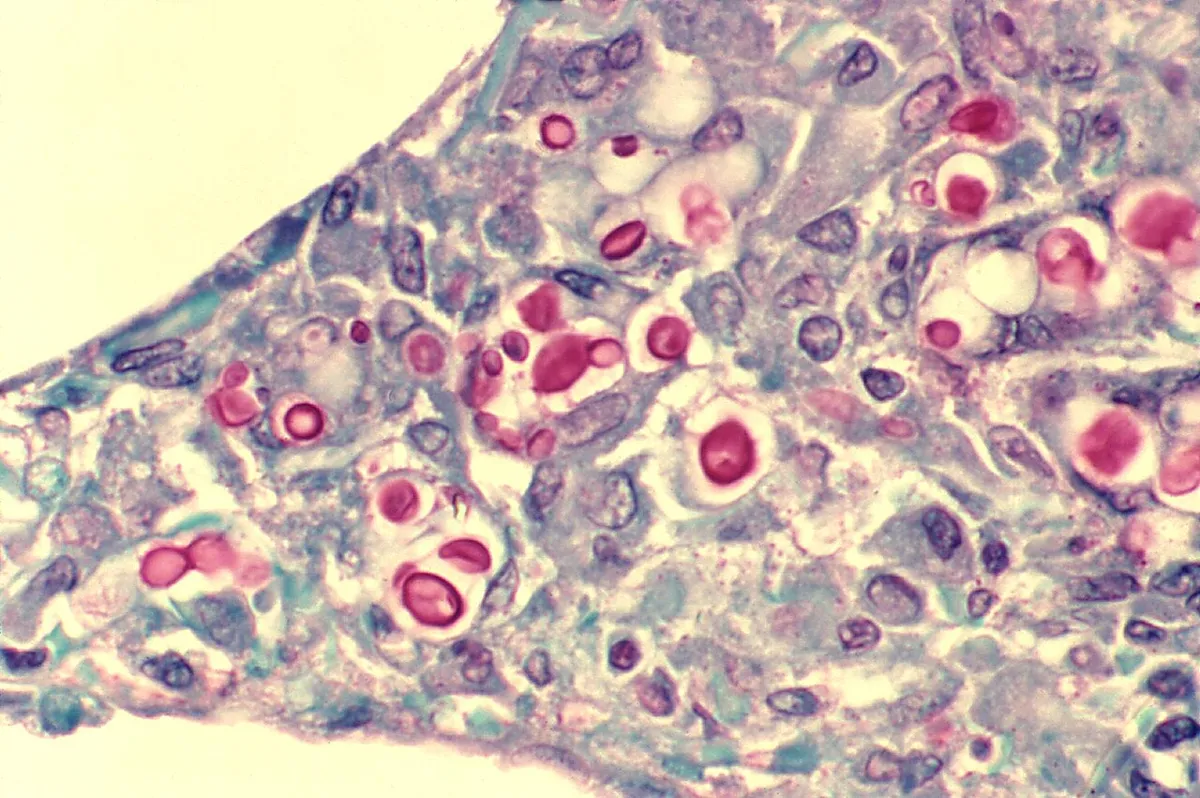
Cryptococcal meningitis is a subacute fungal meningoencephalitis caused mainly by the encapsulated yeast Cryptococcus neoformans, and less often by C. gattii, which can affect immunocompetent people. Inhaled yeasts disseminate to the brain when cell-mediated immunity fails, so most cases occur in advanced HIV with CD4 counts below 100 cells/microlitre; it remains a leading cause of HIV-related death in sub-Saharan Africa and Asia. Headache, fever, vomiting and confusion develop over 1–3 weeks, often with little neck stiffness; raised intracranial pressure causes visual loss, cranial nerve palsies and death. Cryptococcal antigen (CrAg) lateral flow assay in serum or CSF is the key test, with India ink and culture; the CSF opening pressure must always be measured. WHO-recommended induction is a single high dose of liposomal amphotericin B with 14 days of flucytosine and fluconazole, followed by fluconazole consolidation and maintenance. Repeated therapeutic lumbar punctures control pressure, corticosteroids are harmful, and ART is delayed 4–6 weeks to reduce fatal immune reconstitution. CrAg screening of people with low CD4 counts and pre-emptive fluconazole prevent meningitis.
Patient case, mechanism, investigations, management, flashcards and exam-style questions.Open the lesson →
Key facts
- C. neoformans causes most cases (advanced HIV, transplant, steroids); C. gattii also affects immunocompetent people and forms cryptococcomas
- Typical in HIV with CD4 below 100; subacute headache, fever and confusion, often with minimal meningism
- Serum or CSF cryptococcal antigen lateral flow assay is over 95% sensitive and specific
- Always measure CSF opening pressure; it is above 25 cmH2O in about half of HIV-associated cases
- WHO induction: liposomal amphotericin B 10 mg/kg single dose + flucytosine 100 mg/kg/day + fluconazole 1200 mg/day for 14 days
- Consolidation fluconazole 800 mg daily for 8 weeks, then maintenance 200 mg daily until immune recovery
- Start ART 4–6 weeks after antifungal therapy; earlier ART increased mortality (COAT trial)
- Do not give dexamethasone, acetazolamide or mannitol; treat raised pressure with therapeutic lumbar punctures
Differential diagnosis
| Condition | Clues | Key test |
|---|---|---|
| Tuberculous meningitis | Subacute, basal cranial nerve palsies, hyponatraemia, very high CSF protein, low glucose | CSF Xpert MTB/RIF Ultra, culture; CrAg negative |
| Bacterial meningitis | Acute (hours), high fever, neck stiffness, neutrophilic CSF | CSF Gram stain, culture, PCR |
| Cerebral toxoplasmosis | Focal deficits, ring-enhancing lesions, no meningism | MRI, Toxoplasma IgG |
| Viral meningitis or HIV seroconversion meningitis | Acute, lymphocytic CSF, normal glucose, near-normal pressure | CSF viral PCR, HIV RNA |
| Neurosyphilis | Cranial nerve palsies, uveitis, cognitive change | CSF VDRL, treponemal serology |
| Lymphomatous meningitis | Cranial neuropathies, known lymphoma, malignant cells | CSF cytology and flow cytometry |
| Other fungal meningitis (Histoplasma, Coccidioides) | Endemic region exposure | Antigen and antibody testing, culture |
Exam pearls
Guideline
WHO Guidelines for diagnosing, preventing and managing cryptococcal disease among adults, adolescents and children living with HIV (2022); Global guideline for the diagnosis and management of cryptococcosis (ECMM/ISHAM with ASM, 2024); NIH/CDC/HIVMA-IDSA adult and adolescent opportunistic infection guidelines (living guideline, current online version)
References
- World Health Organization. Guidelines for diagnosing, preventing and managing cryptococcal disease among adults, adolescents and children living with HIV. World Health Organization, Geneva 2022.
- Chang CC, Harrison TS, Bicanic TA, et al.. Global guideline for the diagnosis and management of cryptococcosis: an initiative of the ECMM and ISHAM in cooperation with the ASM. Lancet Infect Dis 2024.
- Panel on Guidelines for the Prevention and Treatment of Opportunistic Infections in Adults and Adolescents With HIV (NIH, CDC, HIVMA of IDSA). Guidelines for the prevention and treatment of opportunistic infections in adults and adolescents with HIV: cryptococcosis. ClinicalInfo.HIV.gov 2025.
- Jarvis JN, Lawrence DS, Meya DB, et al.. Single-dose liposomal amphotericin B treatment for cryptococcal meningitis. N Engl J Med 2022.
- Boulware DR, Meya DB, Muzoora C, et al.. Timing of antiretroviral therapy after diagnosis of cryptococcal meningitis. N Engl J Med 2014.
- Beardsley J, Wolbers M, Kibengo FM, et al.. Adjunctive dexamethasone in HIV-associated cryptococcal meningitis. N Engl J Med 2016.
Related topics
By Dr Khalid Seidi (B.Sc., M.D.) · MedEd World Clinical Knowledge library. Original teaching content checked against current guidelines (November 2026); confirm the latest local guidance before clinical use. Not a substitute for clinical judgement.