Clinical Knowledge › Internal medicine › Infectious diseases › HIV and opportunistic infections
HIV pre- and post-exposure prophylaxis
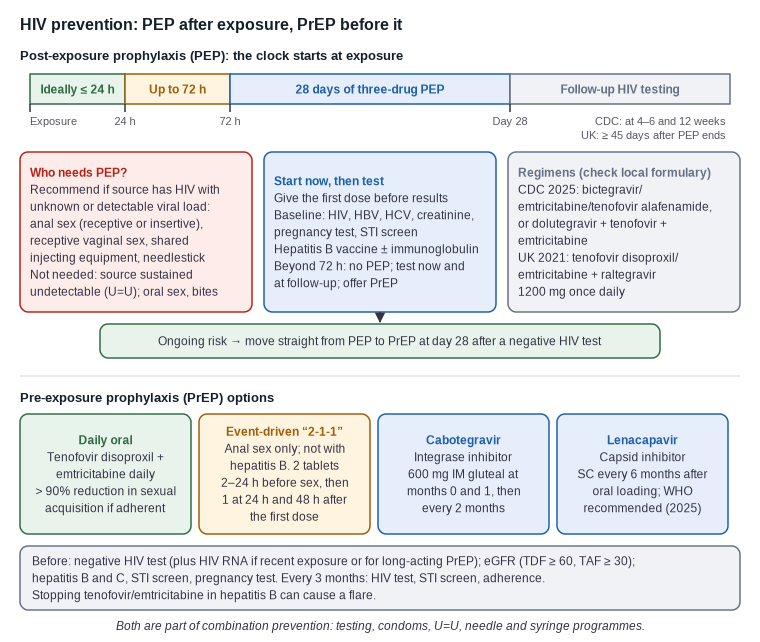
Antiretroviral prophylaxis prevents HIV acquisition in HIV-negative people. Pre-exposure prophylaxis (PrEP) is taken before and during periods of risk: daily oral tenofovir disoproxil with emtricitabine (or event-driven '2-1-1' dosing for anal sex), and long-acting injectables, cabotegravir every 2 months and lenacapavir twice yearly, which WHO recommended in 2025 after near-complete protection in trials. Post-exposure prophylaxis (PEP) is a 28-day course of three antiretrovirals started as soon as possible, ideally within 24 hours and no later than 72 hours, after a significant exposure such as condomless receptive anal sex with a partner of unknown or detectable viral load, sharing injecting equipment or a needlestick from a viraemic source. PEP is not needed when the source has a sustained undetectable viral load (undetectable = untransmittable). Before starting either, exclude HIV infection, check hepatitis B and kidney function, screen for STIs and pregnancy, and arrange follow-up HIV testing and transition from PEP to PrEP when risk continues.
Patient case, mechanism, investigations, management, flashcards and exam-style questions.Open the lesson →
Key facts
- PrEP with daily oral tenofovir disoproxil/emtricitabine reduces sexual HIV acquisition by over 90% when adherence is good
- Event-driven (2-1-1) oral PrEP is for anal sex only: 2 tablets 2–24 hours before sex, then 1 at 24 and 48 hours after the first dose
- Long-acting cabotegravir (intramuscular every 2 months) and lenacapavir (subcutaneous every 6 months) were superior to daily oral PrEP in trials; WHO recommended lenacapavir in July 2025
- PEP must start within 72 hours (ideally within 24 hours) and continues for 28 days with a three-drug regimen
- CDC 2025 preferred PEP: bictegravir/emtricitabine/tenofovir alafenamide or dolutegravir with tenofovir and emtricitabine; UK 2021 first line: tenofovir disoproxil/emtricitabine plus raltegravir
- PEP is not recommended if the source person has a sustained undetectable viral load (U=U)
- Highest-risk single exposures: receptive anal sex (about 1.4%), needle-sharing (about 0.6%) and needlestick from a viraemic source (about 0.2–0.3%)
- Always exclude HIV before PrEP (resistance risk) and check hepatitis B: stopping tenofovir/emtricitabine can cause an HBV flare
Differential diagnosis
| Condition | Clues | Key test |
|---|---|---|
| Acute HIV infection at PrEP start | Recent exposure with fever, rash, sore throat or lymphadenopathy | HIV antigen/antibody test plus HIV RNA |
| Established undiagnosed HIV | Previous risk without testing; weight loss or oral thrush | Fourth-generation HIV test before starting prophylaxis |
| Hepatitis B infection | Risk factors shared with HIV; flare when tenofovir stopped | HBsAg, anti-HBs, anti-HBc |
| Other STI after exposure | Discharge, ulcer or proctitis after condomless sex | NAAT for gonorrhoea and chlamydia; syphilis serology |
| PEP drug adverse effect | Nausea, diarrhoea, headache in first week | Clinical; renal function |
| Low-risk exposure not needing PEP | Oral sex, kissing, or source with undetectable viral load | Risk assessment and source testing |
Exam pearls
Guideline
CDC Antiretroviral PEP after sexual, injection drug use or other nonoccupational exposure to HIV (2025); BHIVA/BASHH UK guideline for HIV post-exposure prophylaxis (2021); BHIVA/BASHH PrEP guidelines (2025); WHO guideline on lenacapavir for HIV prevention (2025); CDC PrEP clinical practice guideline (2021 update)
References
- Centers for Disease Control and Prevention. Antiretroviral postexposure prophylaxis after sexual, injection drug use, or other nonoccupational exposure to HIV — CDC recommendations, United States, 2025. MMWR Recomm Rep 2025.
- British HIV Association and British Association for Sexual Health and HIV. UK guideline for the use of HIV post-exposure prophylaxis. BHIVA/BASHH 2021.
- British HIV Association and British Association for Sexual Health and HIV. BHIVA/BASHH guidelines on the use of HIV pre-exposure prophylaxis (PrEP). BHIVA/BASHH 2025.
- World Health Organization. Guidelines on lenacapavir for HIV prevention and testing strategies for long-acting injectable pre-exposure prophylaxis. WHO, Geneva 2025.
- Centers for Disease Control and Prevention. Preexposure prophylaxis for the prevention of HIV infection in the United States — 2021 update: a clinical practice guideline. CDC 2021.
- Bekker LG, Das M, Abdool Karim Q, et al.. Twice-yearly lenacapavir or daily F/TAF for HIV prevention in cisgender women. N Engl J Med 2024.
Related topics
By Dr Khalid Seidi (B.Sc., M.D.) · MedEd World Clinical Knowledge library. Original teaching content checked against current guidelines (November 2026); confirm the latest local guidance before clinical use. Not a substitute for clinical judgement.