Clinical Knowledge › Internal medicine › Infectious diseases › HIV and opportunistic infections
Kaposi sarcoma
Kaposi sarcoma (KS) is an angioproliferative tumour of lymphatic endothelial-derived spindle cells caused by human herpesvirus 8 (HHV-8, also called KSHV) in the setting of immune dysregulation. Four epidemiological forms are recognised: classic KS in older men of Mediterranean, Eastern European or Middle Eastern origin; endemic KS in sub-Saharan Africa, including an aggressive lymphadenopathic form in children; iatrogenic KS after transplantation or immunosuppression; and epidemic (AIDS-associated) KS, an AIDS-defining cancer that can occur at any CD4 count. Lesions are violaceous macules, plaques or nodules on the legs, face, trunk and oral mucosa, often with lymphoedema, and may involve the gut and lungs. Diagnosis is by biopsy showing spindle cells and slit-like vascular spaces with HHV-8 LANA-1 staining. Treatment of AIDS-KS starts with ART for everyone; local therapy treats limited lesions and pegylated liposomal doxorubicin or paclitaxel treats extensive, symptomatic or visceral disease, with pomalidomide as a later option. Iatrogenic KS often regresses when immunosuppression is reduced or switched to sirolimus, and corticosteroids should be avoided because they worsen KS.
Patient case, mechanism, investigations, management, flashcards and exam-style questions.Open the lesson →
Key facts
- Caused by HHV-8 (KSHV), a gamma-herpesvirus spread mainly through saliva and also sexually, by transplant and by blood
- Four forms: classic, endemic (African), iatrogenic (transplant) and epidemic (AIDS-associated)
- AIDS-KS can occur at any CD4 count and is an AIDS-defining cancer
- Violaceous, non-blanching macules, plaques and nodules on legs, face, trunk and hard palate; lymphoedema is common
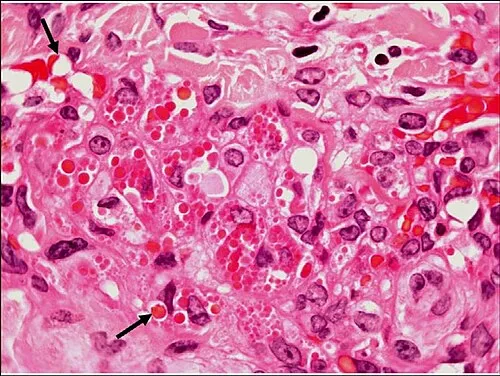
- Biopsy: spindle cells, slit-like vascular channels, extravasated red cells; LANA-1 immunostaining confirms HHV-8
- ART for all AIDS-KS; chemotherapy (liposomal doxorubicin or paclitaxel) for advanced, symptomatic or visceral disease
- Corticosteroids can trigger or worsen KS; KS-IRIS may follow ART
- HHV-8 also causes primary effusion lymphoma and multicentric Castleman disease
Differential diagnosis
| Condition | Clues | Key test |
|---|---|---|
| Bacillary angiomatosis (Bartonella) | Friable red-purple papules in advanced HIV, fever, cat exposure | Biopsy with Warthin–Starry silver stain, Bartonella PCR; responds to doxycycline or erythromycin |
| Pyogenic granuloma | Solitary rapidly growing friable bleeding papule | Biopsy: lobular capillary proliferation, LANA-1 negative |
| Angiosarcoma | Older person, scalp or previously irradiated skin, bruise-like plaque | Biopsy: atypical endothelial cells, LANA-1 negative |
| Acroangiodermatitis (pseudo-Kaposi) | Purple plaques on legs with chronic venous insufficiency or AV malformation | Biopsy: lobular vessel proliferation, LANA-1 negative |
| Haemangioma or purpura | Bright red, blanching or flat bruising | Clinical, platelet count |
| Dermatofibroma or melanoma | Firm pigmented papule or changing lesion | Dermoscopy and biopsy |
Exam pearls
Guideline
European consensus-based interdisciplinary guideline on Kaposi sarcoma (EDF/EADO/EORTC, 2019); BHIVA guidelines for HIV-associated malignancies (2014); WHO guidelines on the treatment of skin and oral HIV-associated conditions in children and adults (2014)
References
- Lebbé C, Garbe C, Stratigos AJ, et al.. Diagnosis and treatment of Kaposi's sarcoma: European consensus-based interdisciplinary guideline (EDF/EADO/EORTC). Eur J Cancer 2019.
- Bower M, Palfreeman A, Alfa-Wali M, et al.. British HIV Association guidelines for HIV-associated malignancies 2014. HIV Med 2014.
- World Health Organization. Guidelines on the treatment of skin and oral HIV-associated conditions in children and adults. World Health Organization, Geneva 2014.
- Cesarman E, Damania B, Krown SE, Martin J, Bower M, Whitby D. Kaposi sarcoma. Nat Rev Dis Primers 2019.
- Krown SE, Metroka C, Wernz JC. Kaposi's sarcoma in the acquired immune deficiency syndrome: a proposal for uniform evaluation, response, and staging criteria. J Clin Oncol 1989.
- Polizzotto MN, Uldrick TS, Wyvill KM, et al.. Pomalidomide for symptomatic Kaposi's sarcoma in people with and without HIV infection: a phase I/II study. J Clin Oncol 2016.
Related topics
By Dr Khalid Seidi (B.Sc., M.D.) · MedEd World Clinical Knowledge library. Original teaching content checked against current guidelines (November 2026); confirm the latest local guidance before clinical use. Not a substitute for clinical judgement.