Clinical Knowledge › Internal medicine › Infectious diseases › HIV and opportunistic infections
Cytomegalovirus (CMV) disease
Cytomegalovirus (human herpesvirus 5) infects most of the world's population and then stays latent for life in myeloid cells. In healthy people primary infection is usually silent or causes a heterophile-negative mononucleosis-like illness, but CMV is the commonest congenital infection and a major cause of sensorineural hearing loss. Disease from reactivation or primary infection occurs when T-cell immunity fails: in advanced HIV with CD4 counts below 50 cells/microlitre it causes retinitis, colitis, oesophagitis, polyradiculopathy and encephalitis; after solid organ and stem cell transplantation it causes fever with cytopenias, pneumonitis, gastrointestinal and hepatic disease, and indirect effects such as graft rejection. CMV infection (viral replication) is measured with quantitative PCR in blood, whereas end-organ disease is confirmed by fundoscopy or by biopsy showing owl's-eye inclusions. Ganciclovir or oral valganciclovir is first-line treatment; foscarnet, cidofovir and maribavir treat resistant or refractory infection. In transplant recipients, prophylaxis (valganciclovir or letermovir) or PCR-guided pre-emptive therapy prevents disease, and in HIV the key is prompt ART.
Patient case, mechanism, investigations, management, flashcards and exam-style questions.Open the lesson →
Key facts
- CMV infection means viral replication (viraemia on PCR); CMV disease means symptoms with end-organ involvement
- Seroprevalence ranges from about 40% to nearly 100%; latency is in monocytes and myeloid progenitor cells
- In HIV, end-organ disease occurs with CD4 below 50; retinitis is the commonest manifestation
- Highest risk in solid organ transplant is donor positive/recipient negative (D+/R−); in allogeneic stem cell transplant it is the seropositive recipient (R+)
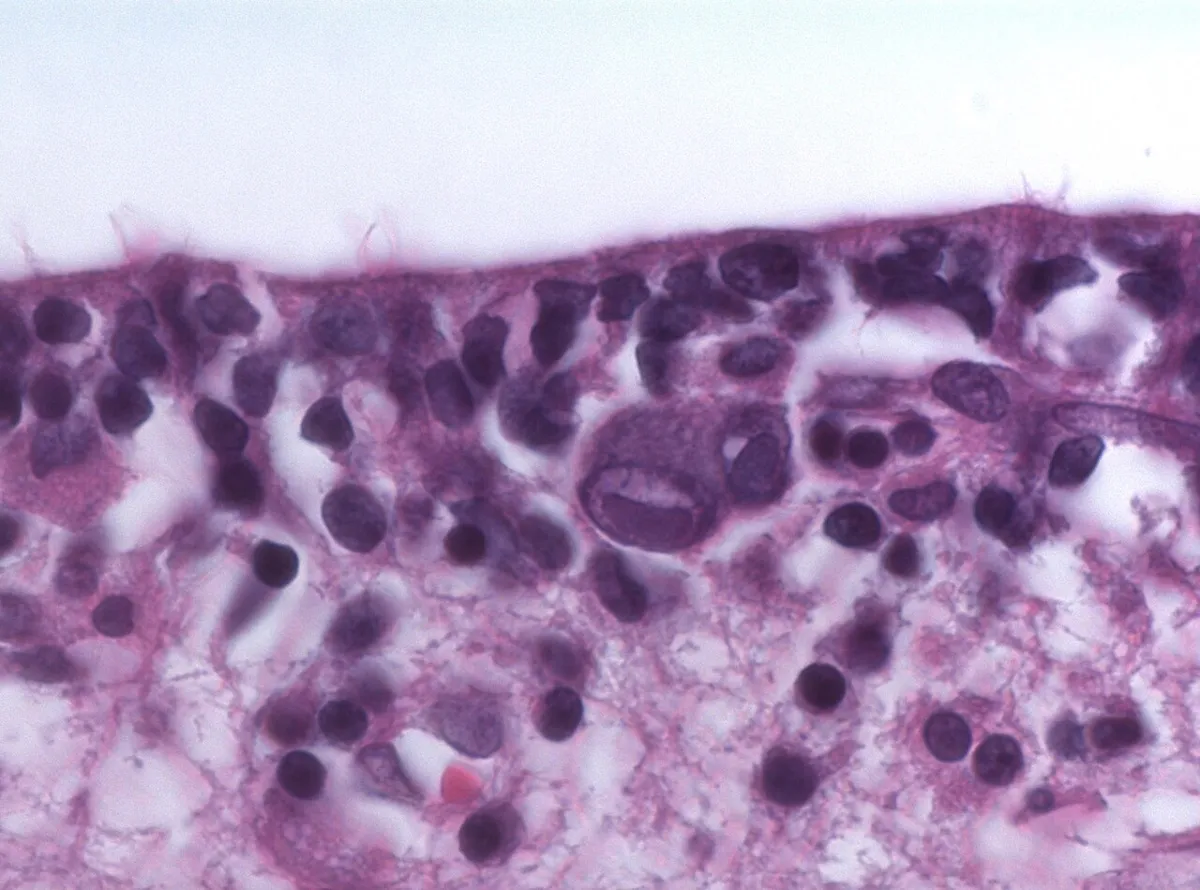
- Histology: enlarged cells with intranuclear owl's-eye inclusions; confirm with immunohistochemistry
- First-line treatment: IV ganciclovir 5 mg/kg 12-hourly or oral valganciclovir 900 mg twice daily; main toxicity is neutropenia
- Foscarnet (nephrotoxic, hypocalcaemia, hypomagnesaemia) and cidofovir (nephrotoxic) for ganciclovir resistance; maribavir for refractory post-transplant infection
- Letermovir (a terminase inhibitor) is used only for prophylaxis: R+ allogeneic stem cell and high-risk kidney transplant recipients
Differential diagnosis
| Condition | Clues | Key test |
|---|---|---|
| Epstein–Barr virus mononucleosis | Pharyngitis, cervical lymphadenopathy, heterophile antibody positive | Monospot, EBV VCA IgM |
| Herpes simplex or varicella retinitis (acute retinal necrosis) | Rapid, painful, peripheral necrosis; may occur at higher CD4 | Aqueous or vitreous PCR |
| HSV oesophagitis | Small, shallow, punched-out ulcers; vesicles | Biopsy edge of ulcer; HSV PCR or IHC |
| Candida oesophagitis | White plaques, oral thrush, responds to fluconazole | Endoscopy and brushings |
| Graft rejection | Rising creatinine or liver enzymes in a transplant recipient without viraemia | Graft biopsy |
| Toxoplasma retinochoroiditis | Fluffy focal lesion with vitritis ('headlight in fog') | Clinical, serology, ocular PCR |
| Inflammatory bowel disease or C. difficile colitis | Diarrhoea and colitis | Stool tests, biopsy with IHC for CMV |
Exam pearls
Guideline
Fourth International Consensus Guidelines on the Management of Cytomegalovirus in Solid Organ Transplantation (2025); ECIL-7 guidelines for CMV in haematological malignancy and stem cell transplantation (2019); NIH/CDC/HIVMA-IDSA adult and adolescent opportunistic infection guidelines, CMV section (living guideline, current online version)
References
- Kotton CN, Kumar D, Manuel O, et al.. The Fourth International Consensus Guidelines on the Management of Cytomegalovirus in Solid Organ Transplantation. Transplantation 2025.
- Panel on Guidelines for the Prevention and Treatment of Opportunistic Infections in Adults and Adolescents With HIV (NIH, CDC, HIVMA of IDSA). Guidelines for the prevention and treatment of opportunistic infections in adults and adolescents with HIV: cytomegalovirus disease. ClinicalInfo.HIV.gov 2025.
- Ljungman P, de la Camara R, Robin C, et al.. Guidelines for the management of cytomegalovirus infection in patients with haematological malignancies and after stem cell transplantation from the 2017 European Conference on Infections in Leukaemia (ECIL 7). Lancet Infect Dis 2019.
- Marty FM, Ljungman P, Chemaly RF, et al.. Letermovir prophylaxis for cytomegalovirus in hematopoietic-cell transplantation. N Engl J Med 2017.
- Avery RK, Alain S, Alexander BD, et al.. Maribavir for refractory cytomegalovirus infections with or without resistance post-transplant: results from a phase 3 randomized clinical trial. Clin Infect Dis 2022.
- Limaye AP, Budde K, Humar A, et al.. Letermovir vs valganciclovir for prophylaxis of cytomegalovirus in high-risk kidney transplant recipients: a randomized clinical trial. JAMA 2023.
Related topics
By Dr Khalid Seidi (B.Sc., M.D.) · MedEd World Clinical Knowledge library. Original teaching content checked against current guidelines (November 2026); confirm the latest local guidance before clinical use. Not a substitute for clinical judgement.