Clinical Knowledge › Internal medicine › Endocrinology › Thyroid disorders
Differentiated thyroid cancer (papillary and follicular)
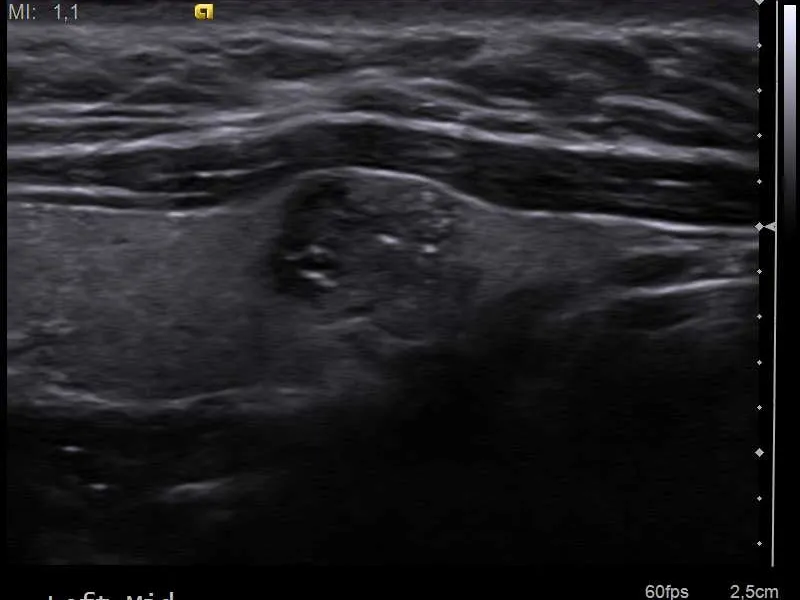
Differentiated thyroid cancer (DTC) arises from follicular cells and keeps many of their features, including iodine uptake, thyroglobulin production and TSH dependence. Papillary carcinoma accounts for about 85% of cases and follicular carcinoma for most of the rest; oncocytic carcinoma is now classed separately. DTC is the commonest endocrine cancer and its recorded incidence has risen sharply, largely because ultrasound finds small, indolent tumours. Risk factors include childhood radiation exposure, female sex, family history and some inherited syndromes. Most patients present with a painless thyroid nodule or cervical lymph node; papillary cancer spreads to neck nodes, whereas follicular cancer spreads through the blood to lung and bone. Diagnosis rests on ultrasound risk scoring and fine-needle aspiration reported with the Bethesda system, with molecular testing for indeterminate results. The 2025 American Thyroid Association guideline promotes individualised, risk-adapted care: active surveillance or lobectomy for many low-risk tumours, total thyroidectomy and selective radioiodine for higher risk disease, TSH suppression tailored to risk and response, and follow-up with thyroglobulin and neck ultrasound. Prognosis is excellent for most patients.
Patient case, mechanism, investigations, management, flashcards and exam-style questions.Open the lesson →
Key facts
- DTC = papillary (about 85%) and follicular carcinoma; oncocytic carcinoma is a separate category in the WHO 2022 classification
- Papillary: nuclear features (grooves, pseudoinclusions, 'Orphan Annie' clearing), psammoma bodies, BRAF V600E or RET fusions, lymphatic spread to neck nodes
- Follicular: diagnosis needs capsular or vascular invasion, so cytology cannot separate adenoma from carcinoma; RAS mutations; haematogenous spread to lung and bone
- Major risk factor: ionising radiation in childhood (for example Chernobyl, therapeutic neck irradiation)
- Work-up: TSH, ultrasound risk score (ATA pattern or EU-TIRADS), fine-needle aspiration reported by Bethesda category, molecular tests for indeterminate cytology
- Low-risk papillary microcarcinoma can be managed by active surveillance; lobectomy is enough for many low-risk tumours up to 4 cm
- Radioiodine is selective: not routine for low-risk disease, considered for intermediate risk and given for high-risk or metastatic disease
- Follow-up uses serum thyroglobulin with anti-thyroglobulin antibodies and neck ultrasound; response to therapy is classed as excellent, indeterminate, biochemical incomplete or structural incomplete
Differential diagnosis
| Condition | Clues | Key test |
|---|---|---|
| Benign colloid or follicular nodule | Spongiform or purely cystic nodule, stable size | Ultrasound pattern; Bethesda II cytology |
| Medullary thyroid carcinoma | Diarrhoea, flushing, family history of MEN2 | Serum calcitonin and CEA; RET testing |
| Anaplastic thyroid carcinoma | Older patient, rapidly enlarging hard neck mass, stridor | Urgent core biopsy; BRAF testing |
| Primary thyroid lymphoma | Rapid growth on a background of Hashimoto thyroiditis | Core biopsy with flow cytometry |
| Metastasis to the thyroid | Known renal, lung or breast cancer | Cytology with immunohistochemistry |
| Reactive cervical lymphadenopathy | Recent infection, oval node with fatty hilum | Ultrasound features; FNA with thyroglobulin washout if suspicious |
| Subacute thyroiditis | Painful tender gland after viral illness, thyrotoxicosis | Raised ESR, low uptake; ill-defined hypoechoic area resolves |
Exam pearls
Guideline
American Thyroid Association 2025 Management Guidelines for Adult Patients with Differentiated Thyroid Cancer, with the ETA 2023 thyroid nodule guideline, the 2023 Bethesda System and the WHO 2022 classification
References
- Ringel MD, Sosa JA, et al.. 2025 American Thyroid Association Management Guidelines for Adult Patients with Differentiated Thyroid Cancer. Thyroid 2025.
- Praw SS, Gigliotti BJ, Tessnow A, Kang H, Margulies DJ.. Executive Summary of the 2025 American Thyroid Association Management Guidelines for Adult Patients with Differentiated Thyroid Cancer. Thyroid 2025.
- Durante C, Hegedüs L, Czarniecka A, et al.. 2023 European Thyroid Association Clinical Practice Guidelines for thyroid nodule management. Eur Thyroid J 2023.
- Haugen BR, Alexander EK, Bible KC, et al.. 2015 American Thyroid Association Management Guidelines for Adult Patients with Thyroid Nodules and Differentiated Thyroid Cancer. Thyroid 2016.
- Ali SZ, Baloch ZW, Cochand-Priollet B, et al.. The 2023 Bethesda System for Reporting Thyroid Cytopathology. Thyroid 2023.
- Baloch ZW, Asa SL, Barletta JA, et al.. Overview of the 2022 WHO Classification of Thyroid Neoplasms. Endocr Pathol 2022.
Related topics
By Dr Khalid Seidi (B.Sc., M.D.) · MedEd World Clinical Knowledge library. Original teaching content checked against current guidelines (November 2026); confirm the latest local guidance before clinical use. Not a substitute for clinical judgement.