Clinical Knowledge › Internal medicine › Endocrinology › Thyroid disorders
Hashimoto thyroiditis
Hashimoto thyroiditis (chronic lymphocytic or autoimmune thyroiditis) is the commonest autoimmune disease and the leading cause of hypothyroidism in iodine-sufficient countries. Genetic susceptibility (HLA-DR3/DR5, CTLA4, PTPN22) combined with triggers such as high iodine intake, smoking cessation, pregnancy and immune-modulating drugs leads to loss of tolerance to thyroid peroxidase and thyroglobulin. Cytotoxic T cells and antibodies destroy follicular cells, leaving a gland infiltrated by lymphocytes with germinal centres and Hürthle cells. Most patients are women aged 30–60 with a painless, firm, rubbery goitre or an atrophic gland. Many are euthyroid with positive TPO antibodies for years and progress to subclinical and then overt hypothyroidism at about 2–5% a year; a brief thyrotoxic phase (hashitoxicosis) can occur. Diagnosis rests on TSH, free T4, TPO antibodies and, when needed, ultrasound. Treatment is levothyroxine when hypothyroid. Associations include other autoimmune diseases and, rarely, primary thyroid lymphoma.
Patient case, mechanism, investigations, management, flashcards and exam-style questions.Open the lesson →
Key facts
- Commonest cause of hypothyroidism where iodine intake is adequate; women outnumber men by about 7–10 to 1
- TPO antibodies are positive in about 90% and thyroglobulin antibodies in 60–80%
- Histology: lymphocytic infiltrate with germinal centres, Hürthle (oncocytic) cells and fibrosis
- Euthyroid antibody-positive people progress to hypothyroidism at roughly 2–5% per year; check TSH yearly
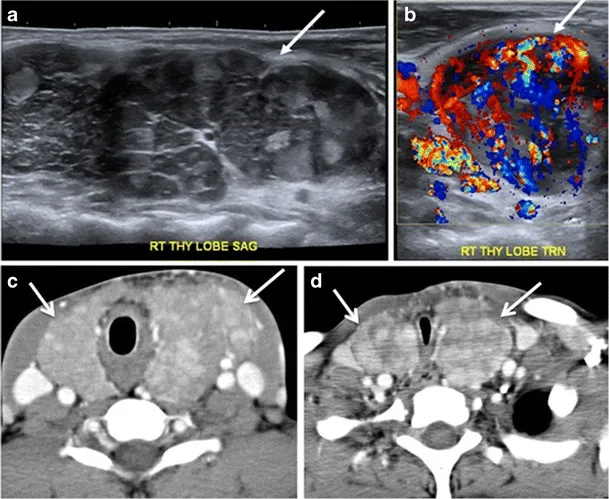
- Ultrasound shows a diffusely enlarged, heterogeneous, hypoechoic gland; it is not needed if antibodies are positive and the gland is smooth
- Associations: type 1 diabetes, coeliac disease, pernicious anaemia, vitiligo, Addison disease (APS type 2), Down and Turner syndromes
- A rapidly enlarging goitre in long-standing Hashimoto thyroiditis suggests primary thyroid lymphoma (usually B-cell)
- Levothyroxine treats hypothyroidism; selenium, gluten-free diets and other supplements are not proven to change the course
Differential diagnosis
| Condition | Clues | Key test |
|---|---|---|
| Graves disease | Thyrotoxicosis, diffuse goitre with bruit, orbitopathy | TSH receptor antibodies; high uptake scan |
| Painless (silent) or postpartum thyroiditis | Transient thyrotoxicosis then hypothyroidism, small goitre, within 12 months of delivery | Low uptake scan; follow-up TSH |
| Subacute (de Quervain) thyroiditis | Painful tender thyroid after viral illness, high ESR | ESR or CRP; low uptake |
| Riedel thyroiditis | Stony-hard fixed gland, compressive symptoms, IgG4-related disease | Biopsy; IgG4 |
| Multinodular goitre | Nodular asymmetric gland, older adult, often euthyroid | Ultrasound |
| Primary thyroid lymphoma | Rapidly enlarging goitre, compressive symptoms, B symptoms in a Hashimoto patient | Core biopsy with flow cytometry |
| Iodine deficiency goitre | Endemic area, diffuse goitre, negative antibodies | Urinary iodine; antibodies |
Exam pearls
Guideline
ATA Guidelines for the Treatment of Hypothyroidism (2014), NICE NG145 Thyroid disease (2019) and ATA 2026 Guidelines for thyroid disease in preconception, pregnancy and postpartum
References
- Jonklaas J, Bianco AC, Bauer AJ, et al.. Guidelines for the treatment of hypothyroidism. Thyroid 2014.
- National Institute for Health and Care Excellence. Thyroid disease: assessment and management (NG145). NICE 2019.
- Caturegli P, De Remigis A, Rose NR. Hashimoto thyroiditis: clinical and diagnostic criteria. Autoimmun Rev 2014.
- American Thyroid Association. American Thyroid Association 2026 Guidelines for Thyroid Disease in Preconception, Pregnancy, and the Postpartum Period. Thyroid 2026.
- Dhillon-Smith RK, Middleton LJ, Sunner KK, et al.. Levothyroxine in women with thyroid peroxidase antibodies before conception. N Engl J Med 2019.
- Ralli M, Angeletti D, Fiore M, et al.. Hashimoto's thyroiditis: an update on pathogenic mechanisms, diagnostic protocols, therapeutic strategies, and potential malignant transformation. Autoimmun Rev 2020.
Related topics
By Dr Khalid Seidi (B.Sc., M.D.) · MedEd World Clinical Knowledge library. Original teaching content checked against current guidelines (November 2026); confirm the latest local guidance before clinical use. Not a substitute for clinical judgement.