Clinical Knowledge › Internal medicine › Endocrinology › Thyroid disorders
Subacute (de Quervain) thyroiditis
Subacute (de Quervain, granulomatous) thyroiditis is a self-limiting inflammatory disease of the thyroid that usually follows an upper respiratory viral infection by a few weeks. It is the commonest cause of a painful thyroid. Typical patients are women aged 30–50 with severe anterior neck pain radiating to the jaw or ear, a firm, exquisitely tender gland, fever and malaise. Inflammation destroys follicles and releases stored hormone, so there is a thyrotoxic phase lasting 3–6 weeks with a high ESR and CRP, a raised thyroglobulin and a very low radioiodine or technetium uptake. A transient hypothyroid phase often follows before recovery within 6–12 months; about 5–15% are left permanently hypothyroid. Because the thyrotoxicosis comes from leakage, not overproduction, antithyroid drugs and radioiodine have no role. Treatment is symptomatic: NSAIDs for mild pain, prednisolone for severe pain or NSAID failure, beta-blockers for adrenergic symptoms and temporary levothyroxine if hypothyroidism is symptomatic. SARS-CoV-2 infection and vaccines are recognised triggers.
Patient case, mechanism, investigations, management, flashcards and exam-style questions.Open the lesson →
Key facts
- Commonest cause of a painful, tender thyroid; usually 2–8 weeks after a viral upper respiratory infection
- Women 3–5 times more often than men, peak 30–50 years; associated with HLA-B35
- Triphasic course: thyrotoxic (3–6 weeks) → hypothyroid (weeks to months) → euthyroid recovery in most by 6–12 months
- ESR typically above 50 mm/h with raised CRP; thyroglobulin high; thyroid antibodies usually absent or low titre
- Radioiodine or technetium uptake is very low (often below 5% at 24 hours), distinguishing it from Graves disease
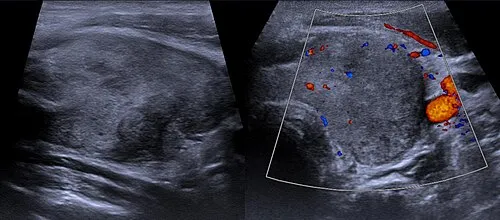
- Ultrasound: ill-defined hypoechoic areas with reduced vascularity; histology shows granulomas with multinucleated giant cells
- Treat with NSAIDs for mild disease and prednisolone (about 40 mg daily, tapered over 4–8 weeks) for severe pain; beta-blockers for symptoms; no thionamides
- Permanent hypothyroidism develops in about 5–15%; recurrence in a small minority
Differential diagnosis
| Condition | Clues | Key test |
|---|---|---|
| Graves disease | Painless diffuse goitre with bruit, orbitopathy, normal ESR | TRAb positive; high diffuse uptake |
| Acute suppurative thyroiditis | Child or immunocompromised adult, fluctuant tender left lobe, high WCC, usually euthyroid | Ultrasound, FNA culture; barium swallow or CT for piriform sinus fistula |
| Haemorrhage into a thyroid nodule or cyst | Sudden localised pain and swelling over a pre-existing nodule; normal ESR and TFTs | Ultrasound showing a cystic or haemorrhagic nodule |
| Painless (silent) or postpartum thyroiditis | Thyrotoxic with low uptake but no pain, normal ESR, TPO antibodies often positive | ESR, TPO antibodies, timing after delivery |
| Anaplastic thyroid cancer or lymphoma | Older patient, rapidly enlarging hard mass, may be tender; compressive symptoms | Ultrasound, core or FNA biopsy |
| Pharyngitis or dental infection | Throat or jaw pain without thyroid tenderness | Examination; normal thyroid tests |
| Amiodarone-induced thyrotoxicosis type 2 | Destructive thyrotoxicosis on amiodarone, usually painless | Drug history; low uptake; low vascularity on Doppler |
Exam pearls
Guideline
ATA 2016 Guidelines for diagnosis and management of hyperthyroidism and other causes of thyrotoxicosis (section on painful subacute thyroiditis), with NICE NG145 Thyroid disease (2019)
References
- Ross DS, Burch HB, Cooper DS, et al.. 2016 American Thyroid Association guidelines for diagnosis and management of hyperthyroidism and other causes of thyrotoxicosis. Thyroid 2016.
- National Institute for Health and Care Excellence (NICE). Thyroid disease: assessment and management (NG145). NICE guideline 2019.
- Stasiak M, Lewiński A. New aspects in the pathogenesis and management of subacute thyroiditis. Rev Endocr Metab Disord 2021.
- Nishihara E, Ohye H, Amino N, et al.. Clinical characteristics of 852 patients with subacute thyroiditis before treatment. Intern Med 2008.
- Alfadda AA, Sallam RM, Elawad GE, Aldhukair H, Alyahya MM. Subacute thyroiditis: clinical presentation and long term outcome. Int J Endocrinol 2014.
- Fatourechi V, Aniszewski JP, Fatourechi GZ, Atkinson EJ, Jacobsen SJ. Clinical features and outcome of subacute thyroiditis in an incidence cohort: Olmsted County, Minnesota, study. J Clin Endocrinol Metab 2003.
Related topics
By Dr Khalid Seidi (B.Sc., M.D.) · MedEd World Clinical Knowledge library. Original teaching content checked against current guidelines (November 2026); confirm the latest local guidance before clinical use. Not a substitute for clinical judgement.