Clinical Knowledge › Internal medicine › Endocrinology › Thyroid disorders
Thyroid storm
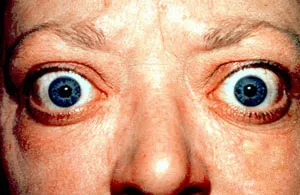
Thyroid storm (thyroid crisis) is the rare, life-threatening extreme of thyrotoxicosis in which the body can no longer compensate for excess thyroid hormone and organ systems begin to fail. It usually occurs in someone with untreated or poorly controlled Graves disease, less often toxic nodular goitre, and is triggered by infection, surgery, trauma, labour, diabetic ketoacidosis, stopping antithyroid drugs, radioiodine or an iodine load. The hallmark is decompensation: high fever, tachycardia often above 140 per minute or atrial fibrillation, heart failure, agitation, delirium, seizures or coma, vomiting, diarrhoea and jaundice. Hormone levels are not necessarily higher than in uncomplicated thyrotoxicosis, so the diagnosis is clinical, supported by the Burch–Wartofsky Point Scale or the Japan Thyroid Association criteria. Treatment starts before results return and attacks every step: a beta-blocker to block adrenergic effects, a thionamide (propylthiouracil or methimazole) to stop synthesis, iodine at least one hour later to block release, glucocorticoids to reduce T4-to-T3 conversion and cover relative adrenal insufficiency, cooling, fluids, treatment of the trigger and intensive care support. Mortality remains around 5–10%, mostly from multiorgan and heart failure.
Patient case, mechanism, investigations, management, flashcards and exam-style questions.Open the lesson →
Key facts
- Thyroid storm = thyrotoxicosis with decompensation of thermoregulatory, cardiovascular, neurological or gastrointestinal–hepatic function
- Free T4 and T3 are often no higher than in uncomplicated thyrotoxicosis: the diagnosis is clinical
- Burch–Wartofsky score 45 or more is highly suggestive; 25–44 indicates impending storm; the Japan Thyroid Association criteria are an alternative
- Common triggers: infection, surgery, trauma, childbirth, DKA, abrupt stopping of antithyroid drugs, radioiodine and iodinated contrast
- Order matters: beta-blocker and thionamide first, iodine at least 1 hour after the thionamide, plus glucocorticoid
- Propylthiouracil also blocks peripheral T4-to-T3 conversion; methimazole is an accepted alternative (preferred in Japan)
- Use paracetamol and cooling for fever; avoid aspirin, which displaces T4 from binding proteins
- Mortality is about 5–10% (higher in older people and with shock or heart failure); admit to intensive care
Differential diagnosis
| Condition | Clues | Key test |
|---|---|---|
| Sepsis | Fever, tachycardia and delirium; may also be the trigger | Cultures, lactate; TSH and free T4 distinguish (both may coexist) |
| Phaeochromocytoma crisis | Paroxysmal hypertension, headache, pallor | Plasma metanephrines; normal thyroid function |
| Neuroleptic malignant syndrome or serotonin syndrome | Rigidity or clonus after antipsychotic or serotonergic drug | Drug history, creatine kinase; normal thyroid function |
| Heat stroke | Exertion or heat exposure, anhidrosis | History; thyroid function normal |
| Sympathomimetic toxicity (cocaine, amphetamine) | Mydriasis, hypertension, drug use | Toxicology screen |
| Alcohol or benzodiazepine withdrawal | Tremor, tachycardia, hallucinations after stopping | History, timing; normal TSH |
| Malignant hyperthermia | Fever and rigidity during anaesthesia with volatile agents or suxamethonium | Setting, raised end-tidal CO2, creatine kinase |
Exam pearls
Guideline
Japan Thyroid Association and Japan Endocrine Society 2016 guidelines for the management of thyroid storm, with the American Thyroid Association 2016 hyperthyroidism guideline
References
- Satoh T, Isozaki O, Suzuki A, et al.. 2016 Guidelines for the management of thyroid storm from The Japan Thyroid Association and Japan Endocrine Society (First edition). Endocr J 2016.
- Ross DS, Burch HB, Cooper DS, et al.. 2016 American Thyroid Association Guidelines for Diagnosis and Management of Hyperthyroidism and Other Causes of Thyrotoxicosis. Thyroid 2016.
- Furukawa Y, Tanaka K, Isozaki O, et al.. Prospective Multicenter Registry-Based Study on Thyroid Storm: The Guidelines for Management From Japan Are Useful. J Clin Endocrinol Metab 2024.
- Burch HB, Wartofsky L.. Life-threatening thyrotoxicosis. Thyroid storm. Endocrinol Metab Clin North Am 1993.
- Kahaly GJ, Bartalena L, Hegedüs L, et al.. 2018 European Thyroid Association Guideline for the Management of Graves' Hyperthyroidism. Eur Thyroid J 2018.
- National Institute for Health and Care Excellence (NICE). Thyroid disease: assessment and management (NG145). NICE guideline 2019.
Related topics
By Dr Khalid Seidi (B.Sc., M.D.) · MedEd World Clinical Knowledge library. Original teaching content checked against current guidelines (November 2026); confirm the latest local guidance before clinical use. Not a substitute for clinical judgement.